This page follows this solution through one arrangement of glasses. It also follows the hard case, a glass that is completely hidden. An example that shows only the easy case would teach the wrong lesson.
Contents#
1. When the glasses are completely hidden#
The worked example below includes a hidden glass, so this section first says what this solution can do about one. A glass that is covered completely leaves no pixel in any picture. No method that reads pictures can find it. Looking again at what was hidden explains why, and it describes the shared answer: work out the wedge of table each found glass hides, and report any patch nobody saw.
That arithmetic fits this solution well, because this solution already works in room distances. For every glass it found, it knows the place, the width and the height. It also knows where the camera is. That is all the wedge arithmetic needs, and it never looks at the picture again.
The arithmetic has one limit. It starts from the glasses it found. So it cannot see a glass hidden behind a glass that was itself hidden. A badly grouped glass also gives a wrong wedge.
The next section shows this arithmetic at work, together with the grouping.
2. A worked example#
This example follows one arrangement through the whole method, including the hidden-glass arithmetic from the last section. It describes what happens rather than giving measurements. Its two key relations were chosen as worst cases.
Six glasses of the kind with the widest range of sizes stand in the glass zone. Call them G1 to G6. The table below says where each one stands and how large it is for its kind. Read each row as a comparison with the others, because no glass's size is written down in this cell.
| where it stands | how big, as this kind goes | |
|---|---|---|
| G1 | middle of the zone, a little to the near side | large: tall and wide |
| G2 | the far corner of the zone, out past G1 on a diagonal | middling |
| G3 | the near corner on the other side | middling |
| G4 | out along the far edge, away from G2 | middling |
| G5 | the near corner on G1's side | middling |
| G6 | on the same diagonal as G1, beyond it | the smallest the kind allows |
Two relations matter. G1 and G2 are the closest legal pair. Their centres are only just further apart than the problem promises. They also lie on a diagonal running away from the middle of the zone, which is the direction splay pushes things.
G6 is the smallest glass, and it stands just beyond the largest one, on the same diagonal. It stands closer to G1 than the layout rule allows, as in the examiner's crowded family. A spaced layout cannot hide a glass at all, as what is asked for shows.
The camera goes to one survey station above the zone and points straight down. One picture from there covers more table than the zone is wide. So every glass's place is inside the frame. That does not mean every glass's outline is inside it, as the next part shows.
What grouping in the picture would return#
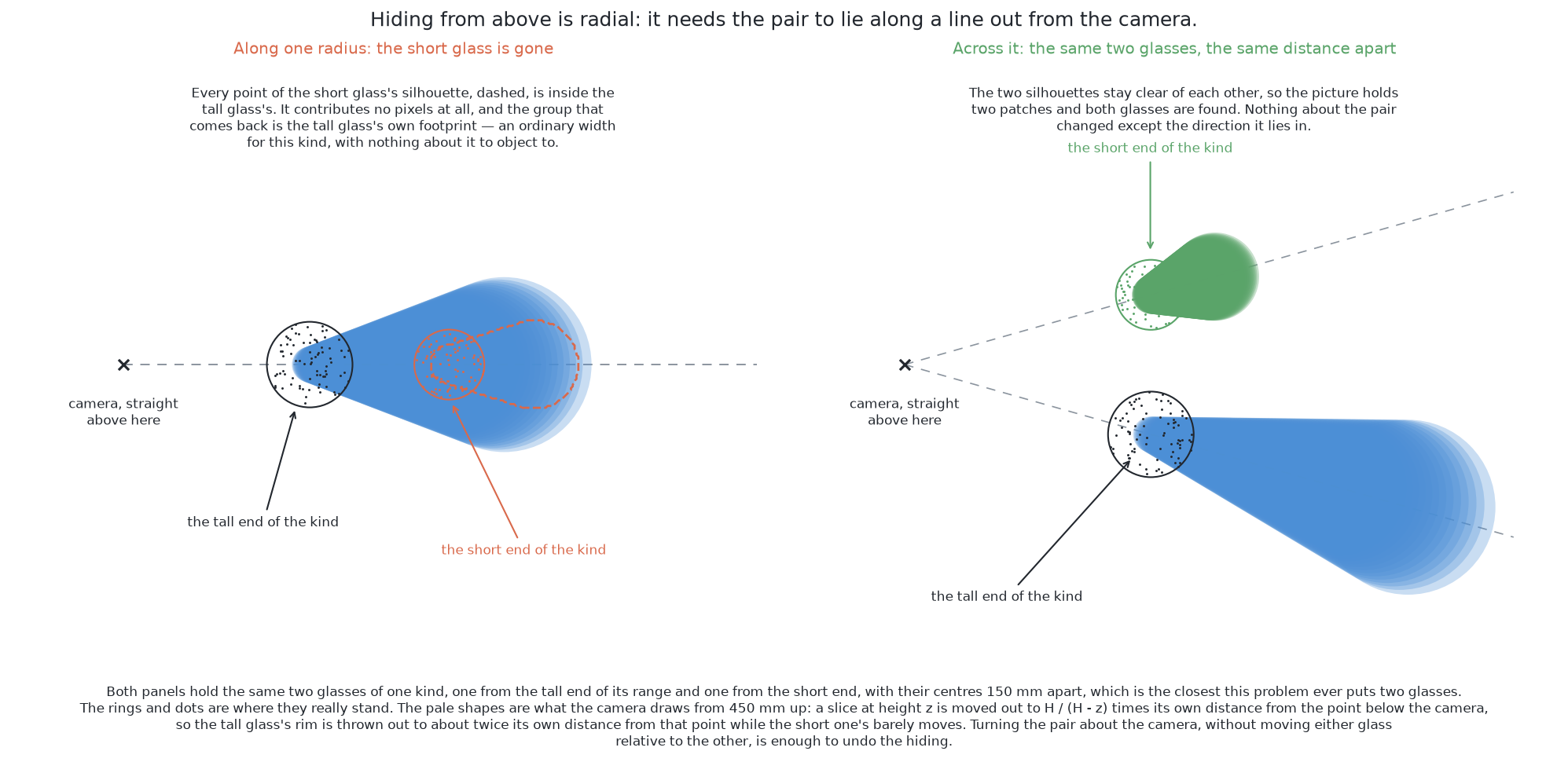
This part shows what a method that groups touching pixels would get. G1 stands a short way out from the point below the camera. Splay pushes its outline further out along the diagonal, towards G2.
G2 stands much further out, so splay pushes it even more. Part of G2's outline runs off the edge of the picture. G1's outline reaches the near edge of what is left of G2's. The two outlines touch. So grouping touching pixels would give one patch for two glasses.
Two outlines can meet in two different ways, and it helps to keep them apart.
- With the frame edge. Take two glasses of similar height on one line out from the point below the camera. Splay pushes the further one more, so the gap between them in the picture grows. They can meet only when one is partly out of frame. This is how G1 and G2 meet here.
- Without the frame edge. If the nearer glass is much taller than the further one, splay pushes the near outline out much more. Then the gap between them in the picture closes.
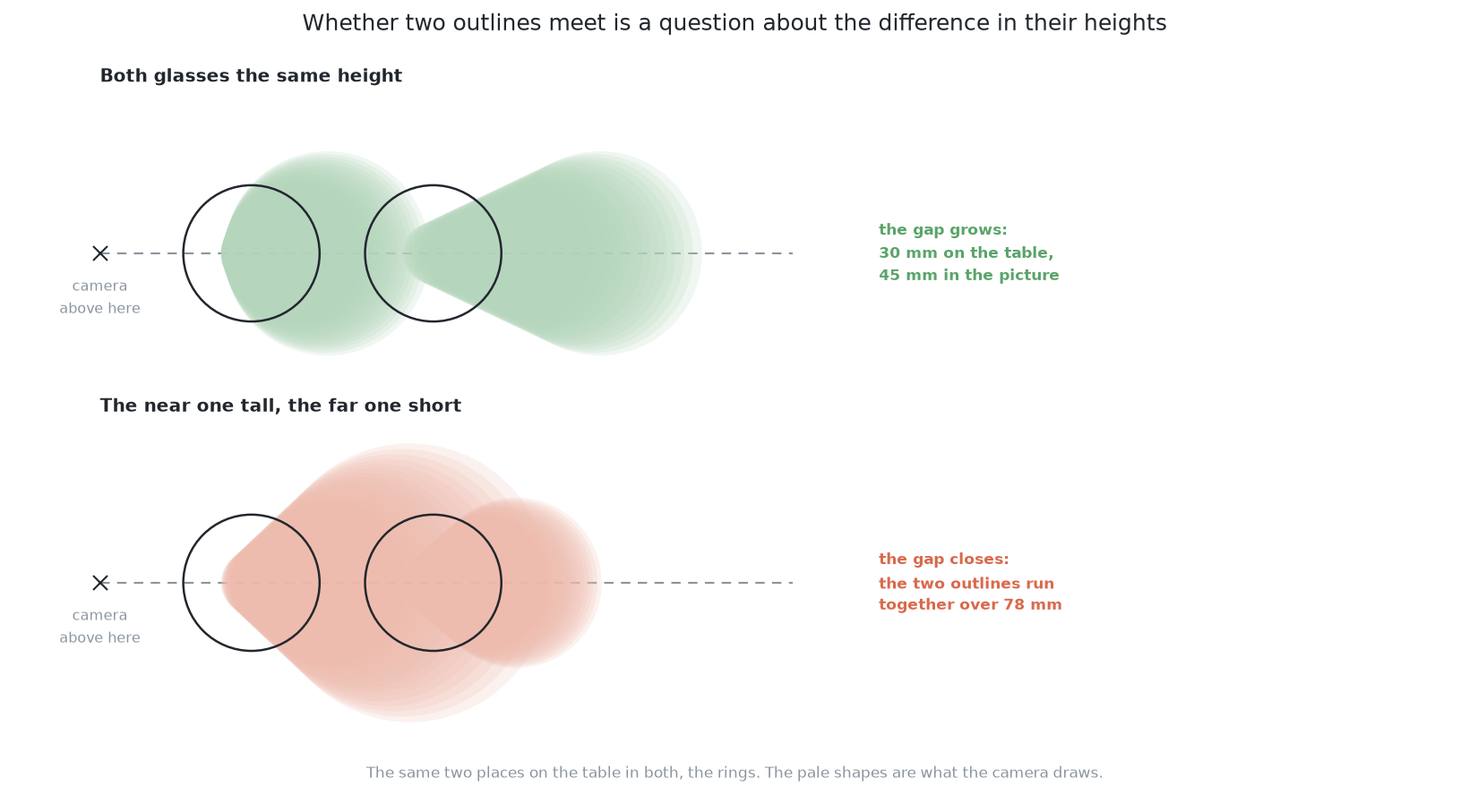
So whether two outlines meet depends on their heights as much as on their places. For two glasses of the same height, splay pushes them apart, not together.
The merged patch of G1 and G2 is several times wider than any glass of this kind. So the picture can tell that something is wrong. It cannot tell what is wrong: one huge object, two glasses or three.
The table can tell. The next part shows how.
What grouping on the table returns#
This part runs the same arrangement through this solution's grouping. On the table, G1 and G2 are far from touching. The strip of bare table between them is several times wider than the grouping distance. The chain cannot cross it, so G1 and G2 come back as two groups. Every other visible pair is further apart, so it is separate too. The picture gave four patches. The table gives five groups, and five masks go to the examiner.
The table below has one row per group. It shows what the dots looked like and what mask the group gives.
| the group | the mask it gives | |
|---|---|---|
| G1 | a full disc of dots | a complete outline, less the band at the base |
| G2 | a partial disc: its top ran past the frame edge | the near part of the glass only |
| G3 | a full disc of dots | a complete outline, less the band at the base |
| G4 | a full disc of dots | a complete outline, less the band at the base |
| G5 | a full disc of dots | a complete outline, less the band at the base |
Four of the five masks are as good as this method can make them. Each one lacks only the thin band at the base. The masks are what this contributes explains that band.
G2 is the interesting one. Part of G2 is not in this picture, so its mask covers only the near part. The width of its group still looks ordinary for this kind. That is the danger, because nothing in one picture objects to it. The defence is that the camera visits more than one station. Each station cuts G2 along a different line. If two stations put G2 in the same place, the fit followed the glass and not the frame edge. The design says a group that only one station found should be reported as doubtful. It may be fine, but it was seen only once.
And the glass that is not in the list at all#
Now count the rows in that table. There are five, but six glasses stand on the table.
G6 is missing, and nothing noticed. G1 is tall and stands nearer the point below the camera. G6 is the smallest glass and stands just beyond it. Splay pushes G1's outline far out over G6 and covers it completely. G6 leaves no pixels. So there is no group, no mask and no warning.
Look at what the checks had to work with. The width check needs a fitted width, and there is none. The residual needs dots, and there are none. The station check needs a group, and there is none. Every check is a check on something that was found.
Now run the other branch, which never looks at the pixels. G1 was found, so its place, width and height are known. Its wedge of hidden table can be worked out. G6 stands inside that wedge. The arithmetic does not know G6 is there. But it does know that a patch big enough for the kind's smallest glass lies inside that wedge, and nobody saw it. So it reports that patch as unsearched.
The next station settles it. From there, the point below the camera has moved, so G1's wedge points somewhere else and G6 is in plain view. The two stations together see all six glasses.
So the arithmetic did not find G6. It turned a run that reports five glasses into a run that reports five glasses and one place it did not look. The first is wrong and silent. The second is incomplete and says so.
Hidden glasses are one limit. Glasses that touch are another, and the last part covers them.
The case the rule cannot answer#
This last part covers glasses that stand too close, the case the grouping cannot separate. The examiner's spaced arrangements never draw it, but the crowded ones do. Pushing crowded glasses apart is about exactly this case.
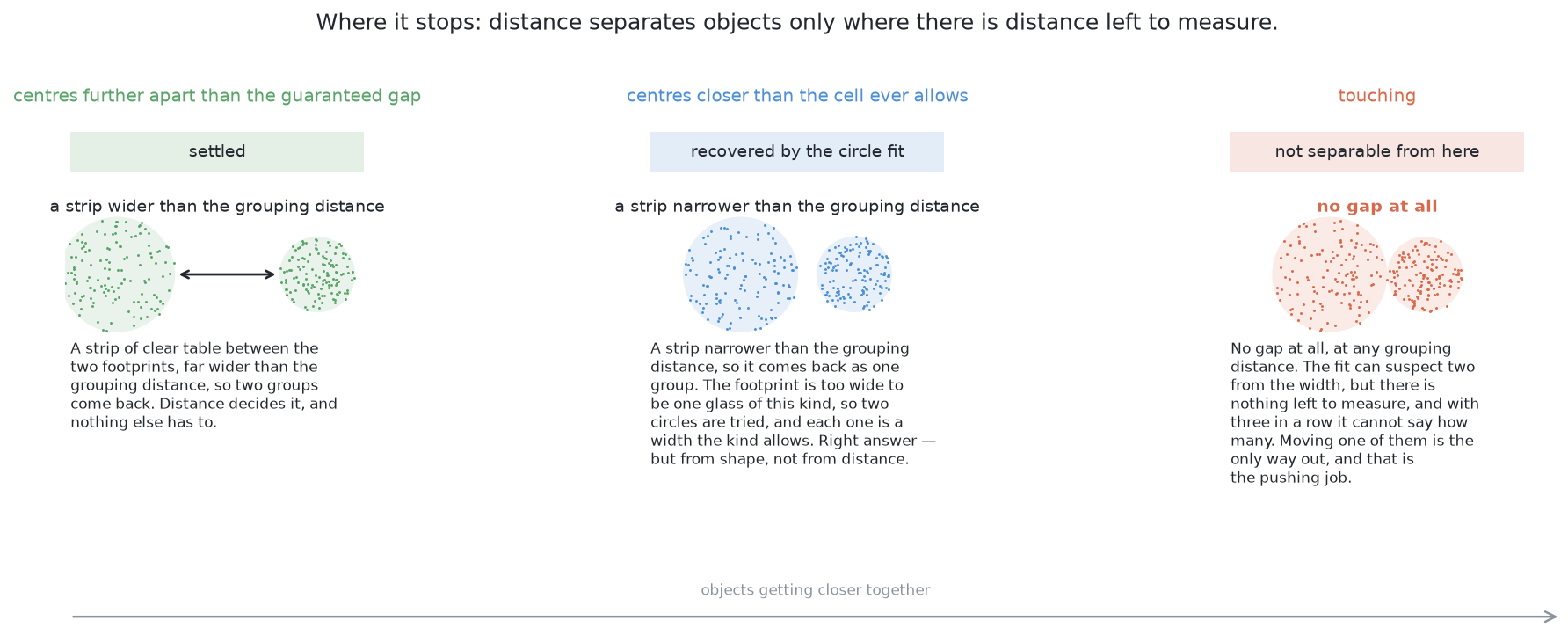
Suppose two glasses stand closer than the cell allows. The strip between them is narrower than the grouping distance, so the chain crosses it. They come back as one group. Now the width check does the work. The fitted width is about twice what one glass can be. So the group is split in two. If both halves have widths the kind allows, the answer is two glasses. Distance has failed here, and the width check recovers the answer.
Now suppose the two glasses touch. There is no strip of bare table at all. So they are always one group, and the answer rests only on the width. The group is too wide, so it is cut in two. The two parts are believed only if both have allowed widths. With three touching in a row, the cut repeats. But each cut is a straight line through a patch with no gap in it. The line falls where the dots divide, not where the glasses do. So the borders between masks are guesses. The more cuts it took, the less the places are worth.
Touching glasses leave no strip of bare table, and that is the limit of this method. That is why the job of pushing the glasses apart exists.
← How it works · What it needs →