1. Introduction#
The previous page, an example of the input, handed over the three pictures of arrangement 10038. This page shows what comes back.
The solution here is the written rule, the first of the six. It was given station 2's grey picture and depth reading. It was told only that the glasses are stemmed glasses. The masks below are its real output. This page shows what the rule handed back, how good each mask is, and what the examiner turns each mask into before marking.
Contents#
- Introduction
- The four masks
- What the two mask numbers say here
- From one mask to one record
- Where to go next
2. The four masks#
We start with the masks, because a mask is the only part of the answer a solution chooses. A mask is the set of pixels the solution thinks are one glass. The written rule returned four masks for station 2 and stated no doubts. So there is one panel per glass below.
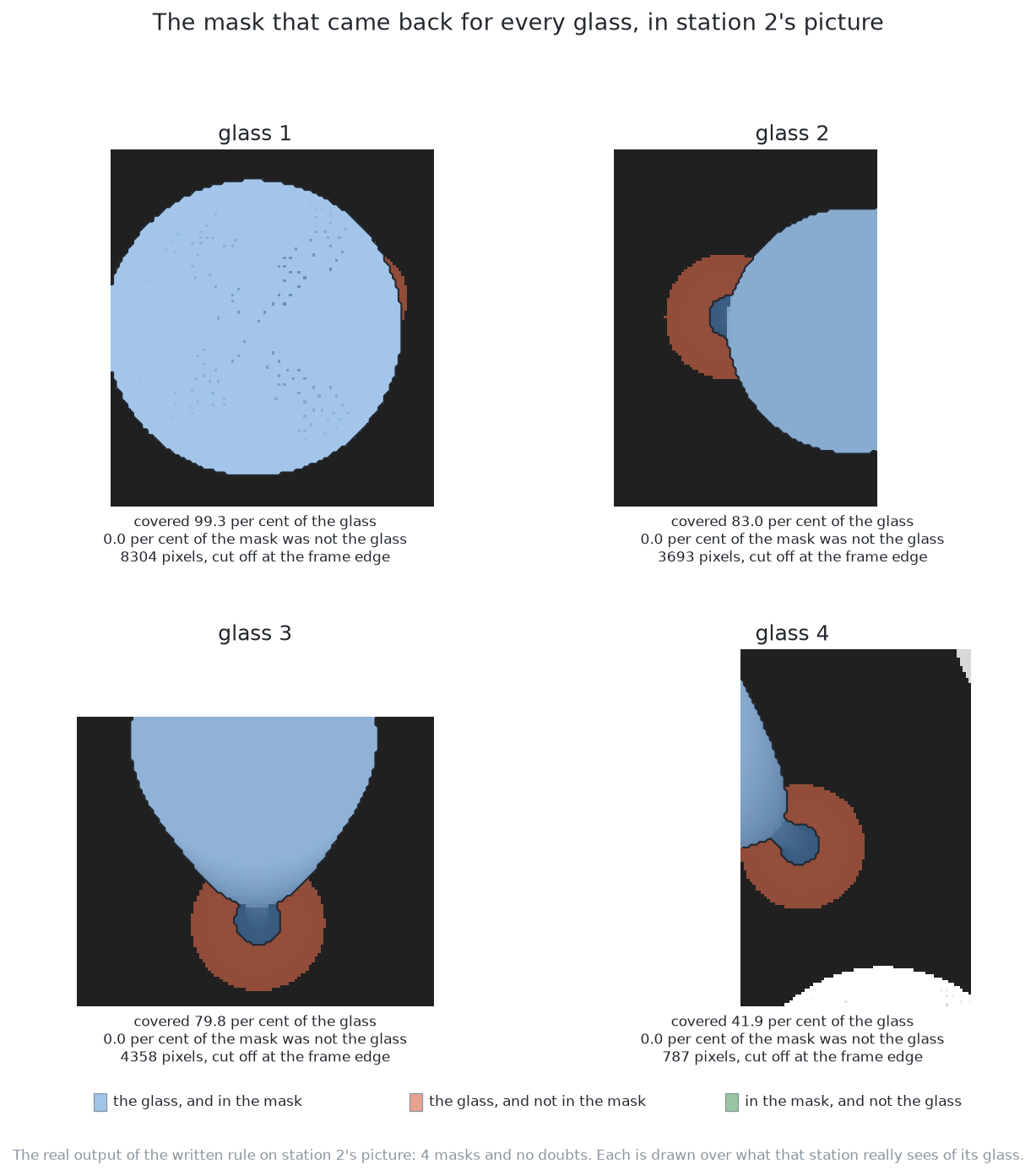
Read each panel by its three colours. Blue is glass the mask got. Red is glass the mask missed. Green is pixels the mask claimed that are not that glass. There is no green anywhere here.
The red is in the same place in every panel. It is a band at the base of the glass, with the foot under it. The rule keeps a pixel only when the depth shows it is clearly above the table. At the base of a glass this is not clear, so all four masks lost that band.
The next section puts numbers on what the panels show.
3. What the two mask numbers say here#
The examiner measures every mask with two numbers. The first is how much of the glass the mask covered. The second is how much of the mask was not that glass. Comparing the outputs explains both. The table below gives them for the four masks. Read across a row for one glass.
| glass | mask covered | mask not the glass | pixels |
|---|---|---|---|
| 1 | 99.3 per cent | 0.0 per cent | 8304 |
| 2 | 83.0 per cent | 0.0 per cent | 3693 |
| 3 | 79.8 per cent | 0.0 per cent | 4358 |
| 4 | 41.9 per cent | 0.0 per cent | 787 |
The first number depends on how much of the glass the station saw. Glass 1 stands almost under the camera. Station 2 sees 8359 pixels of it, and the mask keeps 99.3 per cent. Glass 4 is at the far edge of the picture. Station 2 sees only 1880 pixels of it, and the mask keeps 41.9 per cent. The rule was the same. Only the view changed.
The second number is zero for all four, because the written rule only takes a pixel it is sure about. So it claims too little and never too much.
A mask is not yet a place on the table. The next section shows how the examiner turns one into a place.
4. From one mask to one record#
The problem asks where each glass stands, so each mask must become a place. The examiner does this step itself, the same way for every solution. The picture below follows glass 1's mask through it.
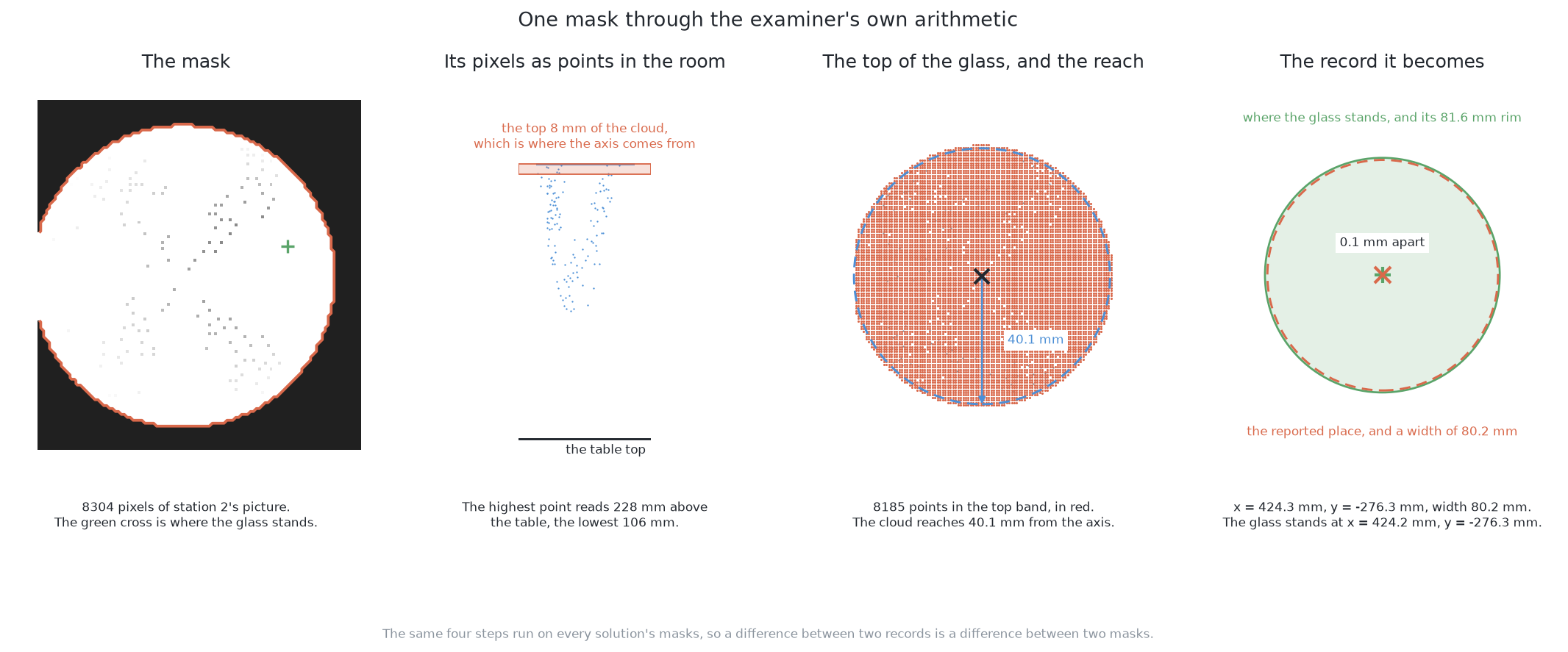
Read it from left to right. The mask has 8304 pixels. Each pixel has a depth reading, so each becomes a point in the room. The highest point is 228 mm above the table, and the lowest is 106 mm. The axis of the glass comes from the top 8 mm of these points. The width is how far the points reach from that axis, which here is 40.1 mm. How a mask becomes a record explains why each step is done this way.
The result is the record: x = 424.3 mm, y = −276.3 mm, and a width of 80.2 mm. Glass 1 really stands at x = 424.2 mm, y = −276.3 mm, with a bowl 81.6 mm across. So the place is 0.1 mm out, and the width is 1.4 mm too small.
This step is the same for all six solutions. So a difference between two solutions' records comes only from their masks. The next page shows how those records are marked.
5. Where to go next#
- Comparing the outputs — how the examiner marks what came back, finished on this same arrangement.
- An example of the input — the three pictures these masks were made from.
- Rules on the table — the solution whose masks these are.
- How a mask becomes a record — the full arithmetic that turns a mask into a record.