Every model learns by comparing its answer with something and then changing its numbers. The page on how a model learns showed the simplest case, where a person has written down the right answer for every example. But that is only one kind of learning, so this page answers the question: what can a model be compared with, and where does that come from?
The thing a model is compared with is called its learning signal, and there are four main kinds of it. Supervised learning compares the model with answers a person wrote down, while self-supervised learning takes the answer from the data itself. Imitation learning compares the model with what a person did, and reinforcement learning gives the model no answer at all, only a score after it tries.
It is for a beginner who has read the three pages before this one, so you should already know what an example, a label and a loss are, from how a model learns. The next page, where the data comes from, is about where the examples are collected, while this page is about what kind of answer each example carries.
Contents#
- The idea in one sentence
- Supervised learning: a person writes the answer
- Self-supervised learning: the data holds the answer · Hide a part and guess it · Match two views of the same thing · The robot labels its own tries
- Imitation learning: copy what a person did
- Reinforcement learning: try, get a score, do better
- A worked example: one arm, three signals
- How one modern model mixes them
- All four in one table
- Why not always use one kind, and what each costs
- Where to read next
- Using it in Python
1. The idea in one sentence#
A model learns by comparing its output with a learning signal, and the four kinds of learning differ only in where that signal comes from.
The training step itself is the same in all four. The model makes a guess, and that guess is compared with the signal, which gives a number that says how bad the guess was. The numbers inside the model are then changed a little, so that the next guess is better. So what changes from one kind to the next is only who, or what, supplies the signal.
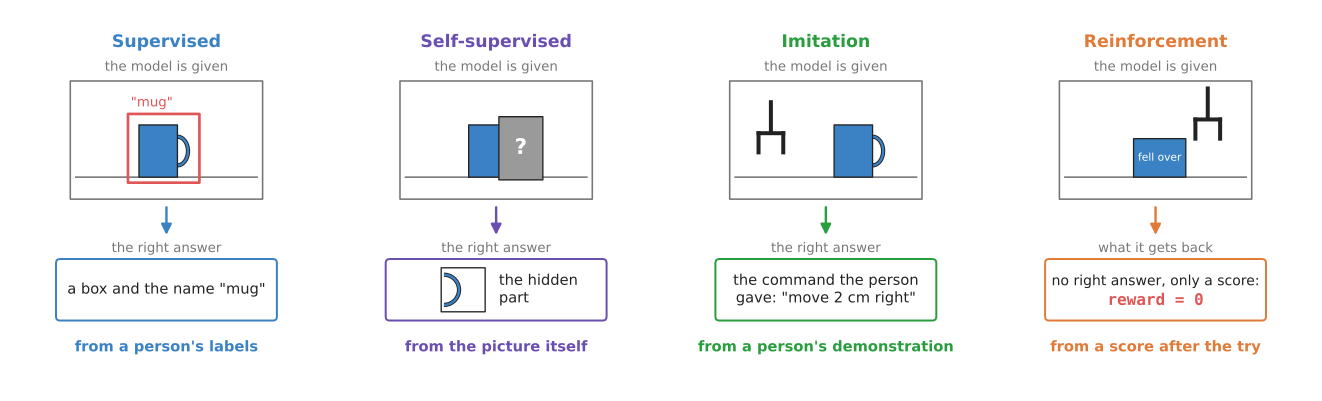
The picture shows one training example of each kind. In the first three, the model is given a right answer to aim for, but in the fourth it is only told how well its try went, so it must work out for itself what to change.
2. Supervised learning: a person writes the answer#
The first of the four kinds is the one the earlier pages already used. In supervised learning, every example comes with a right answer that a person supplied, and the word "supervised" means that someone is watching over the learning and saying what is right. That right answer is what this book calls the label.
The most common robot arm example is an object detector, which is a model that takes a camera picture and draws a box around each object it knows. To train one, people take a few thousand pictures of the table, and for each picture a person draws a box around every mug and writes "mug" next to it. The model is then shown a picture, guesses the boxes, and is corrected towards the boxes the person drew.
Other examples on an arm:
- A person marks the handle and the rim of each mug in a picture, so a model can learn to find those points, and from them the mug's pose. Pose means position and direction together.
- A robot records the signal from its finger sensors while it holds many objects, and a person marks the moments when an object started to slip. So a model can learn to notice slip from those marks.
Supervised learning is the easiest kind to understand and to check, because you know exactly what the model was asked to do. Its weakness is cost, since every label takes a person's time, and a new object or a new kind of answer means labelling again.
3. Self-supervised learning: the data holds the answer#
Supervised learning needs a person for every single example, which is what the second kind avoids. In self-supervised learning nobody writes the answer, because the answer is taken from the data itself. The data supervises itself, which is where the name comes from. This matters because it means any picture, any video or any sensor recording can be used, not only the ones a person has labelled, and there are far more of those.
There are three common ways of doing this, and robot work uses all three of them.
Hide a part and guess it#
Take a picture and cover some patches of it with grey squares, then ask the model to guess what was under them. The right answer is the part you covered, so you already have it without asking anyone. To guess well, the model must learn what things usually look like: that a mug handle is curved, and that a table edge is straight.
The same trick works on other data, and not only on pictures. You can hide the next word of a sentence and guess it, or the next frame of a video, or the next reading from a joint sensor. Large language models learn mainly by guessing the next word. Video prediction models learn by guessing the next frame.
Match two views of the same thing#
Take one picture and make two different versions of it, for example by cropping two different parts or by changing the colours of one. Then ask the model to give similar numbers for the two versions, and different numbers for versions of other pictures. The model learns that the two versions show the same thing, so it learns to ignore crop and colour and to notice the object.
A picture and its caption are also two views of the same thing. The CLIP model (Contrastive Language-Image Pretraining) learned by matching 400 million pictures with the captions that came with them on the internet. That is how an open-vocabulary model can find "the red mug" without ever having been trained on that phrase.
The robot labels its own tries#
In robotics the word has a second use, because a robot can make its own labels by using its own sensors. For example, the arm tries a grasp, lifts, and checks whether the gripper fingers stayed apart. If they did, something is between them, so the grasp worked, and no person had to say so. One well-known study, described on the grasp quality models page, let a real arm collect its own labels this way over hundreds of hours.
Self-supervised learning is also how foundation models are made. A foundation model is a large model trained on a huge, general dataset, so that many jobs can be built on top of it. It is trained first with self-supervised learning on data that nobody labelled, and this first stage is called pretraining. What the model learns there is general, because it does not yet know your task, so a second stage with one of the other kinds of signal usually follows.
4. Imitation learning: copy what a person did#
A detector answers "what is in this picture?", but an arm also needs an answer to "what should I do next?". Nobody can easily write that answer down for every moment, so instead a person shows the robot. They drive the arm through the task, usually with a second, hand-held arm or a game controller, and this is called a demonstration. At every moment, the robot records what its cameras saw and what command the person gave.
Imitation learning trains a model to give the same command the person gave, when it sees the same kind of picture. In other words, it is supervised learning where the label is an action instead of a name. The model is shown a picture from the demonstration, guesses a command, and is corrected towards the person's command, and the simplest form of this is called behaviour cloning.
Imitation learning is the main way robot arms learn tasks today, because a few dozen demonstrations can be enough for one narrow task on one arm. Its weaknesses all come from the copying:
- The model copies the person's habits along with their skill, so if the person always stops a little short, the model stops short too. The worked example below shows this in numbers.
- The model has only seen the situations the person got into, so if the arm drifts a little off the person's path, it sees pictures it was never shown. Its next command is then a worse guess, which moves it further off, and small errors add up.
- The model can never be much better than the demonstrations.
5. Reinforcement learning: try, get a score, do better#
Imitation still needs a person to show the way, which the fourth kind does without. In reinforcement learning nobody gives the model a right answer at all: the arm tries something, and then it gets a number that says how well the try went. This number is called the reward, and for example it might be 1 if the mug ended up in the rack and 0 if not. The model then changes its numbers so that tries like the good ones become more likely, and tries like the bad ones less likely, so over many tries it gets better.
The hard part is that the reward says how well a try went, but not what to change. If the mug fell over, was it the grip, the speed or the angle? The model must work that out from many tries. So reinforcement learning needs a great many tries, often millions. That is too slow and too risky on a real arm, so most of it happens in a simulator, a program that pretends to be the real world.
Reinforcement learning has one strength that the others lack. It can end up better than any person, because it is not copying anyone, so it can find a way of doing the task that nobody showed it.
A reward is also easy to get wrong, because a model will do whatever raises the reward, even if that is not what you meant. For example, if the reward is "the mug is near the rack", the model may learn to push the mug there and knock it over.
6. A worked example: one arm, three signals#
The four kinds are easier to compare on one task, so this section runs three of them on
the same arm. The numbers in this section come from a real run of the diagram script
docs/diagrams/what_models_are_4.py. The arm is simulated, so that we know the truth
exactly, but the learning methods run on it are real.
Here is the job that all three methods have to learn. A mug sits somewhere on a line along a table, between 5 cm and 35 cm from the end, and a one-joint arm slides its gripper along the line. The camera already gives the mug's position, so the model must turn that position into a command for the joint. A reach counts as a success if the gripper stops within 1 cm of the mug.
The arm does not go exactly where it is told, because it stops at 0.9 × command + 1.0 cm, plus a small random error of about 0.3 cm. Nobody has written this quirk down, so a model has to find it from data. A model that turns what the robot sees into a command is called a policy, and here the policy is a straight line with two numbers: command = w × (mug position − 20) + c. The best values are w = 1.111 and c = 21.11, and with those all 2,000 test reaches succeed.
First comes imitation, in which a careful person drives the arm to 20 mugs. Because they can see where the gripper is, they make up for the quirk by eye. But they have a habit: they stop about 1.2 cm short, so as not to knock the mug, which means only 35% of their 20 demonstrations land within 1 cm. A straight line is fitted to the 20 pairs of mug position and command, and it gives w = 1.098 and c = 19.82. That policy succeeds on only 31.7% of the test reaches, and on average it stops 1.15 cm short, so it has copied the habit exactly.
Second comes self-supervised learning, in which no person is involved at all. Instead the arm sends itself 50 random commands and reads where it stopped from its own joint sensor. The command is the question and the sensor reading is the answer. A straight line fitted to the 50 pokes gives a gain of 0.901 and an offset of 0.96 cm, close to the true 0.9 and 1.0. So turning that line round gives a policy with w = 1.110 and c = 21.14, which succeeds on 100% of the test reaches.
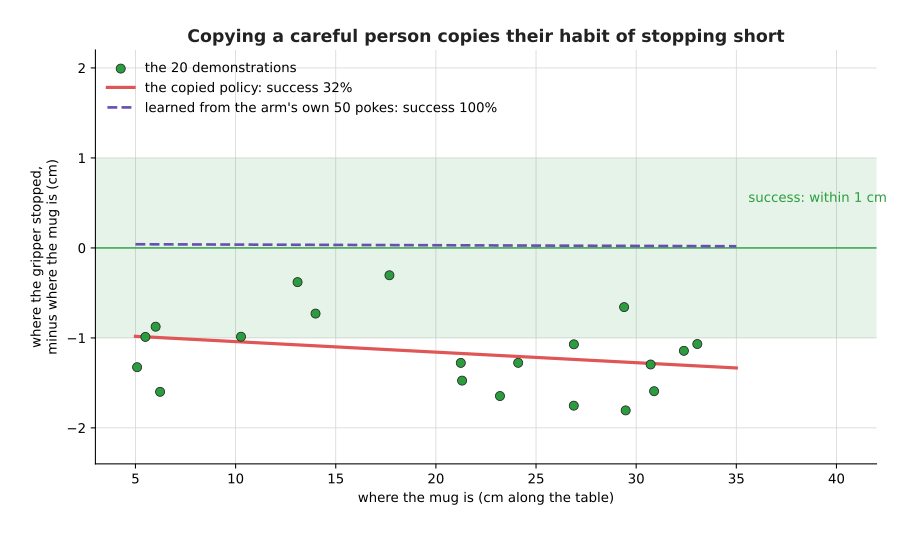
The picture shows how far short or long each reach stops, and the green band is the success zone. The copied policy runs through the middle of the person's demonstrations, below the band, while the policy from the arm's own pokes runs along zero.
This worked so well only because the job is so simple. Knowing where the gripper stops is all there is to it, and the arm's own sensor measures exactly that. Most real tasks, such as "hang the mug on the peg", have no sensor that gives the right command.
Third comes reinforcement learning, in which there are no demonstrations and no known answer, only a score. Each trial makes a small random change to w and c, and then the old and the new policy each reach for the same 5 random mugs, so the one whose average miss is smaller is kept, which is 10 reaches per trial.
Starting from a blank guess (w = 0.5, c = 5), almost no reach succeeds for the first 50 trials. The policy first reaches 90% success after 217 trials, which is 2,170 reaches. Starting instead from the copied policy, it reaches 90% after only 8 trials, or 80 reaches. Both end at w ≈ 1.12 and c ≈ 21.1, close to the best values.
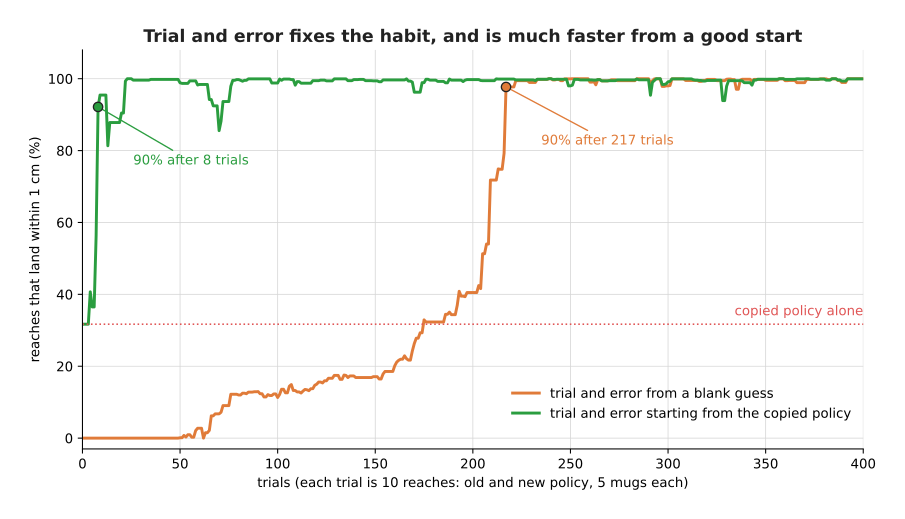
Read the picture from left to right, where the dotted red line is the copied policy on its own. Trial and error lifts it above 90% almost at once, because it only has to remove the 1.2 cm habit. But from a blank guess, trial and error has to find everything, so it takes about 27 times as many trials.
Three lessons come out of this small example:
- Imitation is fast and needs no reward, but it copies the demonstrator's faults.
- Trial and error can fix those faults, because it is not copying anyone.
- Trial and error is far cheaper when it starts from a copied policy. This is why real systems often demonstrate first and then practise.
7. How one modern model mixes them#
The worked example mixed two kinds of signal, and the largest robot models today do the same thing on a much larger scale. A vision-language-action model (VLA) is a model that takes camera pictures and an instruction in words, and gives out arm movements, and it is usually trained in three stages.
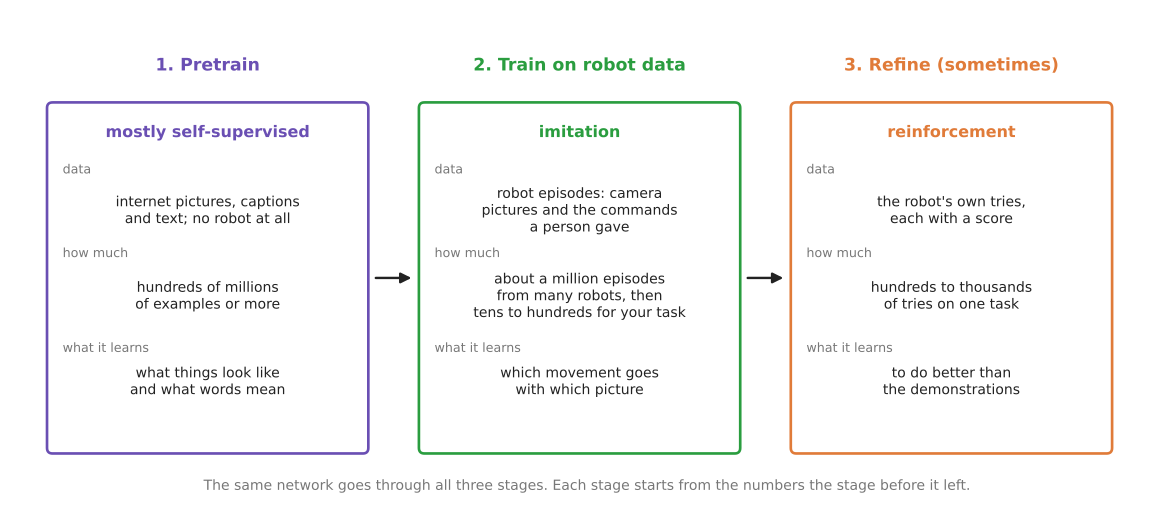
- Pretrain, mostly self-supervised. The model starts as a vision-language model, trained on hundreds of millions of internet pictures, captions and texts. Much of that training hides words or matches pictures with captions, and no robot is involved at this stage. So the model learns what things look like and what words mean.
- Train on robot data, by imitation. The model is then trained on robot demonstrations, first from many robots and then from yours. OpenVLA, for example, was trained on 970,000 demonstrations from a shared pool. The model learns which movement goes with which picture and instruction.
- Refine by reinforcement, sometimes. A few recent models then practise on the real task and are scored. For example, Physical Intelligence's π*0.6, from late 2025, learned from demonstrations first and then improved by practising, which raised its success at assembling boxes from roughly 40% to roughly 90%. The foundation models document describes it.
The same network goes through all three stages, because each stage starts from the numbers that the stage before it left. This is the same order as in the worked example above, where copying first and practising second was far faster than practising alone.
8. All four in one table#
Now that all four kinds have been described, the table below puts them side by side. Read each row across: the kind of learning, what one training example looks like, one example on a robot arm, and the pages of this book whose models are mostly trained that way.
| Kind | What the data looks like | An arm example | Pages in this book that use it |
|---|---|---|---|
| Supervised | an input and the right answer a person wrote | pictures of the table with a box drawn round each mug, to train a detector | object detection, segmentation, keypoints and object pose, image classification, force and slip models, collision and failure detection |
| Self-supervised | data with a part hidden, two views of one thing, or the robot's own sensor readings | a video from the wrist camera, with the next frame hidden | open-vocabulary models, vision-language models, 3D feature maps, learned dynamics models, video prediction models, touch sensing models, learned arm models |
| Imitation | pictures and joint angles at each moment, with the command a person gave | fifty recordings of a person driving the arm to put a mug on a rack | behaviour cloning, action chunking transformers, diffusion and flow policies, learning from human video, vision-language-action models |
| Reinforcement | a try, and a score for how well it went | a simulated arm that tries a million grasps and scores 1 for each one that lifts | reinforcement learning policies, reward and progress models, latent world models |
Many pages appear under one kind but use a second kind too. For example, a detector is often pretrained with self-supervised learning before it is trained on labelled boxes. A reward and progress model is usually trained by supervised learning, and then used to give the reward for reinforcement learning. So the table shows only the main kind for each.
9. Why not always use one kind, and what each costs#
The obvious alternative to all this is to pick one kind and use it for everything. Supervised learning would be the natural choice, because it is the simplest and the easiest to check. The trouble is that each kind is cheap for some answers and impossible for others.
- A person can draw a box round a mug in a few seconds, so supervised learning suits seeing. But a person cannot write down the right joint command for every moment of a task. That is why movement is taught by imitation.
- Imitation needs a person at the arm for every demonstration, so that limits it to thousands of examples rather than billions. Self-supervised learning, however, can use billions of unlabelled pictures and words, which is why it is used for pretraining.
- Only reinforcement learning can do better than the people who teach the robot. But it needs a reward that says exactly what you want, and a great many tries, usually in a simulator. So it is used last, to polish, or where a simulator is good enough.
Each kind also has its own cost, on top of the answers it can and cannot give. Supervised learning costs labelling time, while self-supervised pretraining costs a great deal of computing, so it is usually done once by a large lab and shared. Imitation costs a person's time at the arm, and it copies their mistakes, while reinforcement learning costs tries, and a badly chosen reward teaches the wrong thing.
10. Where to read next#
- Where the data comes from is the next page, and it describes how the examples for each kind are collected: labelling, teleoperation, simulation and the internet.
- Behaviour cloning explains imitation learning in full.
- Reinforcement learning policies explains reinforcement learning in full.
- Fine-tuning explains how a pretrained model is trained a little more for your task.
- Learned methods for one arm in Book 3 compares learning from demonstrations, from trial and error, and from large-scale pretraining for a real arm.
11. Using it in Python#
Sections 2 to 5 described four learning signals, and section 8 put them in one
table. In Python, three of the four are the training loop of
how a model learns with a different y, while
reinforcement learning needs a different shape of code altogether. This section
shows that difference, because it is the clearest way to see what each signal
really costs you.
from torch import nn

# Supervised, self-supervised and imitation learning share one loop.
# Only where y comes from changes:
#   supervised     - y is the answer a person typed for each example
#   self-supervised - y is a part of X that you hid from the model
#   imitation      - y is the joint speed the person's hand produced
policy = nn.Sequential(nn.Linear(n_inputs, 64), nn.ReLU(), nn.Linear(64, 7))
loss = nn.MSELoss()(policy(X), y)   # then the loop of the previous page

# Reinforcement learning has no y at all. The environment returns a reward.
import gymnasium as gym
from stable_baselines3 import PPO

env = gym.make("Pendulum-v1")
model = PPO("MlpPolicy", env, verbose=0)
model.learn(total_timesteps=100_000)   # it collects its own examples as it goes
The seven outputs of policy are the seven joint speeds of a typical arm, and
MSELoss is the mean squared error, which measures how far the model's seven
numbers are from the recorded ones. Notice that the imitation version and the
supervised version are the same three lines, which is why section 4 said that
imitation learning is supervised learning with the person's actions used as the
labels.
The libraries give you a lot for reinforcement learning. Stable-Baselines3
provides PPO and the other algorithms of section 5, and Gymnasium provides the
interface an environment must follow, which is a reset that starts an episode
and a step that takes an action and returns the next observation and the
reward. Pendulum-v1 above is one of Gymnasium's built-in practice
environments.
What you write yourself is the environment, and that is the real cost of reinforcement learning. You write the reset, the step, and above all the reward function, and the reward function is where most of the work and most of the mistakes live, because a reward that can be collected in an unintended way will be. For the other three signals you write no environment at all, and the work moves to collecting the data instead.
What you have to decide is which signal to use, and the number 100_000 above
makes the answer clearer than any table can. One hundred thousand steps is a few
minutes in simulation and weeks of wear on a real arm, which is why section 5
said that reinforcement learning for arms is done in simulation first. The
next page is about where the examples for the
other three signals come from.