This page judges this solution. It says where the solution is strong and where it breaks. It names the older ideas behind it. Then it places it beside the other six.
Contents#
1. Where it is strong and where it breaks#
The earlier pages showed the method at work. This section adds up its strengths and weaknesses. Both come from the same fact: the method claims very little. That is what makes it a clean control.
Its strengths#
It cannot be wrong about pushing, because it predicts nothing about pushing. Every other solution has a prediction that can be wrong. This one has only a direction, which is right for any friction. Its distance is small on purpose.
Its answer can be read. Every step is a number that can be printed. So a person can read why it went wrong, instead of guessing. Every refusal has a reason you can check with a ruler.
One run of it is a measurement. Nothing in it is fitted, and nothing is random. So it behaves the same way on the hundredth table as on the first. The examiner asks the trained solutions for several runs, because they vary. This one does not need that. Its number has no spread.
It tests the whole contact sequence. The jaw closes, drops to height, feels forward until the force fires, pushes along a line, backs off and lifts. A real glass can be knocked over at any of these steps. This method runs all of them with no planning code in the way. So if a glass falls while you build this project, the fault is in the contact, not in a plan.
Short pushes are safe pushes. A glass can be knocked during any millimetre of travel. This method moves each glass as little as it can. The small gain gives it that habit.
Its weaknesses#
One weakness matters more than the rest, so it comes first.
It has nowhere to stand. The jaw pushes in the direction it points. So the arm comes in along the same line as the push. To push a glass straight away from its neighbour, the arm must come in from the neighbour's side. The tool is long and gets wider behind the fingertips. All of it is at the height of the push, so all of it must miss every glass on the table. What the examiner draws gives the tool's sizes. In a tight group, the neighbour stands exactly where the tool would need to be. This method has only one direction to offer. So when that direction is blocked, it must refuse the glass. Every solution that searches over directions can ask for a different approach. This one cannot. So for this method, where the arm comes in from matters more than where the glass goes.
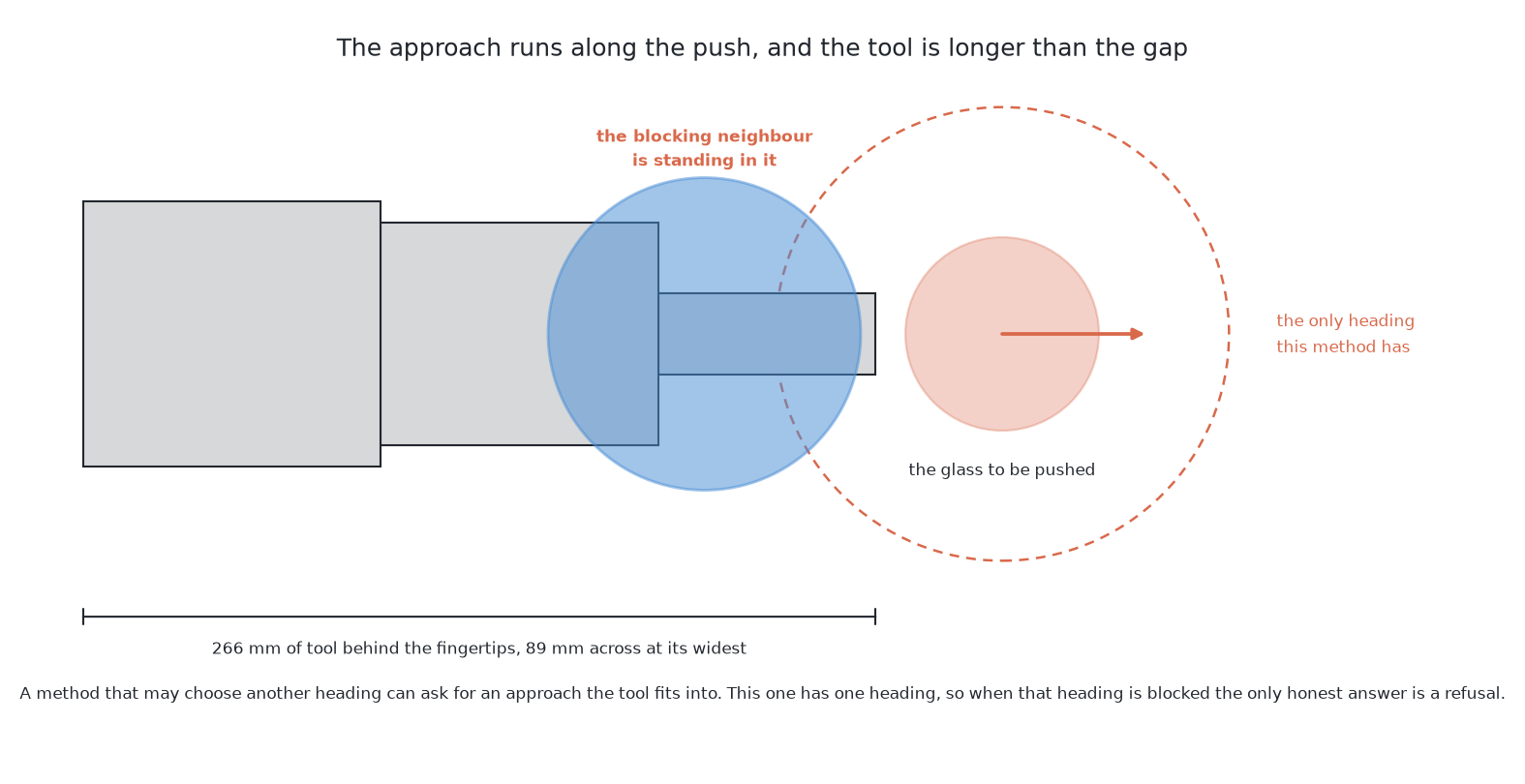
It cannot help a glass crowded from two sides. A push away from one neighbour is a push towards the other. A table where it does not shows this.
It never looks at the free table. The shortfall says how far, but nothing says where to. The method does not check that the place it sends a glass is empty. It does not check that the place is in the glass zone, in the arm's reach, or clear of the rack. It does not check for a glass in the path either. So it can drive one glass into another. That cannot be undone, because two upright glasses that hit each other is how a glass falls over.
It does not use the shared target layout. The target layout works out where every glass should finish, and the least travel the task needs. This method uses neither. It pushes away, not towards a goal. So its travel will be well above that least travel.
It does not pick the safer glass of a pair. Of two crowded glasses, the one on the wider foot is safer to push. This rule always pushes the glass that is short of room, which may be the narrower one. If that glass fails the tipping check, the method refuses it. It does not try the other one. That is safe, but it racks fewer glasses. A baseline must turn down easy fixes like this to stay a baseline.
It throws away the force report. The jaw reports how hard it pushed and how far the glass moved. Both depend on the friction. So they are the only clue about the friction that this cell gives. Why the force reading matters explains this. This method reads none of it. It only checks whether the jaw touched anything. This is the deepest reason it is the weakest of the solutions. Every solution that does better reads that report in some way.
It pays in pushes, and the budget is limited. Its only way to recover is to push again. A table that needs many pushes can use up the budget.
These strengths and weaknesses are not new. The next section names the older ideas the method is made of.
2. The general ideas behind this#
The last section judged the method on its own. This section names the older ideas it is built from. Knowing them tells you where to expect it to work and where not.
Proportional control#
A correction equal to the error times a fixed gain is a proportional controller. It is the simplest member of a family called PID. PID adds a term for the error added up over time, and a term for how fast the error changes.
It works well when three things are true. The error can be measured. The correction acts in the right direction. And the effect of the correction is at least within known limits. Then a small gain is stable with no model at all. These are weak needs, which is why proportional control is used everywhere.
It has two known weak points. First, it is slow when a good model exists, because a model can do in one step what the controller does in several. Second, it leaves a steady error if something keeps pulling against it. The second point does not apply here, because nothing pulls the glass back. The first point applies fully. The other solutions exist to find out what a good model is worth.
Singulation#
Separating crowded objects so they can be picked one at a time is called singulation. Chang, Smith and Fox's Interactive Singulation of Objects from a Pile (ICRA 2012) named this problem for robot handling. It already uses the same pattern as this solution: act on the pile, look again, repeat.
It works well in bin picking and warehouse work, where the only question is how to reach each object. It fits less well here. That work assumes walls that keep objects in, and objects lying flat that cannot fall over. An open table of upright glasses has neither. So the pattern carries over, but the safety does not.
Fixed push policies#
Pushing a short fixed distance in a direction chosen by a simple rule is a real method. Danielczuk and others' Linear Push Policies to Increase Grasp Access in Dense Clutter (IEEE CASE 2018) describes it clearly. They found that such pushes are cheap, and often open enough space for a grasp. This solution relies on that finding.
It works well for dense clutter in a bin, where a push does little harm. It fits less well here, for the reasons in the last section and one more. A flat object in a bin can be pushed from a side the gripper can easily reach. An upright glass must be pushed from its side, and the side is where the neighbour is.
Quasi-static planar pushing, which this solution deliberately does not use#
There is a well-developed theory of what happens when an object is pushed slowly across a table. Mason's Mechanics and Planning of Manipulator Pushing Operations (IJRR 1986) gave the main result, called the voting theorem. It says which way a pushed object turns. That depends on where the line of the push passes, compared with the object's centre of friction. Lynch and Mason's Stable Pushing: Mechanics, Controllability and Planning (IJRR 1996) used this to plan pushes that carry an object along a chosen path.
This theory works when the friction, and how the weight sits on the foot, are known or can be measured. Here, neither is measured. Yu, Bauza, Fazeli and Rodriguez's More than a Million Ways to Be Pushed (IROS 2016) measured what that costs. They pushed the same objects the same way many thousands of times. The results spread out widely, and the spread does not average away. So the choice is between a prediction that needs an unknown number, and no prediction. This solution makes no prediction. Solution 4 makes the other choice and learns a model instead.
Guarded moves#
A motion that ends when a sensor fires, not at a computed point, is a guarded move. It is one of the oldest ideas in robot assembly. Lozano-Pérez, Mason and Taylor's Automatic Synthesis of Fine-Motion Strategies for Robots (IJRR 1984) explains why it helps. When an object's position is uncertain, a motion that stops on a sensor is reliable. A motion that stops at a computed point is not.
It helps with every contact against an object measured from a distance. That is every contact in this project. But it is not a full answer. A guarded move finds the surface. It does not say what to do next. So it prevents some collisions, but it does no planning.
Baselines, as a discipline#
Last, this solution is a baseline. A baseline is the simplest method that does the job at all. It is built first and kept as the number every other method is scored against. A method that beats nothing has not been shown to be good.
Baselines matter most when several methods are compared and some are expensive. A price can only be judged against a free choice. A baseline goes wrong when someone keeps improving it until it competes. Each small change seems reasonable, but together they spoil it. This method has one place where that could happen, which is the gain. That is why the gain is argued, not tuned on the training tables. A baseline must also be scored on the same tables, in the same way, as the methods meant to beat it. The examiner does that.
These ideas say what kind of method this is. The next section places it beside the other six solutions.
3. Where it sits among the others#
The last section named the ideas inside the method. This section compares it with the other six. The overview of the solutions states the question it answers: does any learning beat a fixed nudge? What it is says why a solution that cannot beat it has earned nothing. The scores are in the results.
Against solution 2, the difference is a search and a ranker. Solution 2 uses the same input, room test and tipping rule. Then geometry makes many possible pushes for each crowded glass, and a model ranks them. Because it can choose its direction, it avoids two of this solution's main weaknesses. Its scored pushes are also examples that other solutions can learn from. So it teaches solutions 3 and 6, and this solution teaches nobody.
Against solution 3, the difference is everything that is fitted. Solution 3 learns from solution 2's examples, and outputs a chunk of waypoints instead of a push. The examples are free, so it pays for training runs on this laptop. If it does not clear more tables than a fixed nudge, that training bought nothing.
Against solution 4, the comparison is the sharpest. Solution 4 learns a model of what a push does, and plans with it while it runs. It buys exactly the prediction this solution refuses to make. It pays twice: once for training data, and once for planning time on every push. So this pair asks the question directly: is a prediction worth more than a repeat?
Against solution 5, the link is that both fit nothing in this cell. This one has one argued constant. Solution 5 uses a large model trained somewhere else. Against solution 6, which is that same model trained further here, the fixed nudge is the floor. Both solutions 5 and 6 must clear it before the difference between them matters. Against solution 7, which swaps in a newer and larger borrowed model, the fixed nudge is the same floor. Its three fits did not learn the task, so its scoring run was stopped.
So think of this method as the first thing to build and the last thing to ship. Build it first. It is the cheapest way to get a real push against a real glass. Everything after it needs the same contact steps and the same refusals. Do not ship it, because of the weaknesses in where it is strong and where it breaks.
Also read it the other way round, as the book on telling the glasses apart reads its own written rule. This method works at all only because of four promises. The glasses stand upright on a flat table. The gripper's clear room is a known constant. The camera work reports a position and a width for every glass. And a refusal is an acceptable answer. Each of the other six needs fewer of these promises. So if a fixed nudge looks good to you, that says how generous this book's promises are. The value of the other six is what they do when those promises fail.