This page shows the main code of this solution. It also says what the solution hands back to the rest of the cell. It follows what it is. How it works then explains each part of this code.
Contents#
1. The code at the heart of it#
It helps to read the code before the explanation. Two pieces of this solution are written and running in the repository. The first decides whether a glass can be pushed at all. It answers "yes", "no" or "try". The second is the short test push the method makes when the answer is "try". Solution 2 and three others reuse the first piece. The second piece is the only place where the arm checks the world before it decides, not after.
The tipping test comes from
src/09_pushing-the-glasses-apart/01-one-fixed-nudge/plan.py.
No library decides anything in it. It is three divisions, three comparisons and
two arctangents from Python's own math. The rule behind it is set out in
pushing without toppling.
The function runs in three steps, and each step is marked in the code.
- Take half the width of the glass's foot. Divide it by the highest friction in the range. This gives the lowest push height that could tip the glass. If the jaw is below it, the answer is "yes". Then divide by the lowest friction. This gives the highest such height. If the jaw is at or above it, the answer is "no".
- Between those two heights, the unknown friction decides. So measure how far this glass can lean before it falls. This depends on its foot and the height of its centre of mass.
- Compare the lean the short test push could cause with that angle. Answer "try" only if the lean stays well inside it.
# Glass on a dry wooden top is somewhere in here. Nothing in the cell measures
# it, so the tipping check is made at both ends.
MU_LOWEST = 0.2
MU_HIGHEST = 0.5
...
def slides(glass: Seen) -> str:
    """Whether a push at the jaw's top edge slides this glass: "yes", "no" or "try".

    It slides while the push is lower than a / mu: half the foot, over the
    friction. The top edge, because a glass wider higher up meets the jaw
    there first. "try" means it depends on the friction, and a probe is safe.
    """
    # Step 1: take half the width of the foot the glass stands on -- how far the foot's edge
    # is from the middle, which is what keeps the glass from going over
    half_foot = glass.foot / 2
    # Step 1: divide it by the grippiest friction in the range, which gives the lowest push
    # height that tips this glass; a jaw under that slides it at every friction in the range
    if half_foot / MU_HIGHEST > JAW_TOP:
        return "yes"
    # Step 1: divide it by the slipperiest friction, which gives the highest such height; a
    # jaw at or above that one tips the glass at every friction in the range, so refuse it
    if half_foot / MU_LOWEST <= JAW_TOP:
        return "no"
    # Step 2: between the two widths the friction decides it, so measure how far this glass
    # can lean before it falls: half its foot against the height of its centre of mass
    falls_past = math.atan2(half_foot, CENTRE_OF_MASS_SHARE * glass.height)
    # Step 3: allow the short test push only while the lean it could cause stays well inside
    # that angle, so a glass tall enough to be leaned most of the way over is refused instead
    return "try" if math.atan2(PROBE, JAW_TOP) < PROBE_LEAN_SHARE * falls_past else "no"
Step 1 is a question about the foot. The picture below marks the two foot widths it compares against. Between those two widths, the arithmetic cannot decide.
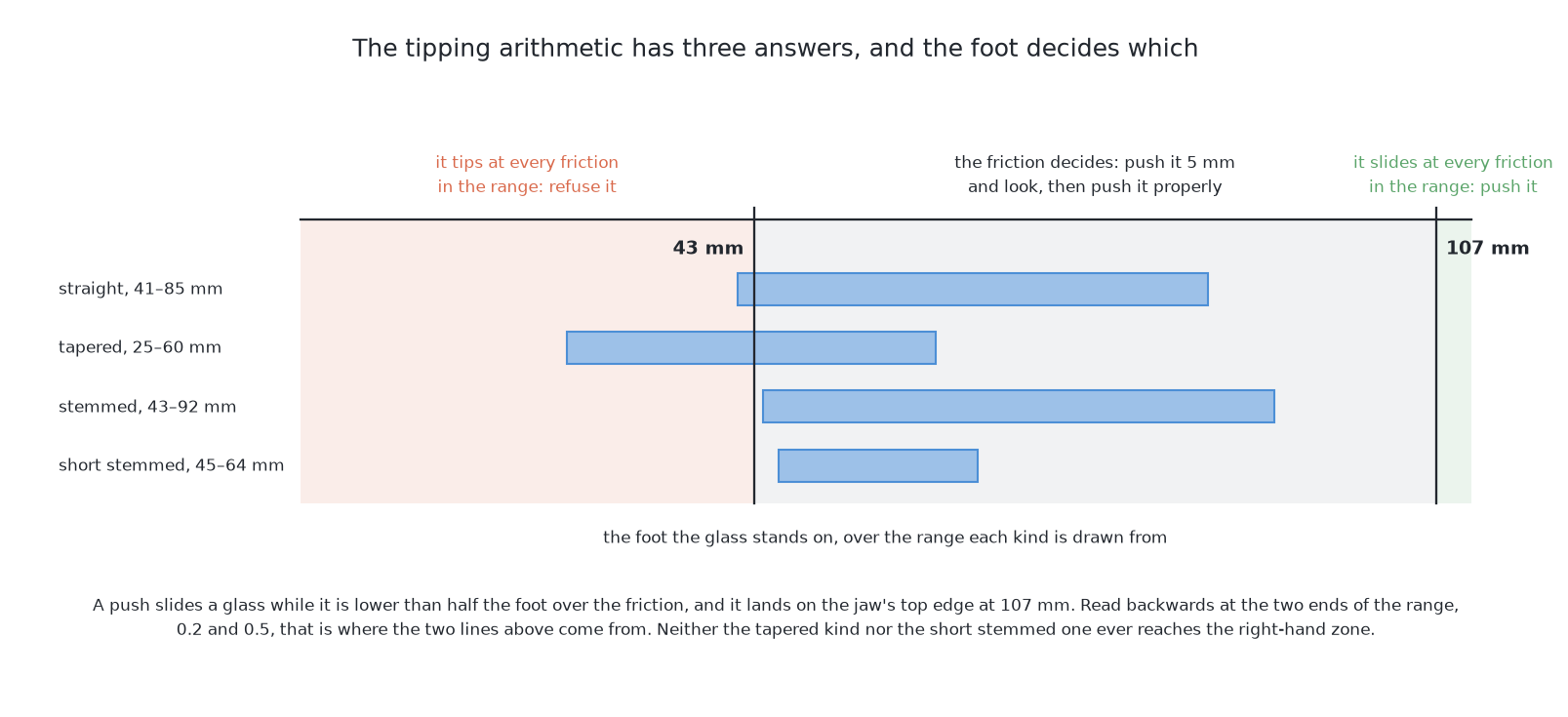
Steps 2 and 3 handle that middle zone. Some glasses are so tall that even the short test push could lean them most of the way over. Those glasses are refused instead of tried.
A glass that gets "try" gets the short test push. This is probe in the same
file. It takes the chosen push, cuts it to one short length, and keeps the same
line. The arm looks before and after. The
test push
is part of the shared rules. probe runs in three steps.
- Turn the push's direction into a unit vector, which is what NumPy is for here.
- Step back from the aim by the whole push length. This gives the glass's middle. Aim five millimetres past that middle instead.
- Return the same push with the short length and the new aim. Keep the start point, the direction and the feeling distance.
The two-line needs_probe below it decides when a test push is needed.
# A glass that slides only at the low end is tried with a push this long, and
# looked at before and after. Short pushes lose up to 2.5 mm to the contact
# taking up and the glass settling onto its far edge, so this is well over that.
PROBE = 0.005
...
def probe(push: Push) -> Push:
    """The same push, cut down to PROBE."""
    # Step 1: turn the heading into a unit vector, so distances can be stepped along the push
    u = np.array([math.cos(push.heading), math.sin(push.heading)])
    # Step 2: step back from the aim by the whole travel, which lands on the glass's middle
    middle = np.array(push.aim) - push.travel * u
    # Step 2: aim PROBE past that middle instead, so the jaw carries the glass 5 mm and stops
    aim = middle + PROBE * u
    # Step 3: hand back the same push with the short travel and the near aim; where the
    # fingertips come down, the heading and the feeling forward are all unchanged
    return Push(push.glass, push.start, push.heading, push.reach, PROBE, (float(aim[0]), float(aim[1])))

def needs_probe(glass: Seen, proven: set[int]) -> bool:
    # Step 1: ask for the test push only while the arithmetic says "try" and this glass has
    # not already slid under one -- a glass that slid once is pushed for real after that
    return slides(glass) == "try" and glass.id not in proven
Together, the two blocks show the whole idea of this solution. Where the arithmetic can answer, it answers. Where it cannot, because the friction is unknown, the method makes one short push to find out. It does not guess.
With this gripper, the test push rarely gets a clear answer. The jaw touches
the glass at 107 mm, so a glass leans before it slides. The lean uses up the
whole 5 mm. A glass that the full push would slide moves less than a
millimetre under the test push. That is smaller than the error in the looks. So the test push
often says "it tipped" about a glass that would have slid. Its mistakes all
point that way. It refuses glasses it could have moved, but it never calls a
glass safe and then tips it.
test_programmed.py
checks that direction and nothing else.
Note which fixed nudge this is. The share-of-the-gap nudge in
the main idea has no constant in the
repository. PROBE does. So the fixed length above is the one this code really
uses.
The next section says what this code hands to the rest of the cell.
2. The pushes are what this contributes#
The last section showed how the method decides. This section shows what it hands over. The method thinks in whole pushes. So it hands over a parameterised push. That is a small set of numbers. They say which glass to move and where the fingertips come down. They say which way the jaw points, how far to feel forward and how far to push. And they say where the glass should end up. The examiner's own code turns those numbers into jaw movements, the same way for every solution. What must come out explains this.
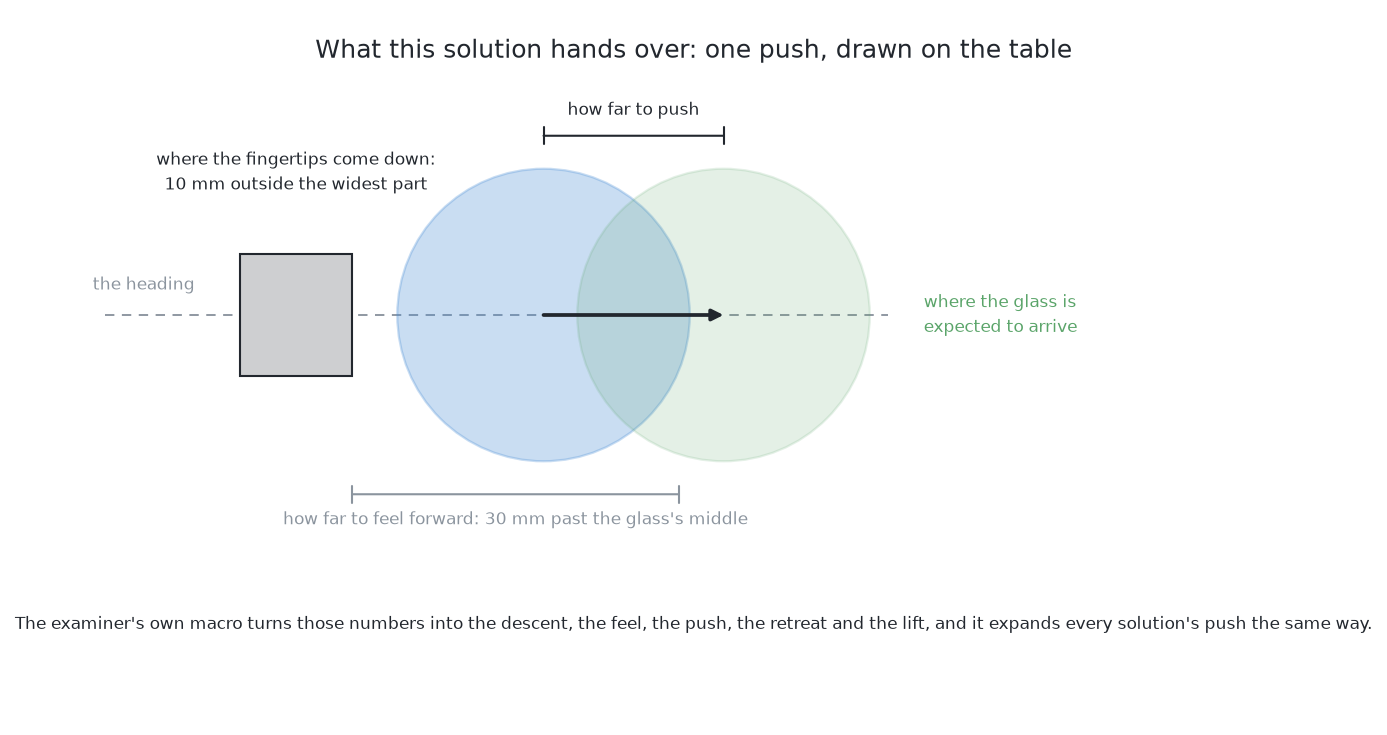
One field says where the glass should end up. That looks like a prediction, but it is not. The examiner asks for it so it can measure how far each glass ended from its aim. This solution fills it with the place the fingertips stop. It assumes the glass moves with the jaw and no further. It never uses this number again. It just looks again.
The jaw does not drive to a computed point on the glass. It comes down behind the glass, a little outside its widest part. Then it moves forward slowly until it feels a small force. A movement that stops when a sensor fires is called a guarded move. It is needed because the glass's position and width each have some error. A jaw driven to a computed point could stop short, or hit the glass too fast.
After the push, the jaw reports what it felt, including the force. This solution uses almost none of that report. It only checks whether the jaw touched anything. This is the main reason it is the weakest of the solutions. Where it is strong and where it breaks explains why.
Pushing is not the whole run. Before any push, the runner racks every glass that already has room. That step is shared by every solution. This page only describes what happens to the glasses that are left.
The next section puts all these parts in the order the arm meets them.
3. How the concepts fit together#
The last two sections showed the parts one at a time. This section puts them in
the order the arm uses them. The room test finds the glasses that cannot be
gripped. The shortfall gives each of them one number, which is the error. The
neighbour that causes the shortfall gives the direction. The gain turns the
error into a distance. The tipping rule decides if the glass may be touched.
The guarded move finds the glass without hitting it. A fresh look() then
replaces everything the last pass assumed.
As a loop, it is:
- Look at the table.
- Rack every glass that already has room. This step is shared.
- For each glass that is left, compute its shortfall against every neighbour's edge, and keep the worst.
- Take the glass with the largest shortfall, and the neighbour that caused it.
- Check that glass against the tipping rule. If it fails, refuse it with the reason, and go back to step 3 without that glass.
- Push it away from that neighbour, by a fixed share of the shortfall, at the lowest height the gripper reaches. Feel forward for the glass instead of driving to it.
- Go back to step 1.
The loop ends when no glass is short of room, when the push budget is used up, or when every glass left has been refused. How it works explains each of these steps in turn.
← What it is · How it works →