Perception has given you a shape — a mask, a point cloud, an outline, a set of measured dimensions. This document is everything you can do with that shape and no trained model at all: work out where the fingers should go, how wide they should open, how hard they should squeeze, and whether the answer is one you can trust.
It is the other half of models that grasp. Reach for this half first. When the object has a describable shape, a rule written as a sentence beats a network, for reasons section 10 sets out properly and the perception overview argues in its general form.
Every number below is either computed from a formula shown on the page, so you can check it, or taken from a manufacturer's published figure with the source named. The friction coefficients in particular are Robotiq's own measured values rather than textbook ones, because textbook friction coefficients are the single largest source of confident wrong answers in this subject.
Who this is for#
Someone who has a measurement in hand and now has to turn it into a gripper pose and a squeeze force. You do not need any mechanics beyond forces and torques, and every term is explained where it first appears. If you have not read the overview, the distinction between a force fit and a form fit introduced there runs through everything here.
Contents#
- The question a grip planner actually answers
- Force closure and form closure
- Friction cones and the antipodal test
- How hard to squeeze, from first principles
- The centre of mass, and the torque nobody budgets for
- Rules from a measured profile
- Bounding the search by the gripper's own body
- Clearance: the room the gripper needs to close
- Grasp quality metrics you can compute
- Why a rule beats a network
- Testing a grip rule
1. The question a grip planner actually answers#
A grasp, for a two-finger gripper, is five numbers and one decision. The five numbers are a position in space, an approach direction, a rotation about that direction, a finger opening, and a squeeze force. The decision is whether to attempt it at all.
That last item is not decoration. A grip planner that always returns its best candidate is a planner that will happily recommend an impossible grasp on a bad measurement, and the whole of section 11 is about making refusal a mechanism rather than an intention — the same argument the perception area makes about declining as a mechanism.
The five numbers split into two groups that are worth keeping separate in your code, because they fail differently.
Where the fingers go is geometry. It comes from the shape, it is checkable against the shape, and when it is wrong you can usually see that it is wrong by drawing it. Sections 2 to 8 are about this.
How hard the fingers squeeze is mechanics. It comes from the mass, the friction and the acceleration, none of which are in the picture, and when it is wrong nothing is visibly wrong until the object slips or breaks. Section 4 is about this, and holding on is about what happens next.
Mixing the two is the commonest structural mistake here. A grasp search that scores candidates on geometry alone and then applies a single global squeeze force has, in effect, assumed every object weighs the same.
2. Force closure and form closure#
These two terms are used loosely and they mean different things. Getting them apart is worth the paragraph, because the difference is the difference between the two payload numbers in the overview.
Form closure means the object cannot move at all, no matter what forces are applied to it, because the contacts physically block every direction. Friction plays no part. A peg in a matching hole has form closure. A part sitting in a shaped nest has form closure.
Force closure means the object cannot move given the forces the fingers can apply, which for a squeeze means given friction. A block held between two flat pads has force closure and not form closure: nothing geometrically prevents it sliding out sideways, and only friction stops it.
The practical difference is what happens when the assumption behind friction fails. Oil on the part, a dusty surface, a sudden acceleration — all of these attack force closure and none of them touch form closure. This is why form closure is worth engineering for even though it is harder to achieve.
True form closure needs more fingers than you have. Here is the reasoning,
which is worth following rather than memorising. A frictionless contact can only
push, never pull, so it removes the object's freedom to move in one direction and
does nothing about the opposite direction. A rigid body in three dimensions has
six degrees of freedom. To block all six in both directions you need the contact
normals to positively span a six-dimensional space, and the smallest number of
vectors that can positively span a d-dimensional space is d + 1. So form
closure of a solid object needs at least seven frictionless contacts, and in
the plane it needs four.
A two-finger gripper has two contacts. It therefore never achieves form closure in the strict sense, and everything anyone calls "form fit" in a product catalogue is really partial form closure: the geometry blocks the directions that matter — usually downward, along gravity — and friction handles the rest. That is a perfectly good engineering answer and it is not the textbook property, and knowing the difference stops you looking for a guarantee that is not there.
This is why an encompassing grip is stronger. When a Robotiq 2-finger gripper curls around a cylinder, the fingers are no longer two flat pads pushing inward. They form a cradle, and the object would have to deform or lift out of the cradle to escape. OnRobot quote the two capacities separately for exactly this reason: 2 kg force fit and 5 kg form fit on the RG2, 7 kg and 11 kg on the 2FG7.
Five jobs form closure thinking suits:
- designing a fingertip, where a groove or a lip is nearly free to add
- deciding whether a part needs a nest rather than a gripper at all
- handling anything where the friction coefficient is unreliable, such as oily machined parts or dusty castings
- high-acceleration moves, where friction is the first thing to run out
- anything the robot will invert, where gravity changes direction relative to the fingers
Five jobs it cannot do:
- handle an object whose shape gives the fingers nothing to get behind — a flat plate, a sphere, a smooth block
- work when the object's size varies, since the shaped feature fits one size
- be achieved by two fingers in the strict sense, as above
- help with suction, magnetic or soft grippers, which have no equivalent
- be verified by a sensor, since nothing on the gripper reports which kind of closure it achieved
3. Friction cones and the antipodal test#
This is the one calculation underneath every two-finger grasp, and it is simple enough to do in your head once you have seen it.
3.1 The cone#
Push a finger against a surface. The surface pushes back along its normal, which is the direction perpendicular to the surface at that point. Friction adds a sideways force, and the largest sideways force friction can supply is the normal force multiplied by the coefficient of friction, written as the Greek letter mu.
So the total force the contact can transmit lies inside a cone around the normal, and the half-angle of that cone is
half-angle = arctan(mu)
That is the whole of it. The cone is the set of directions in which the contact can push or pull the object without slipping.
The half-angle for the values that actually turn up:
| Coefficient of friction | Half-angle of the friction cone | Where this value comes from |
|---|---|---|
| 0.1 | 5.7 degrees | polished metal on polished metal, or anything wet |
| 0.3 | 16.7 degrees | Robotiq's measured value for their silicone fingertip against lubricated steel |
| 0.6 | 31.0 degrees | Robotiq's stated value for silicone against steel in their 3-Finger manual |
| 1.0 | 45.0 degrees | soft rubber against a clean dry surface |
The two Robotiq values are the same fingertip on the same material, and they differ by a factor of two. The only difference is cutting oil. This is the first trap in this document and it is a large one: the coefficient you looked up is a property of the pair of surfaces in the condition they are in, not of the gripper, and a machine-tending cell acquires a film of coolant on every part somewhere between commissioning and the second week of production. Halving mu doubles the squeeze force needed for the same object. If you have one number to measure on real hardware rather than assume, this is it.
3.2 The antipodal test#
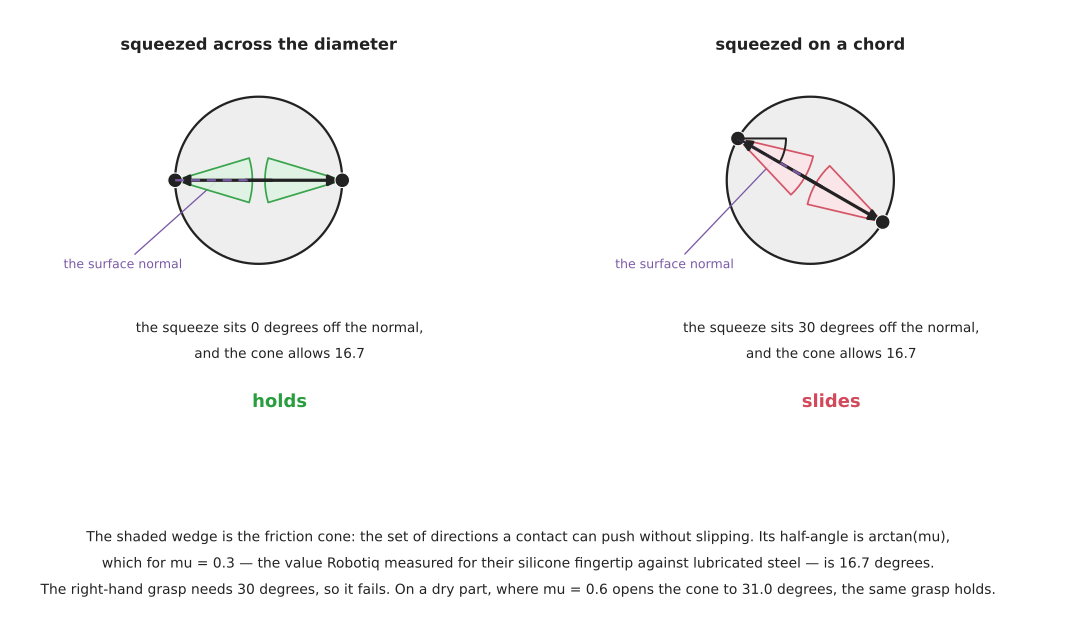
Two fingers squeezing an object apply forces roughly along the line joining the two contact points. That squeeze holds the object without it sliding out if and only if the line lies inside the friction cone at both contacts. A pair of contacts with that property is called an antipodal pair, and finding antipodal pairs is what almost every geometric grasp search actually does.
Written out, for each candidate pair of surface points:
- Take the two points and the surface normal at each.
- Form the line joining them.
- Measure the angle between that line and each normal.
- Accept the pair if both angles are less than
arctan(mu).
On a mask or a point cloud this is a few lines of code, it runs in milliseconds over thousands of candidate pairs, and it needs no training, no graphics card and no licence.
A worked case, because the numbers are unintuitive. A cylinder lying on a table, gripped across its diameter, gives two contacts whose normals point exactly along the line between them, so both angles are zero and the grasp passes at any mu. The same cylinder gripped along a chord 30 degrees off the diameter gives angles of 30 degrees at both contacts: it passes at mu = 0.6 and fails at mu = 0.3. The grasp that works dry fails with oil on it, and the failure is a slide rather than a drop, so the object arrives at the next station in the wrong place rather than on the floor.
3.3 Three ways the antipodal test quietly lies#
The test on a silhouette is not the test on the surface. If your normals come from the outline of a mask rather than from a point cloud, they are the normals of the silhouette, which are all perpendicular to the viewing direction by construction. For an object whose gripped faces genuinely are perpendicular to the camera — a bottle seen from the side — that is correct. For a domed or tapered object it is not, and the test passes on a pair of points whose real surfaces slope away from each other. The symptom is a grasp that squeezes the object out of the fingers like a pip, upward and away, and it looks like a squeeze force problem.
The linearised cone is not the cone. Nobody computes with a real cone; they approximate it with a pyramid of six or eight faces, because that turns the test into linear algebra. A pyramid inscribed in the cone is conservative and rejects some valid grasps. A pyramid circumscribed about it is optimistic and accepts some invalid ones. Both appear in published code, neither is usually documented, and the difference is a few per cent of grasps — which is invisible in a benchmark and visible in a cell running ten thousand picks a day.
A symmetric object returns a plateau, not a maximum. Scoring antipodal pairs along a cylinder gives an identical score everywhere along the parallel section. Code that takes the first index of the best score puts every grasp at one end of the plateau, which is the end nearest whichever way you happened to iterate. On a tapered object this is invisible, because there is a genuine maximum. On a parallel one it biases every grasp towards one end of the object, and the resulting torque about the grasp is section 5's problem. Take the middle of the plateau, and test on an object family that includes a parallel section — this is exactly the class of bug that property testing finds.
Five jobs the antipodal test suits:
- any rigid object with two roughly opposed reachable faces
- searching thousands of candidate grasps in milliseconds, on a laptop
- bin picking where you have a point cloud and no model of the objects
- filtering the output of a grasp network down to the ones that also make geometric sense
- explaining, after a failure, exactly which condition was violated
Five jobs it cannot do:
- tell you which of two valid grasps is better, since it is a pass-or-fail test
- account for the object's weight, its centre of mass or the acceleration
- handle a deformable object, whose normals change as you squeeze
- work from a silhouette alone without the error in 3.3
- say anything about whether the gripper can physically get there, which is what section 7 and section 8 are for
4. How hard to squeeze, from first principles#
Two flat pads hold a mass m against gravity by friction alone. Each pad presses
with normal force F. The friction available is mu * F at each of the two
contacts. Divide by a safety factor S chosen by you. So the condition is
2 * mu * F / S >= m * g
and rearranging gives the squeeze you need:
F = m * g * S / (2 * mu)
Robotiq's manual writes the same relation the other way round, as the weight a
given grip can hold, W = (2 * F * Cf) / Sf, and works an example: 200 N of
grip, a coefficient of 0.3, a safety factor of 2.4, giving 50 N, which is about
5 kg.
Worked the way you would actually use it, for a safety factor of 2:
| Object | Friction coefficient | Squeeze needed per pad |
|---|---|---|
| 200 g | 0.3 | 6.5 N |
| 500 g | 0.3 | 16.4 N |
| 500 g | 0.6 | 8.2 N |
| 1 kg | 0.3 | 32.7 N |
Two things fall out of that table that are worth carrying.
The forces are small. A Robotiq 2F-85 goes up to 235 N. Half a kilogram on a dry silicone pad needs 8 N. Almost every failure to hold a light object is a friction problem or a geometry problem, not a force problem, and turning the squeeze up is the wrong first move — it damages the object and does not fix either cause.
Doubling the friction halves the force. Which means the cheapest way to hold something more securely is almost always a better pad, not a harder squeeze. This is the argument for silicone and for textured fingertips, and it is why grippers and hardware treats the fingertip as a first-class design decision rather than an accessory.
4.1 The safety factor is where the physics stops and the judgement starts#
The formula above is exact and the answer it gives is only as good as S. What
S is really absorbing is everything the formula left out: the acceleration of
the move, the uncertainty in the mass, the uncertainty in mu, and the fact that
the contact patch is not a point.
Robotiq's own worked example uses 2.4 and their 3-Finger manual uses 2. Those are sensible numbers for a slow move. They are not sensible for a fast one, and the manual says so in the next paragraph: at 2 g of acceleration the 5 kg object in their example produces 98 N of inertial force on its own, against a 50 N holding capacity, and it is dropped.
The honest way to handle this is to stop hiding the acceleration inside S. Put
it in the formula:
F = m * (g + a) * S / (2 * mu)
and let the motion planner tell you a. Then S covers only the uncertainties,
and a number like 1.5 to 2 is defensible. If you cannot get a from the planner,
measure the worst acceleration the arm actually produces and use that — for most
collaborative arms on a normal trajectory it is well under 1 g, and for an
emergency stop it is very much not.
4.2 The other bound, which is the one that actually bites#
Everything above is a lower bound on the squeeze. There is an upper bound too, and it has nothing to do with friction: the force at which the object is damaged.
For anything fragile this bound is the binding one, and it should be recorded per kind of object, not per object. The perception area's glass case study does exactly this and treats exceeding the cap as a refusal rather than something to clamp to and continue with. That is the right structure, and the reason is worth stating plainly. If the force needed to hold an object exceeds the force its walls can take, that object cannot be safely held by this gripper, and the useful output is a line in a report saying so. Clamping to the cap and lifting anyway converts a clean refusal into a crack.
There is a third bound that is easy to forget. The gripper itself has force and moment limits that are separate from its grip force. A Robotiq 2F-85 grips at up to 235 N but its fingers may only carry 50 N of external force in any direction and 3 Nm about the tool axis. Those limits are about what the arm does to the object once it is held, not about the squeeze, and exceeding them damages the gripper.
5. The centre of mass, and the torque nobody budgets for#
The friction calculation in section 4 assumes the object hangs straight down from the grasp. If the centre of mass is not under the line between the fingers, the object also tries to rotate, and the grasp has to resist a torque as well as a force.
The torque is the weight multiplied by the horizontal offset:
torque = m * g * d
For a 500 g object whose centre of mass is 30 mm to one side of the grasp, that is 0.147 Nm. Against a gripper's published moment limit — 3 Nm about the tool axis on a 2F-85 — that looks like nothing, and this is where the trap is. The limit that matters is not the gripper's moment rating. It is the torque the friction patch can resist before the object rotates in the fingers.
A flat pad resists rotation only through friction acting at a small radius. For a pad 20 mm across gripping with 20 N, the resisting torque is roughly the friction force multiplied by an effective radius of a few millimetres — of the order of 0.05 Nm. The 0.147 Nm above exceeds it, and the object rotates in the fingers, slowly, while the gripper's finger-position reading does not change at all.
Three consequences, each of which is a design rule:
Grasp near the centre of mass, not near the centroid of the mask. These are different, and for common objects they are noticeably different. A mug's handle puts the centroid of the silhouette off to one side of the mass. A bottle with liquid in the bottom has its mass low and its silhouette centroid high. Anything with a metal insert in a plastic body is worse. If perception gives you an outline, you have the centroid, and using it as the centre of mass is an assumption you should write down rather than one you should make silently.
Grasping above the centre of mass is stable; grasping below it is not. An object gripped above its centre of mass hangs and self-centres. An object gripped below its centre of mass is an inverted pendulum in the fingers, and any disturbance grows. For tall objects this decides the grasp height on its own, before any quality metric is consulted.
When you cannot find the centre of mass, measure it. A wrist force-torque sensor reading both force and torque gives you the offset directly: divide the measured torque by the measured weight. That is a real measurement, available the moment the object leaves the table, and it costs one deliberate pause. The perception area covers weighing the object at the wrist, including the trap that a force sensor reports in the tool's frame, so a side-on grasp reads zero weight unless you rotate the wrench into the world frame first.
Five jobs centre-of-mass reasoning suits:
- tall or long objects, where grasp height decides stability
- objects with a handle, a spout or any mass that is not where it looks
- anything that will be inverted or tilted after the pick
- deciding between two antipodal pairs that are otherwise equally good
- explaining a failure where the object rotated rather than fell
Five jobs it cannot do:
- find the centre of mass from a picture, which no vision method does
- help with a symmetric uniform object, where it is where you expect
- account for liquid that moves while the arm does
- substitute for a weighing step, since it needs the mass it cannot see
- apply to suction, where the equivalent question is torque about the cup and is answered differently
6. Rules from a measured profile#
The sections above take a shape and find grasps that will not slip. A rule does something different: it takes a shape and finds the grasp that is correct for this kind of object, which is usually a much stronger constraint.
A rule is a sentence about the geometry. Hold the narrowest part below the widest. Take the flattest band in the lower third. Never let a finger land within 5 mm of the rim. Each of these is checkable against a measured profile, each of them encodes something a network has no way to learn from slip labels, and each extends to a new object by writing another sentence.
6.1 What a profile gives you#
A side-on silhouette of an object, converted to a width at each height, is one array. Almost every useful rule is a query on that array.
- the widest point, and its height
- the narrowest point below the widest, which is the stem of a glass or the neck of a bottle
- the longest run of nearly constant width, which is where parallel pads sit best
- the height at which the width first exceeds the gripper's opening, which bounds the grasp from above
- the fraction of the total height below the grasp, which decides whether the object can be inverted afterwards
The perception area's silhouette section produces exactly this array for objects that are solids of revolution, which covers a large share of the things a table-top arm handles.
6.2 The properties a good rule has#
It refuses. A rule that cannot find a grip on this object should raise rather than return its least bad answer. This is the single most valuable property and the one most often missing.
It is expressed in millimetres the gripper understands. The narrowest part below the widest becomes a band of at least 12 mm of height whose width lies between 4 and 40 mm, where 4 and 40 come from the gripper's own stroke and its minimum useful closure. A rule whose thresholds come from the geometry rather than from the hardware will quietly refuse a whole class of shape and you will not know which.
It states the assumption it is making about the object. This assumes the object is a solid of revolution. This assumes the mass is evenly distributed. Written down, those become the first two things you check when the rule fails.
It is tested on a generated family, not on one object. See section 11.
Five jobs a geometric rule suits:
- an object family that varies in proportion rather than in appearance — glassware, bottles, tools, machined parts
- anything where a part of the object must not be touched
- anything where the grip has to permit a specific later action, such as pouring or inverting
- projects that need to add a new object kind without collecting data
- anything fragile, because a rule can be made to refuse
Five jobs it cannot do:
- an open-ended object set with no shared structure, which is the honest case for a grasp model
- objects that differ in appearance rather than shape, such as by a label
- transparent or mirrored objects, where the profile itself is unreliable and the depth hole is the only signal
- clutter, where the profile is of several objects at once
- anything where the rule would need more exceptions than it has clauses, which is the signal to stop writing rules
7. Bounding the search by the gripper's own body#
This section exists because of a mistake that is nearly universal and almost never named.
A grasp is not a pair of contact points. It is a pose for a physical object — the gripper — that is typically 150 mm long, 100 mm wide and open to 85 mm, and which must arrive at the contact points without any part of it occupying space that is already occupied. The fingers must pass either side of the object. The palm must clear the top of it. The body must clear the neighbours, the tote wall and the table.
Which of those is binding is a question the arm answers rather than the gripper, and the reachability document is where the workspace holes, the joint limits and the eight configurations that reach the same pose are set out.
The mistake is to score candidates first and check collisions afterwards. It is a natural way to write it: generate antipodal pairs, rank them by quality, hand the best one to the motion planner, and let the planner reject it if it does not fit. The pipeline then behaves correctly on isolated objects and fails in a specific and confusing way on objects near a wall — the planner rejects candidate after candidate, latency goes up by a factor of ten, and eventually a poor grasp is accepted because it was the only one left. Nothing errors. The symptom is that the cell is fine in testing and slow and unreliable in a full tote.
The constraint should bound the search, not the answer. Concretely, before scoring anything:
- Reject any candidate whose required opening exceeds the gripper's stroke minus twice the fingertip thickness. A Robotiq 2F-85 opens to 85 mm, and with, say, 6 mm pads on each finger the largest object it can take is 73 mm, not 85.
- Reject any candidate below the gripper's minimum encompassing diameter if you wanted an encompassing grip. Robotiq publish 43 mm for the 2F-85 and 90 mm for the 2F-140 — an object narrower than that cannot be wrapped, whatever the grasp score says.
- Reject any approach direction along which a swept volume of the open gripper intersects the table, the tote wall, or another object's point cloud. This is a cheap test against a voxel grid and it removes most candidates in clutter. Section 8 works out how large that swept volume actually is, which is larger than most people guess.
- Reject any candidate whose finger contact points fall on a region marked as not-to-be-touched.
- Only now, score what is left.
The reordering costs nothing and changes the failure mode from "slow and occasionally bad" to "returns fewer candidates, and says so".
A second, smaller version of the same mistake. A gripper's stroke is quoted with the manufacturer's own fingertips. Custom fingertips change it in both directions: a thick pad reduces the maximum opening, and a fingertip that extends below the finger reduces the minimum. Robotiq's manual states that custom fingertips must not exceed 100 mm in height or width from the base, and that they are still subject to the equilibrium line rule. If your gripper model in software carries the catalogue stroke while the hardware carries your fingertips, every bound above is wrong by a few millimetres in the unsafe direction.
8. Clearance: the room the gripper needs to close#
Section 7 asked whether the gripper's body fits where the fingers want to be. This section asks the question underneath it, which is skipped more often than any other check in a grasp pipeline: how much empty space must surround the object before the gripper can arrive at that pose and close on it.
Clearance here means free space around the object, measured outward from its surface, into which nothing else may intrude. It is not the same thing as the gripper touching nothing at the instant of the grasp, and it is a great deal larger than that.
8.1 The final pose is the wrong thing to check#
The gripper does not appear at the grasp pose. It opens wider than the object, it travels in along the approach direction from a pre-grasp standoff — a point set back along that direction, usually somewhere between 50 and 150 mm — and only then does it close. Three different volumes are therefore in play: what the gripper occupies at the end, what it sweeps on the way in with its fingers open, and what the fingers sweep as they close. A swept volume is the union of every position a moving body passes through, and it is the swept volumes that have to be free, not the final one.
The sizes are not close. Take a Robotiq 2F-85 approaching 100 mm with its fingers fully open, using the figures in Robotiq's 2F-85 and 2F-140 instruction manual. The fingers alone sweep a box 152.7 mm wide, 35 mm deep and 100 mm long, which is 534 cubic centimetres. The two silicone pads at the grasp pose measure 38 by 22 by 6.5 mm each, which is 11 cubic centimetres between them. Both figures over-state the solid they describe, and they still differ by a factor of nearly fifty.
So a pipeline that collision-checks the grasp pose and nothing else accepts grasps that cannot be performed. The failure then shows up in the motion planner, which cannot find a path to the pose it was handed, and because the planner is where the error surfaces it is recorded as a planning problem. It is not. The grasp was never feasible, and the planner was the first component honest enough to notice. Leaving the check to the planner is weaker than it sounds for a second reason as well: a planner tests for collisions at sampled points along the path rather than continuously, so a thin obstacle between two samples is missed entirely, which planning a path sets out.
8.2 The clearance a jaw needs, read off its own drawing#
The requirement is arithmetic on four numbers you can read from the gripper's own dimensioned drawing: the opening, the thickness of a fingertip, how far the finger body stands outboard of that fingertip, and the half-width of the widest part of the gripper.
Picture the open gripper from the front, in the plane the fingers move in. The outline is a staircase that widens as you go back from the fingertips. For the first 38 mm, which is the length of the pad, the two fingers present a pair of slabs whose outer faces are 98 mm apart with the 85 mm channel between them. Behind the pads the finger bodies step out to 123.5 mm. Behind those the knuckles bulge to 152.7 mm, which is the widest the gripper ever gets. No part of it is narrower than the fingertip, and the fingertip is the only part a final-pose check tends to look at.
Each row of the table below is one cross-section through that staircase, taken with the gripper fully open and fitted with the standard flat silicone fingertip. The first column is the figure the manual prints, the second is half of it, which is the distance from the grasp centre line to the outside of the gripper.
| Measured across | 2F-85, fully open | Half-width from the centre line |
|---|---|---|
| the pad faces, which is the opening | 85 mm | 42.5 mm |
| the outside of the two fingertips | 98 mm | 49 mm |
| the outside of the two finger bodies | 123.5 mm | 61.75 mm |
| the widest part of the gripper | 152.7 mm | 76.35 mm |
Two spacings fall straight out of that table and they are the constants of the
gripper. A fingertip is t = (98 - 85) / 2 = 6.5 mm thick. A finger body stands
f = (123.5 - 98) / 2 = 12.75 mm outboard of its own fingertip. The 2F-140 gives
the same two numbers from its own drawing — 6.35 mm and 12.75 mm — because the
two grippers share a chassis, which is a useful check that the reading is right.
Now let w be the object's width across the grasp and let the gripper be opened
to some commanded opening. The opening margin is the air between each pad and
the object as it approaches:
m = (opening - w) / 2
and the clearance the object needs on each side, measured outward from its own surface, is
at the fingertip   m + t
at the finger      m + t + f
at the widest part b - w / 2
where b is the half-width of the widest part, 76.35 mm for a fully open 2F-85.
That last figure shrinks as the gripper closes, because the knuckles that make it
swing inward: the 2F-85 measures 126.4 mm across when fully closed against
152.7 mm when fully open. Use the open figure anyway, because the gripper is open
for the whole of the approach and only closes once it has arrived.
Worked for a 40 mm object with the gripper opened all the way to 85 mm, so
m = 22.5 mm: the fingertip needs 29 mm each side, the finger needs 41.75 mm,
and the widest part needs 56.35 mm. A 40 mm object therefore needs more free
space on each side than the object is wide. Open to 60 mm instead of 85 mm and
m drops to 10 mm, which takes the first two figures to 16.5 mm and 29.25 mm.
The useful way to hold this is to add the two sides and the object together. The
free lane the open gripper needs is opening + 2t + 2f, which for a fully open
2F-85 is 123.5 mm at the fingers and 152.7 mm at the widest part. The object's
width has cancelled out. The lane is set by how wide you opened the gripper and
not by what you are picking, because opening wider for a bigger object is exactly
offset by the object filling more of the opening.
The opening margin is set by your perception error, not by preference. If m
is smaller than the error in the estimated position and width of the object, a
pad strikes the object on the way in instead of closing on it. The perception
area's error budget
puts the realistic total at several millimetres for a consumer depth camera on a
well-calibrated arm, so 10 mm is a defensible default and 2 mm is wishful. Every
millimetre of margin is also a millimetre of clearance the scene has to provide,
which makes this one number the link between how well you see and how tightly you
can pack.
The body behind the fingers needs clearance too, and it is never the narrowest part. Perpendicular to the finger plane the picture turns round: the fingers are 35 mm thick in that direction and the gripper's base is a circle 75 mm across, so there the body is more than twice the width of the fingers. Whichever way the gripper is turned, its widest cross-section is behind the fingertips. Anything bolted to the wrist — a camera, a cable gland, a tool changer — makes it wider still, and the collision model in software usually carries the bare gripper only.
One warning about catalogue numbers. The 2F-85's mechanical specification table gives a maximum width of 148.6 mm while Figure 6-1 of the same manual dimensions the open gripper at 152.7 mm. The 2F-140 shows the same disagreement, 202.1 mm against 206.9 mm. Four to five millimetres is a large fraction of a sensible opening margin, so take the larger figure, and measure the gripper you actually have before you commit a layout to it.
8.3 The two sweeps, and the one that is forgotten#
The approach sweep runs along the approach direction and is the one people think of. The closing sweep is the one that is forgotten, and on an underactuated gripper it does not point where you expect.
The 2F-85's linkage carries its fingertips further from the wrist as it closes. The manual's drawings give the overall length as 149.3 mm with the fingers open and 162.8 mm with them closed, so the tips advance 13.5 mm along the approach direction in the course of closing. The 2F-140 advances 23 mm, from 209.8 mm to 232.8 mm. That is a net figure for the extreme point; the path the tip takes between the two is a curve rather than a straight line.
The consequence is a specific failure. Arrive with the fingertips 5 mm above the table, close, and the tips drive 13.5 mm further down into it. Picking a thin object lying flat on a table is precisely this case, and the symptom is that the fingers stall on the table before they reach the object, which the gripper reports as a closure at a width the camera did not predict — the check in the two-finger gripper document catches it, and catching it is not the same as avoiding it. Your clearance budget must therefore include the space beyond the grasp point along the approach direction, and for a 2F-85 13.5 mm of it is the floor rather than a comfort margin.
8.4 Turning clearance into a spacing for the scene#
When the obstacle is a neighbouring object rather than a wall, the clearance
requirement becomes a spacing, and a spacing is something a cell can be designed
around. Take a row of identical objects of width w standing on a table, each to
be picked by approaching straight down with the finger plane along the row, which
is the worst case. Pitch is the distance from the centre of one object to the
centre of the next. The outside of the finger must clear the neighbour's near
surface:
pitch >= w/2 + m + t + f + w/2 = w + m + t + f
and the free gap left between two objects is that pitch less the objects themselves:
gap = pitch - w = m + t + f
which does not contain w at all. The gap a neighbour must leave is a property
of the gripper and of your perception error, and nothing else. For a 2F-85 with a
10 mm opening margin it is 29.25 mm, and it is 29.25 mm for a 10 mm part and for
a 60 mm part alike.
The table below applies both bounds to three object sizes, again for a 2F-85 with
a 10 mm opening margin. Read the second column when only the fingertips come down
as far as the neighbour, and the third when the grasp is deep enough that the
widest part of the gripper reaches the neighbour's height as well, in which case
the binding half-width is 76.35 mm and the pitch is 76.35 + w/2.
| Object width across the grasp | Minimum pitch, fingertips level with the neighbour | Minimum pitch, widest part level with the neighbour |
|---|---|---|
| 20 mm | 49.3 mm | 86.4 mm |
| 40 mm | 69.3 mm | 96.4 mm |
| 60 mm | 89.3 mm | 106.4 mm |
Those are numbers worth having before a cell is laid out rather than after. Fixture pitch, tote dividers and pallet spacing are decided months before anybody writes a grasp planner, and a 50 mm pitch chosen because the parts are 40 mm wide leaves 10 mm of gap where the fingers need 29 mm. No pick along that row is then possible, and the cell depends entirely on the crosswise approach in 8.5 fitting instead. The same arithmetic run backwards answers the other question a layout raises, which is the largest gripper a fixed spacing can accept.
8.5 The approach direction is the free variable#
When clearance fails from one direction it very often succeeds from another, because the gripper's envelope is not a circle. In the finger plane the open 2F-85 spans 152.7 mm; across that plane it spans 35 mm. Rotating the tool a quarter turn about the approach axis changes the footprint from 152.7 by 35 mm to 35 by 152.7 mm and changes nothing at all about the grasp: the same two contacts, the same opening, the same squeeze. A row of parts with little room along the row and plenty across it is picked by putting the finger plane across the row.
That rotation is already one of the five numbers in section 1, so searching over it costs one loop in code you have written anyway. The cost comparison is what makes this the first thing to try. Rejecting a candidate on clearance is one test of a swept box against a voxel grid, which is microseconds. Moving a neighbour out of the way is an extra pick, an extra place, a fresh measurement afterwards, and a fresh opportunity to knock something over, which is seconds. Enumerate the approach directions exhaustively before you consider changing the world.
8.6 What to do when the clearance is not there#
Four moves, cheapest first.
Change the approach direction, as above, including tilting it away from straight down. This costs nothing but search.
Change the grasp. Reduce the opening margin, but only as far as your perception error genuinely allows. Grasp higher up the object so the widest part of the gripper stays above the neighbours. Take a different pair of faces, which the antipodal search has usually already offered you.
Move something. Push the neighbour aside, or pick an easier object first and come back for this one. That is a different subject with its own failure modes, and singulation and pre-grasp covers it.
Decline. A refusal that names the clearance that failed and by how many millimetres is a useful output, and it is the same mechanism section 11 asks every rule to have. An attempt that proceeds with 3 mm of clearance where 29 mm was needed will strike the neighbour, and saying so before the arm moves costs nothing.
Clearance applies section 7's rule to a different obstacle, and it is worth saying so directly. Section 7 says to bound the search by the gripper's body rather than to score first and check collisions afterwards, and its obstacles are the fixed furniture: the table, the tote wall, the region you are not allowed to touch. This section changes the obstacle to the object's neighbours and the test from the occupied volume to the swept one, and the structural advice is unchanged. Reject on clearance inside the candidate loop, before anything is scored, which is step 3 of that list. The reason for repeating it is that the neighbours behave differently from the furniture: the table is in your model permanently and the neighbours arrive with every new scene, which makes it easy to write a system that checks the first properly and the second not at all.
Five jobs clearance reasoning suits:
- deciding whether a geometrically valid grasp can actually be executed, before the motion planner is called
- laying out a cell, where it gives fixture pitch, tote dividers and pallet spacing as numbers
- choosing between candidate approach directions in clutter, which is the cheapest repair available
- explaining a failure that presents as a planner problem and is not
- sizing the opening margin against the perception error you actually have
Five jobs it cannot do:
- say whether the arm can hold the gripper in that pose, which is joint limits, self-collision and reachability
- see an obstacle perception did not see, such as a neighbour hidden behind the target
- handle a neighbour that would yield rather than resist, such as a cloth bag, since it treats everything as rigid
- account for the object moving as the fingers touch it, which changes the clearance during the grasp rather than before it
- replace a collision check on the whole trajectory, since it tests one straight approach segment and the closing motion and nothing else
9. Grasp quality metrics you can compute#
The antipodal test answers yes or no. When several candidates pass, you need a score. There is a substantial literature on grasp quality measures — Roa and Suárez's review in Autonomous Robots surveys them — and for a two-finger gripper on a table you need very few of them.
9.1 The ones worth computing#
Distance from the grasp line to the centre of mass. Smaller is better, directly, for the reasons in section 5. This is one subtraction and it is the most useful single score available.
Margin inside the friction cone. Not just whether the angles are less than
arctan(mu), but by how much. A grasp passing with 5 degrees to spare survives a
worse-than-expected friction coefficient; a grasp passing with 0.5 degrees does
not. Reporting the margin rather than the boolean is nearly free and turns a
pass into a ranking.
Contact patch flatness. How much the surface deviates from flat over the area the pad covers. A pad on a curved surface makes a line contact instead of an area contact, which reduces both the friction and the resistance to rotation. Fitting a plane to the points under each pad and taking the residual is enough.
Alignment with a preferred approach. Most cells have one — straight down, or along the tote's long axis. Scoring the angle between the candidate approach and the preferred one is a task constraint expressed as a number, which is exactly the kind of thing a grasp network cannot be told.
The epsilon metric, if you have the wrench space. The classical measure, from Ferrari and Canny's 1992 paper, builds the set of all wrenches — force-and-torque pairs — the grasp can resist, takes its convex hull, and reports the radius of the largest ball centred on the origin that fits inside. In plain terms: the worst-case disturbance the grasp can take, whichever direction it comes from. It is the standard, it is what Dex-Net was trained against, and Murray, Li and Sastry's A Mathematical Introduction to Robotic Manipulation is the textbook treatment of the wrench algebra underneath it.
9.2 The trap in the epsilon metric#
The epsilon metric mixes forces, measured in newtons, with torques, measured in newton-metres. Those are different units, so taking the radius of a ball in the combined six-dimensional space requires choosing how many newton-metres are worth one newton. That choice is a length — usually the object's radius, or the distance from the contacts to some reference point — and the metric's value and even its ranking of two grasps depend on it.
The consequence is concrete. Two implementations of the epsilon metric, both correct, can rank the same two grasps in opposite orders because one normalised torques by the object's bounding radius and the other by the distance to the object's centroid. Neither documents the choice. A published quality number with no stated torque scale is not comparable with anything.
For a two-finger gripper picking table-top objects, the simpler scores in 9.1 are more informative and much harder to get wrong. Reach for the epsilon metric when you have more than two contacts and genuinely need a single number.
Five jobs a computed quality score suits:
- ranking the survivors of a hard geometric filter
- comparing two fingertip designs on the same object set, offline
- producing a number that can be logged and argued about after a failure
- setting a threshold below which the system declines rather than attempts
- generating labels for a model you are training yourself
Five jobs it cannot do:
- rank grasps the gripper cannot reach or cannot approach, which is the job of sections 7 and 8 and comes first
- capture a task constraint you did not encode as a term
- be compared against a number from another paper, for the unit reason above
- account for the object's deformation under the squeeze
- predict whether the grasp survives the placement, which loads it differently
10. Why a rule beats a network#
The perception overview makes the general argument. Here is the version specific to grasping, which is stronger, because what a grasp network is trained to predict is narrower than it looks.
A grasp network predicts one property: the object did not fall out. Every label in every grasp dataset is a slip outcome, in simulation or on a real gripper. Nothing else is in the loss function. So the model learns to avoid slipping and is blind, by construction, to:
- which part of the object must not be touched
- whether the grasp permits the next operation — pouring, inserting, inverting
- whether the object arrives at the next station in a known orientation
- how much force the object can take before it is damaged
- whether the grasp is reachable by your arm with your gripper
Each of those is a sentence you can write in an afternoon and none of them can be added to a pretrained network without retraining it on data you would have to generate.
A rule extends by editing; a network extends by retraining. Adding a new kind of glass to a rule means writing another clause and checking it against a few dozen generated examples, which takes minutes and no hardware. Adding it to a network means collecting attempts, labelling them, and retraining. If your objects vary in proportion rather than in appearance, the rule generalises further and it generalises immediately.
A rule can refuse and a network cannot. A network always returns its best-scoring pose. There is no output that means I do not understand this object. Where the cost of being wrong exceeds the cost of doing nothing — glassware, anything fragile, anything near a person — you need a step that declines, and that means a threshold you chose.
A rule keeps the test loop fast. A rule over plain arrays is tested in a second with no simulator, no weights and no graphics card, which is why trying a new rule is free. A network in the same position needs a download, a device and a minute. The ability to iterate quickly is caused by the architecture, not separate from it.
None of this says grasp models are wrong. It says they are wrong as the decider. They belong where the alternative is genuinely worse:
- the object set is open-ended and shares no structure you can write down, which is the honest description of a mixed warehouse tote
- you want fifty candidates quickly, for something else to filter
- the object is a shape nobody has a sentence for, such as a handful of crushed packaging
- you are generating labels for a small fast model of your own
11. Testing a grip rule#
A grip rule is not a model, so dataset metrics are the wrong instrument. The right one is property testing, and the perception area describes the method in testing a rule is not testing a model. What follows is the gripping-specific version: which properties to assert.
Generate a family, not an example. Forty objects drawn across the plausible range of proportions, with the generator seeded so any failure reproduces exactly. Include the degenerate cases on purpose: an object with a long parallel section, one at the very edge of the gripper's stroke, one whose widest point is at the very bottom, one that is almost a sphere.
Assert properties the gripper cares about, not labels.
- every object either gets a grip the gripper can physically make, or is refused with a reason
- no returned grip requires an opening outside the gripper's usable stroke
- no returned grip puts a finger on a forbidden region
- the grasp line passes within a stated distance of the object's centre of mass, which the generator knows and the rule does not
- the squeeze force returned is below the object's damage cap and above the friction requirement for its generated mass
Do not assert the classification. A tempting test is that each generated object is identified as the kind it was generated as. It is the wrong test, and it fails for a good reason: a very shallow cone is physically a nearly straight object, and the straight-object rule holds it perfectly well. Asserting the generated label forces the rule to preserve a distinction the gripper does not care about.
Use the simulator's ground truth for scoring and never for acting. The generator knows every object's true mass, centre of mass and dimensions. The report may read them. The robot may not. Keep the boundary visible in the directory layout, because the moment a code path the robot runs reads that file, every number the report produces afterwards means nothing.
The faults this actually catches, in this specific subject, are the ones in section 3.3 and section 5: a plateau search that biases every grasp to one end, a centre-of-mass assumption that holds for the object the author pictured, a tolerance derived from geometry rather than from the gripper's stroke. None of them is a crash. Each is a rule that is true of one object, and the family is what reveals which object that was.