There are perhaps a dozen genuinely different ways to make a robot arm do something useful, and the first thing to understand is that they are not alternatives to one another in the way that a list of them suggests. Some of these methods decide what the arm should do next. Some decide how it should move from one place to another. Some decide only what to do in the last millimetre, when the part the arm is carrying has already touched the part it is being fitted into. Because they answer different questions, a working robot system nearly always uses several of them at the same time, and most of the arguments you will read about "planning versus learning" turn out to be arguments between people who are talking about different layers of the same machine without realising it.
This document is the map of that landscape. It sets out the jobs that arms are actually bought to do, the layers that every arm system is built from, the family tree of the methods themselves, and a grid that says which method suits which job. The four companion documents then take the methods one at a time, and one of them is a hands-on path if you would rather build than read.
Who this is for, and what it is for#
This is written for someone who can picture an arm moving, and who knows roughly what a camera does and what a joint angle is, but who has not yet had to choose between these approaches for a real project. You do not need to have used any of them, and where a term is likely to be unfamiliar it is explained as it appears.
The folder also has a particular purpose behind it, and being explicit about that changes quite a lot of what is in it. It is written for someone who wants to learn this field well enough to be useful in it within about a year — well enough to talk credibly about a robotics project, to scope one sensibly, to win service or consulting work, or to start building something real over the next one to three years as the hardware and the models get cheaper.
It is not a guide to building a production robot this month, and that difference shows up in two ways throughout. The first is that every method carries a line saying whether it is worth your time to learn right now, which is a genuinely different question from whether the method is any good. Some excellent methods are not worth your time, because they are research techniques that really need a team and a budget behind them. Some distinctly unglamorous ones are very much worth your time, because they are what people are actually paid to do. The second difference is that wherever something has been announced but cannot actually be downloaded, or has been demonstrated in a video but never deployed anywhere, this document says so plainly. The gap between a press release and a working system is where most of the wasted effort in this field ends up going.
The short answer, before the long one. There are two broad families. In programming, a person writes down what the arm should do, in one form or another. In training, the behaviour comes out of examples or out of practice instead of out of somebody's head. Programming gives you precision, and it gives you a system you can inspect and check line by line, which matters enormously in a factory; what it cannot give you is any ability to cope with variety, because everything it knows had to be written down in advance. Training is the other way round: it copes with variety well, it needs a great deal of data to do so, and when it fails it cannot tell you why. Every serious system therefore uses both, programming the parts of the job that are easy to say out loud and training the parts that are not.
The documents in this folder#
This document — the map. The tasks, the layers, the family tree, the grid of which method suits which job, and an honest account of what is realistic to build in the next year. Read it first. If you would rather start by building something, go straight to the learning path and come back here when a choice needs making.
Programmed methods. The behaviour a person writes down: teaching, offline programming, behaviour trees, motion planning, task and motion planning, and feedback control. This is what runs in factories today.
Learned methods. The behaviour that comes from data: imitation learning, reinforcement learning, large pretrained policies, learned components sitting inside an otherwise conventional system, and language models used as planners. This is where most of the research is.
A learning path, in simulation. The practical companion to the rest: five complete projects — tidy a desk, fit a connector, empty a bin, copy a task from video of your own hand, assemble a kit — each built four times, starting from code you write by hand and ending at the 2026 frontier. Every version has cameras, motion, a grasp and an honest evaluation. Almost all of it runs on an ordinary Mac.
Glossary. Every term used in this folder, explained in plain words and grouped by what it is about — the arm itself, seeing, moving, touching, learning — followed by a table of every framework and whether it runs on a Mac. Look things up here rather than reading it through.
A case study: a glass on a drying rack. One small household job, built four times: pick up the empty glasses on a table, turn each one over, and stand it mouth-down on a peg, leaving the full ones alone. It is where the choices in this document get applied to something concrete — which part is a planner, which part is a model, which part is a force loop, and the named tool for each.
What is changing, and why. The direction the field is travelling in and the reasons behind it — why methods get displaced, the five forces driving 2026, what each new capability actually lets you do, and how to tell a real shift from a passing fashion. Read this when you want to understand the field rather than any particular method.
There is also a companion folder, two-arm training, covering what changes when a second arm is added. That turns out to be considerably more than you would guess, and none of it makes sense until the single-arm picture is clear, so start here.
Contents#
- What an arm is actually asked to do
- The five things that make a task hard
- The four layers of an arm system
- The family tree
- Which method for which task
- Three worked examples
- What is current, and what is fading
- What each method costs you
- What real systems actually do
- What you can realistically do in the next year
- How to read the numbers in this field
- Where this repo fits
1. What an arm is actually asked to do#
Methods are far easier to compare once you have some real jobs in mind, so this section sets out the jobs before anything else. They are arranged in four groups, ordered by how much is known about the world in advance. That ordering is not arbitrary, and it is worth saying why: how much you know in advance turns out to be the single best predictor of which method you will end up using, better than the industry you are in or the arm you have bought.
The picture below places all of these jobs on the two properties that do most of the predicting. It is worth spending a minute on it before reading the tables, because each of its four corners wants a genuinely different method, and the four groups below are really just regions of that picture.
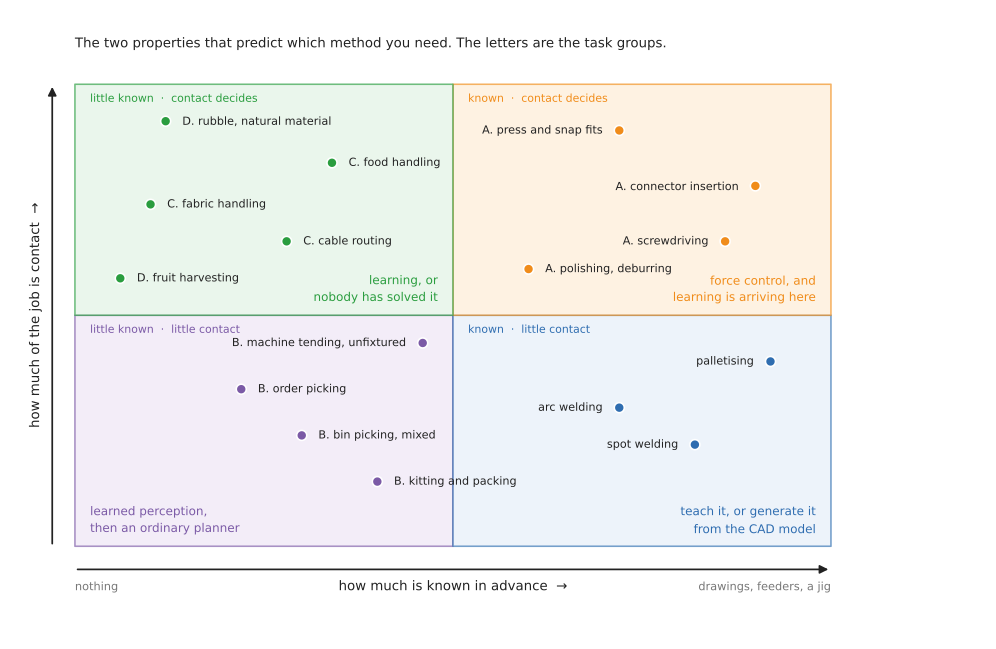
The solved bulk, which comes before the four groups#
Think of spot and arc welding, machine tending, palletising, painting and dispensing, polishing a part that is clamped in a jig, or moving sample tubes between laboratory instruments. What all of these have in common is that the workpiece is held by a fixture, the geometry is known because it came off a drawing, and the job is simply to be accurate and fast a million times in a row.
These tasks account for the great majority of the robots installed in the world, and they are solved — solved by the programmed methods, and solved well. Nothing in the learned-methods document improves on them. It is worth saying that plainly right at the start, because a great deal of the writing about robot learning carries an implication that the existing approaches are obsolete, and in the places where robots actually earn their keep they are not remotely obsolete. What is true is that these tasks are a shrinking share of what people now want robots to do, and that is the reason the rest of this document exists.
Group A: the parts are known, but the fit decides everything#
Here you have the drawings, and the parts arrive neatly in feeders, and yet the job still fails. The reason it fails is that success is settled in the last millimetre by contact between two surfaces rather than by getting the arm to the right position. This is where most of the difficulty in industrial robotics actually lives, and it is a genuinely hard problem rather than a solved one.
| Task | What makes it hard |
|---|---|
| Connector and harness insertion | clearances under a millimetre, tighter than the arm's own repeatability, with the contact hidden from view |
| Screwdriving | engaging the thread without cross-threading, and knowing from the torque when it is properly seated |
| Press-fits and snap-fits | the force needed is large, the tolerance for being off-axis is small, and a failure damages the part |
| Polishing and deburring | holding a set contact force along a curved surface, faster than the arm can react |
Group B: the objects are known, but their arrangement is not#
In this group the catalogue of objects is fixed, or very nearly so, but nothing is where you left it. The arm has to work out where things are before it can do anything with them. This is the class of problem that learned perception unlocked, and it is where machine learning is genuinely in production today rather than in a demonstration video.
| Task | What makes it hard |
|---|---|
| Bin picking of mixed items | clutter, occlusion, and objects whose pose has to be worked out rather than known |
| Order picking from shelves or totes | thousands of product types, many of them deformable or shiny, at a rate per hour that matters commercially |
| Kitting and packing | many small motions, items starting in different places, a long sequence where one error spoils the tray |
| Machine tending with unfixtured parts | the part arrives roughly positioned, and the chuck needs it exactly positioned |
Group C: the object has no fixed shape#
Cloth, cable, food, foam, bags. The defining property of this group is that the object's shape is decided by where you are holding it, which means there is no such thing as "the object's position" in the way there is for a rigid block. You cannot look up where a shirt is, because a shirt does not have a single answer to that question.
| Task | What makes it hard |
|---|---|
| Cable and harness routing | the cable moves while you work, tension is invisible, and the task is long so failures compound |
| Food handling | every item differs, most are fragile, and hygiene rules constrain the gripper |
| Garment and fabric handling | effectively infinite configurations, and most of the object hidden under itself |
Group D: the geometry is unknown and physics decides the outcome#
This is the hardest class of all. There is no model of the object anywhere in the system, and whether an attempt actually worked is often only known a moment after the arm has let go.
| Task | What makes it hard |
|---|---|
| Harvesting fruit and vegetables | every specimen differs, the target is occluded by leaves, and it bruises |
| Handling rubble, scrap or natural material | no model of any piece, and errors accumulate |
| Assembling something whose parts do not fit as drawn | reality and the drawing disagree, and the arm has to find out by touching |
2. The five things that make a task hard#
Five properties do most of the work in those tables, and placing a new task on these five will tell you more about which method you need than any amount of reading about the methods themselves. It is worth taking each in turn.
How much is known in advance. At one end of this scale sit fixtures, engineering drawings and a fixed catalogue of parts; at the other sit a jumbled bin of objects or a rough stone picked up off the ground. The programmed methods need this knowledge in order to function at all, and where it exists they are excellent, which is why the solved bulk above is solved.
How much of the job involves contact. Moving an arm through empty space is a well-understood problem and a comparatively easy one to plan. Deciding what to do while pressing one object against another is neither of those things, because the outcome depends on friction and on contacts that are usually hidden from any camera you could point at them. Insertion, polishing and folding are contact tasks in this sense; welding and palletising are not, because the tool never has to feel its way.
How many steps there are, and whether the order matters. Driving a single screw is one skill exercised once. Assembling and packing a component might be twenty steps, and in a twenty-step job it is entirely normal for a small mistake at step four to quietly ruin step nine, with nothing obviously wrong in between. Long tasks therefore need something in the system that keeps track of where it has got to and can recover when a step fails.
How tight the tolerance is. Repeatability is how precisely an arm returns to a position it has been to before, and a good industrial arm manages about a tenth of a millimetre. That sounds impressive until you try to seat an electrical connector whose clearance is fifty microns — half of a tenth of a millimetre — because at that point the arm's own error is larger than the gap it is aiming at. Once the tolerance is tighter than the accuracy you can achieve, the task stops being a geometry problem and becomes a feedback problem: the arm has to feel its way in rather than calculate its way in.
What a failure costs. Failing to pick a strawberry costs you a retry. Scratching a car body costs a great deal more than that. Tasks where failure is cheap and easily repeated can be learned by practice, because practice means failing repeatedly on purpose. Tasks where failure is expensive have to be verified before they are allowed to run at all. This single property explains most of why industry adopts new methods far more slowly than researchers expect it to.
3. The four layers of an arm system#
An arm doing a real job has to answer four questions, over and over, and the useful thing to notice is that "which method should I use" usually has a different answer at each of the four. This is why comparing a motion planner with a vision-language-action model is a bit like comparing a wheel with a car: they are not competing, because they are answering different questions.
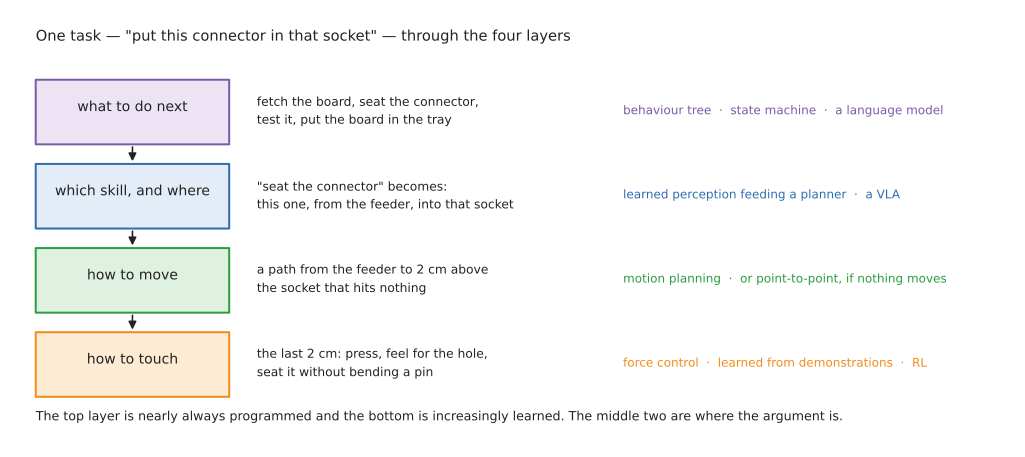
What to do next is the sequence of the job. For a circuit board it might be: fetch the board, seat the connector, test it, and put the board in the tray.
Which skill, and where takes one of those steps and makes it concrete. "Seat the connector" becomes this connector, taken from that feeder, and pushed into that socket — which means that something in the system has to know where those three things actually are at this moment.
How to move is the path from wherever the arm is now to where it needs to be, arranged so that it does not hit anything on the way.
How to touch is the layer that actually decides whether the job succeeds: pressing hard enough to seat the connector without bending a pin, feeling around for the hole when the first attempt does not go in, and recognising from the force reading that the part is properly home.
In practice the top layer is nearly always programmed, because a competent person can write the sequence of a job down in a morning and there is little to be gained from learning it. The bottom layer is increasingly learned, because nobody can write down what to do in the last millimetre even though almost anybody can demonstrate it. The two middle layers are genuinely contested, and that contest is where most of current robotics research is happening.
4. The family tree#
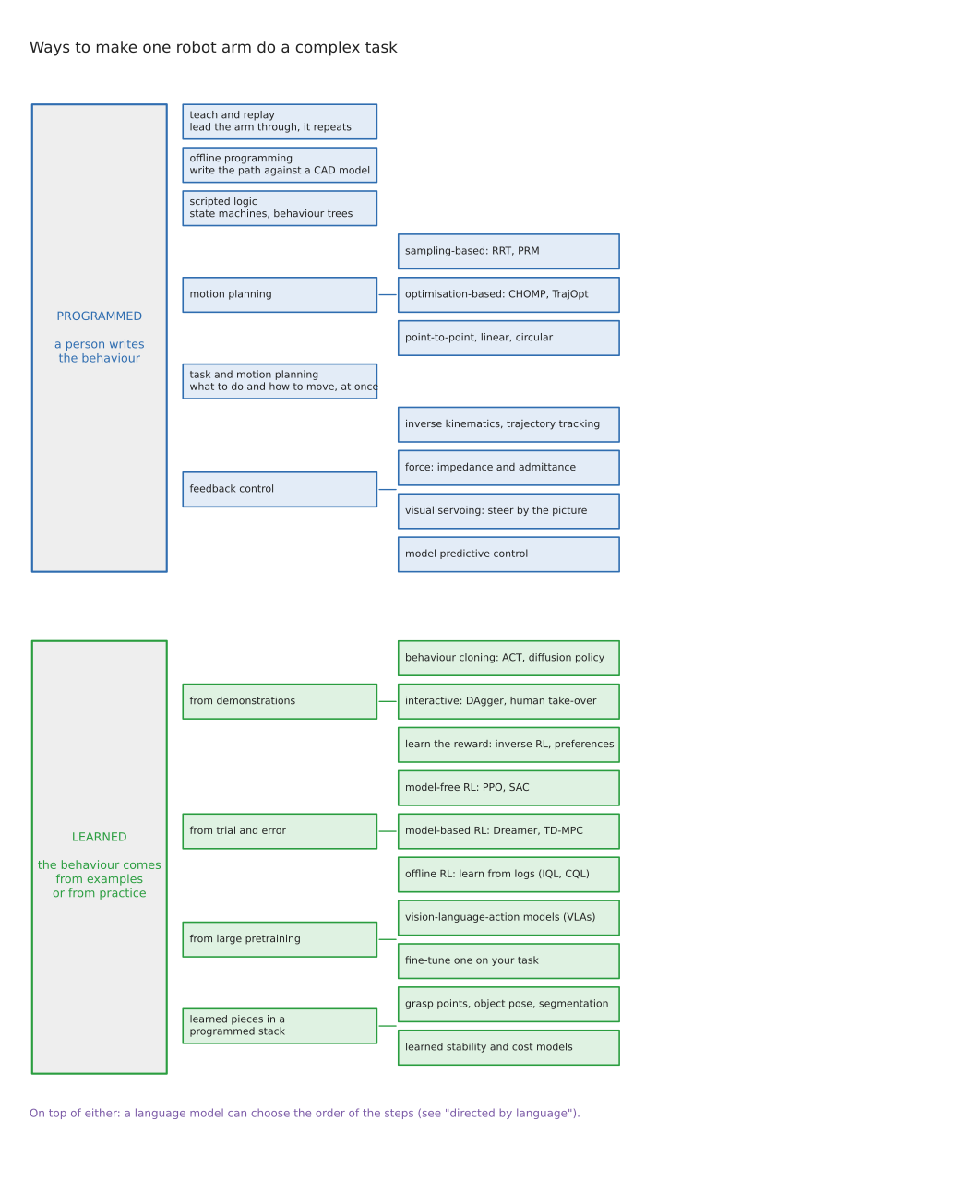
The first branch in the tree is the split introduced at the top of this document: behaviour that a person writes down, against behaviour that comes out of data. Within the programmed family, the branches run from simply replaying a recorded motion, through computing motions from a model of the robot and its surroundings, to planning what to do and how to move as a single problem. Within the learned family, the branches are divided by where the learning signal comes from — from a person's demonstrations, from the robot's own practice, or from a large pool of data gathered somewhere else entirely.
One branch deserves attention before the others, because it is the quiet workhorse of the whole field: learned pieces sitting inside an otherwise programmed system. Most of the deployed robots that use machine learning at all use it in exactly this way — a conventional system with one network doing the perception — rather than the end-to-end approach that receives nearly all of the attention.
5. Which method for which task#
This section gives the direct answer to "is this the right method for this task". You can read a row of the grid to plan a system, or read a column to see where a particular method earns its keep.
A column heading like "learned perception" is only a label, though, until you know what you would actually install and run in order to get it. So the nine columns are explained first, each with the open-source projects that implement it and something concrete you can go and look at.
The nine columns, explained#
Teach / offline programming. These are two ways of writing the motion down in advance. In teaching, you drive the arm to each position in turn and press a button to record it. In offline programming, you build a model of the workcell in CAD and generate the path against that model instead, without touching the robot.
The teaching half has no open-source equivalent at all, because it lives inside each vendor's own pendant software. The nearest open thing to it is hand-guiding, where you physically push the arm around and it remembers where you put it, and you get that by running an admittance controller on an arm that can sense the torque in its joints.
The offline half, by contrast, has a serious open stack that almost nobody outside industry seems to know exists. Tesseract provides the planning environment and the solvers, Noether generates toolpaths from the surface mesh of a part, and scan_n_plan_workshop wires the whole chain together — scan the part, reconstruct its surface, generate a toolpath, plan the motion, execute it. That last one is the thing to go and look at, because it is a complete industrial pipeline that you can actually read. RoboDK is the accessible commercial tool if you want to see what the mainstream looks like. One warning: Tesseract ships no packaged binaries, so you will be building it from source.
Motion planning. The job here is to find a path from where the arm is to where it needs to be that collides with nothing on the way. MoveIt 2 is what you will actually use, and its tutorials are the fastest way in; OMPL supplies the underlying algorithms that search for paths.
Two pieces inside MoveIt matter considerably more than their profile suggests. The first is the Pilz industrial motion planner, which produces deterministic point-to-point, straight-line and circular motions in the way a real industrial controller does — meaning the arm does exactly the same thing every time, which is what you need if you ever have to certify a cell. The second is Ruckig, which works out the timing along a path so that the arm accelerates smoothly rather than jerking. If you need multi-stage pick-and-place with alternatives and fallbacks built in, look at MoveIt Task Constructor, which is the closest mainstream thing to structured task planning. Finally, cuRobo is a planner that runs on a graphics card and is fast enough to replan continuously rather than planning once and executing — it needs an NVIDIA card to work.
Force control. Instead of telling the arm where to be, you tell it how it should respond when it feels a force. The baseline is ros2_control together with the admittance controller in ros2_controllers.
The piece that people consistently miss is cartesian_controllers. The distinction it draws matters: the standard controller works in joint space, meaning it reasons about each joint separately, whereas this one works in Cartesian space, meaning it reasons about the gripper's position and the forces on it directly. That is much closer to how you naturally think about a contact task — push this way with this much force — and much closer to what such tasks need.
Beyond those, Drake and Pinocchio are the model-based libraries for anything serious, franka_ros2 is the reference driver for an arm that genuinely senses torque in every joint, and MuJoCo MPC lets you drag a predictive controller around on screen, which is by far the fastest way to build an intuition for what these controllers are doing.
It is worth knowing where this stops, because the boundary is abrupt. There is no open implementation of hybrid force-position control, and none of the contact-rich assembly strategies that industry uses. Past admittance control, you either write it yourself or buy it from the robot vendor.
Learned perception. Here a network tells you what is in front of the arm and where it is, and ordinary code does everything else. Segment Anything works out which pixels belong to which object, without having been trained on your particular objects. FoundationPose goes further and estimates an object's full position and orientation — its position along three axes and its rotation about each of them, which together are called its six degrees of freedom — again without needing to be trained on that specific object first. That last point is what changed the economics, because the old approach needed training per object and therefore needed an engineer per customer.
For grasping, GraspNet-1Billion is now most useful as a dataset and a benchmark rather than as code to run, and NVIDIA's GraspGen is the current research line, though note that it carries a research licence rather than a permissive one. Contact-GraspNet is best avoided, as it depends on a long-dead generation of TensorFlow.
The example worth building from this column is simple to describe: Segment Anything and FoundationPose feeding grasp poses into MoveIt is a complete bin-picking system, and it is the shape of essentially every deployed machine-learning robot on earth.
Imitation. You show the arm the task a number of times, and train a policy to copy what you did. LeRobot is the answer here and there is no close second: it hosts ACT, diffusion policy and the rest, it supports the cheap open arms directly, and a policy trains in under an hour on a single consumer graphics card. robomimic is a careful study of which implementation details actually matter, and it is worth reading before you conclude that your data is the problem.
If you want to practise without buying hardware, LIBERO provides long single-arm tasks and FurnitureBench provides the honest hard case. The original ACT and diffusion_policy repositories are dormant now, so use LeRobot's versions of those methods rather than theirs.
Reinforcement learning in simulation. The idea is to let the robot practise millions of times somewhere that costs nothing, and then transfer what it learned to the real arm. Isaac Lab is the current standard, and it requires an NVIDIA graphics card. So, be warned, does most of the rest of this column: MuJoCo Playground documents no processor-only path, and the JAX backend it relies on does not support Apple graphics at all. On a Mac the honest option is plain MuJoCo driven by Stable-Baselines3 on the processor, which is fine for learning how the algorithms behave and far too slow for a real training run. This is the one column in the grid where the hardware genuinely decides for you.
Around those, ManiSkill and robosuite provide the manipulation tasks to practise on, mujoco_menagerie provides ready-made models of real robots, and Stable-Baselines3 is the cleanest place to actually understand how the algorithms work.
The worked industrial example is IndustRealKit, where training happened entirely in simulation and transferred to a real arm with no real-world data at all, reaching between 83% and 99% success across 600 insertion trials. One note on staleness: if you meet a tutorial that uses Isaac Gym, it is out of date.
Real-robot reinforcement learning. Here the arm practises on the actual hardware, with a person standing by to take over when it is about to do something stupid. HIL-SERL is the system, and it now ships inside LeRobot, which is where you should use it from. Its predecessor SERL has been formally deprecated by its own authors, so ignore any tutorial built on it. This column carries the strongest published numbers in this entire document: 100% success on every task it was tried on, after between one and two and a half hours of training on the real robot.
Vision-language-action models. These are single large pretrained models that take camera images and a sentence describing the task, and emit arm commands. The openly released ones are π₀, π₀-FAST and π₀.₅ from openpi, and GR00T N1.7.
If you are working with a cheap arm, the one that actually matters is SmolVLA. It ships inside LeRobot and it was designed from the start to be trained and run on consumer hardware, which makes it the realistic entry point to this whole column — the others are not, because they want more memory than a consumer graphics card has. OpenVLA is still the baseline in most papers, but it has had no commits since March 2025, so treat it as a reference point rather than as something to build on. SimplerEnv is how you evaluate these models without owning a robot, and SimpleVLA-RL is the open version of the reinforcement-learning stage that polishes a model once it has been fine-tuned.
Language planner. In this column a language model decides the order of the steps, and something else entirely carries them out. There is no standard framework here, and you should be suspicious of anyone who implies otherwise. SayCan, Code as Policies and VoxPoser are research projects with web pages rather than maintained libraries, and Inner Monologue is the idea of feeding failures back to the model so that it can replan.
In practice you build this yourself out of a language-model API plus BehaviorTree.CPP or py_trees as the thing that actually runs. The model picks which branch of the tree to invoke, and the tree keeps the resulting behaviour inspectable, which is the property you would otherwise lose.
What runs on what#
This is worth knowing before you invest a weekend, because discovering it afterwards
is the most common way to lose one. Everything in the imitation column trains on a
single consumer graphics card, or on a cheap rented one. Everything in the
vision-language-action column except SmolVLA wants more memory than a consumer card
has. Isaac Lab, cuRobo and MuJoCo Playground all require CUDA and will not run on an
Apple Silicon Mac, and neither will any open learned grasp-pose model. What does run
natively: MuJoCo, Gazebo, MoveIt 2, RViz2, ros2_control, Drake, Pinocchio, and
LeRobot's training on Apple's Metal backend.
The grid#
★ the usual choice today · ✓ used, and works · ~ emerging, or used in part · – not used
| Task | Teach / offline | Motion planning | Force control | Learned perception | Imitation | RL in sim | Real-robot RL | VLA | Language planner |
|---|---|---|---|---|---|---|---|---|---|
| Welding, painting, palletising | ★ | ✓ | – | – | – | – | – | – | – |
| A. Connector / harness insertion | ✓ | ✓ | ★ | ✓ | ✓ | ★ | ★ | ~ | – |
| A. Screwdriving | ★ | ✓ | ★ | ✓ | ~ | ~ | ✓ | – | – |
| A. Polishing and deburring | ★ | ✓ | ★ | – | – | ~ | ~ | – | – |
| B. Bin picking of mixed items | – | ★ | ✓ | ★ | ~ | ~ | – | ~ | – |
| B. Order picking from shelves | – | ★ | ✓ | ★ | ~ | – | – | ~ | ~ |
| B. Kitting and packing | ✓ | ★ | ~ | ★ | ~ | – | – | ~ | ~ |
| C. Cable routing | ~ | ✓ | ★ | ✓ | ★ | ~ | ~ | ~ | – |
| C. Food handling | ✓ | ✓ | ✓ | ★ | ✓ | – | – | ~ | – |
| D. Fruit harvesting | – | ★ | ✓ | ★ | ~ | ~ | – | ~ | – |
| D. Unknown-geometry assembly | – | ★ | ★ | ✓ | ~ | ~ | ~ | – | ~ |
Four things fall out of that grid, and each is worth drawing out.
The first row is the one to keep in mind whenever someone tells you the field has moved on. The tasks that pay for most of the world's robots use two of these nine columns and ignore the other seven entirely, and any claim about where robotics is going has to account for that row rather than skipping past it.
Learned perception is the column that changed everything. It is the only learned column with a star anywhere in it, and it has three of them. Turning "where is the object" from an unsolved problem into a solved one is what made Group B commercially real, and the striking thing is that it did so without disturbing anything else in the stack: the planner, the controller and the logic all carried on exactly as before.
Force control is the answer to Group A. Whatever else you use, the moment a job is decided by contact rather than by position, something in the system has to manage that contact. This is also the column where the learned methods are now arriving most credibly, which makes Group A the interesting place to watch.
Groups C and D are where the learned methods stop being optional. There is no CAD model of a shirt, and there is no CAD model of a strawberry. Where an object's shape is not knowable in advance, learning is not an improvement on the alternative approach — it is the only approach there is.
6. Three worked examples#
Inserting a connector into a board. This is the canonical Group A problem and the clearest case anywhere of position not being enough. The clearance is tighter than the arm's repeatability, which means that a plan that is geometrically perfect will still jam, because the arm cannot execute a perfect plan perfectly.
The way this is done is to programme the approach — either teach it or generate it offline — and then to treat the last centimetre as a force problem rather than a geometry problem. The arm comes in compliant, meaning deliberately soft so that a small misalignment pushes it aside rather than jamming it. It then searches in a small spiral or figure-of-eight pattern until the forces it feels indicate that the pin has dropped into the hole, and only then pushes home.
This is a solved problem that vendors sell as a product, and it is simultaneously the task where the learned methods have their strongest published numbers, which makes it the best place in the whole field to compare the two families honestly. If you want a project that teaches you the most per hour spent, this is it.
Bin picking of mixed items. This is the Group B problem, and it is the template that essentially every deployed machine-learning robot follows. A depth camera looks into the bin, a network proposes places the gripper could close, ordinary code picks the best one that the arm can actually reach, a planner moves the arm there, and force control handles pulling the item out without snagging it.
Nothing about this is end-to-end, and nothing needs to be. The learning is confined to the one part of the job that required recognising something, everything else stays inspectable, and when the system fails you can look at the grasps it proposed and see which of them was wrong.
Picking a strawberry. This is the Group D problem, and it shows where the field genuinely is rather than where the videos suggest it is. Every fruit is a different shape, half of them are hidden behind leaves, the ripeness has to be judged visually, and squeezing too hard destroys the very thing you are trying to sell.
Perception here has to be learned, because nothing else works on a natural object that has no drawing. The approach path is planned in the ordinary way. The grasp and the cut want force control, and a learned policy is a reasonable choice for the final approach. This example is also a useful sanity check against hype: fruit harvesting has had serious money and serious research behind it for over a decade, and it is still hard, for reasons that are physical rather than algorithmic.
7. What is current, and what is fading#
Methods in this field rarely die of old age. They are displaced by something that needs less of whatever happens to be expensive at the time. That single sentence explains nearly every transition you will read about, and it carries a corollary worth holding on to: because what is expensive changes over the years, a method can be displaced without ever having become worse at its job.
The short version for 2026 looks like this.
- Superseded, with notices to prove it. Isaac Gym (use Isaac Lab instead), D4RL (use Minari), OpenAI Gym (use Gymnasium), SERL (use HIL-SERL), RT-1 and RT-2, ROS 1, and hand-designed visual features.
- Quietly dormant rather than dead. The original ACT, diffusion_policy, Octo and OpenVLA repositories, along with the classical grasping stack. The imitation methods themselves are alive and maintained inside LeRobot — their homes changed, which is not at all the same thing as dying.
- Widely got wrong. CAD model matching was not replaced by learned grasping. It was replaced for unknown and mixed items only. For parts you know, model matching is still the standard product and still the right engineering choice.
- Not moving at all, which is where the durable skills are. Force control, behaviour trees, motion planning and calibration. Teaching is actually growing rather than shrinking, because collaborative-robot hand-guiding made it easier rather than obsolete.
- Arriving now. Reinforcement learning used as polish rather than as training; world models; learning from ordinary human video; verification at run time; and small vision-language-action models sized for cheap hardware.
What is changing, and why is the full treatment of all of this: the mechanism behind the shifts, the five forces driving 2026, every deprecation with the reason behind it, what each new capability actually lets you do, and five questions for telling a real shift from a fashion. If you read one thing beyond this overview, read that one, because the specific names in the list above will be stale within a year and the reasons behind them will not.
8. What each method costs you#
These are the same methods as in the grid above, but grouped differently — as things you would commit to building rather than as capabilities you might want. That is why the columns do not match. Teaching and offline programming split apart here, because although they achieve similar things they cost completely different things, and three families appear that were not columns in the grid at all.
The three families that were not in the grid#
Task and motion planning, usually shortened to TAMP, searches for what to do and how to move at the same time, because there are situations where the two genuinely cannot be separated. Whether you have to move the pan out of the way before putting the mug in the sink depends on the geometry, and whether you can move the pan depends on whether a collision-free path exists for it. Decide the sequence without checking the geometry and you get plans that cannot be executed; check the geometry and you needed the sequence first.
PDDLStream is the well-documented reference implementation, and its last commit was in 2023, which is a fair indicator of the state of the field. The expensive part is what you have to supply: a symbolic model of your domain, listing every action along with its preconditions and its effects. In industry this job is done by a behaviour tree instead, for the simple reason that a tree is free to write and a domain model is not.
Classical control is the whole feedback layer treated as a single commitment rather than as one column: inverse kinematics and trajectory tracking, force and impedance control, visual servoing, and model predictive control. The stack you would install is ros2_control with ros2_controllers and cartesian_controllers, then Drake or Pinocchio for the model-based side, and ViSP if you need visual servoing.
What this family asks of you is a model of the robot and something of a control engineer's instincts. What it gives back is the only thing in this entire table that genuinely handles contact, and the only thing you can verify line by line.
Learned pieces inside a classical stack is the least glamorous family here and, by a wide margin, the most deployed. You keep the planner, the controller and the logic exactly as they were, and you replace only the parts that require recognising something. In practice that means Segment Anything and FoundationPose feeding MoveIt 2, with the engineering that actually matters sitting in the ordinary code in between.
It asks for labelled data, or increasingly for nothing at all beyond a downloaded model. It gives back the ability to handle objects the system has never seen, while keeping the system inspectable — when it fails you can look at the proposed grasps and the estimated pose and see which one was wrong. If you are aiming at paid work rather than at research, this is the family to be good at.
What you would actually install#
| Family | The stack you install | What you must supply | First milestone |
|---|---|---|---|
| Teach & replay | vendor pendant software; ros2_controllers admittance for hand-guiding | the motion itself | the arm repeats a taught path |
| Offline prog. + planner | Tesseract, Noether, scan_n_plan_workshop, MoveIt 2, RoboDK | a CAD model, and calibration | a path generated from the model runs on the real cell |
| TAMP | PDDLStream | a symbolic domain model | a plan that is both sensible and reachable |
| Classical control | ros2_control, cartesian_controllers, Drake, MuJoCo MPC | a model of the robot | the arm presses on a surface without fighting it |
| Imitation | LeRobot, robomimic, LIBERO | 50–1000 demonstrations | a policy that does the task some of the time |
| RL (sim → real) | Isaac Lab or MuJoCo Playground, both needing CUDA; Stable-Baselines3 on plain MuJoCo otherwise | a reward, and a simulator that is close enough | it works in simulation, then survives the transfer |
| VLA fine-tune | openpi, Isaac-GR00T, SmolVLA in LeRobot | 10–500 demonstrations, and a checkpoint that fits your robot | a pretrained model doing your task |
| Learned pieces in a classical stack | Segment Anything, FoundationPose, GraspGen + MoveIt 2 | labelled data, or just a downloaded model | picking an object the system has never seen |
The two tables that follow put the same eight families against seventeen points of comparison. The first seven rows are what each method demands before it will work at all; the remaining ten are what you get back in return. Where a cell says "somewhat", it means the method copes with variation of a kind it has seen before but not with a new kind. "Deployed widely" means you can buy it today; "research" means you would be building it from papers.
What the method asks of you
| Teach & replay | Offline prog. + planner | TAMP | Classical control | Imitation | RL (sim → real) | VLA fine-tune | Learned pieces in a classical stack | |
|---|---|---|---|---|---|---|---|---|
| 1. What you must supply | the motion | a CAD model | symbolic rules + geometry | a model of the robot | demonstrations | a reward | demonstrations | labelled data, or a ready model |
| 2. Robot model needed | no | yes | yes | yes | no | yes, for the simulator | no | no |
| 3. Simulator needed | no | helpful | helpful | helpful | no | yes, in practice | no | no |
| 4. Training compute | none | none | none | none | hours on one GPU | days, many GPUs | hours to days | hours |
| 5. Compute when running | trivial | milliseconds to seconds | seconds or more | trivial | one network pass | one network pass | a large network pass | one network pass |
| 6. Time to something working | hours | days | weeks | days | weeks | weeks to months | days, if a checkpoint fits | days |
| 7. Who has to be skilled | an operator | a robot programmer | a researcher | a control engineer | anyone who can do the task | an RL practitioner | an ML engineer | an ML engineer |
What you get back
| Teach & replay | Offline prog. + planner | TAMP | Classical control | Imitation | RL (sim → real) | VLA fine-tune | Learned pieces in a classical stack | |
|---|---|---|---|---|---|---|---|---|
| 8. Objects it has never seen | no | no | limited | no | somewhat | somewhat | best of these | yes, that is the point |
| 9. Positions it has never seen | no | yes, with sensing | yes | yes, with sensing | somewhat | somewhat | yes | yes |
| 10. Contact-rich work | poor | poor | poor | good | good | good | good | not applicable |
| 11. Long multi-step tasks | yes, if nothing varies | yes | yes, by design | no | poor | poor | improving | not applicable |
| 12. Can you see why it failed | yes | yes | yes | yes | no | no | no | partly |
| 13. Can it be verified for safety | yes | yes | mostly | yes | weak | weak | weak | inherits the stack's |
| 14. Cost to change the task | re-teach it | edit and re-simulate | edit the domain model | re-tune | collect new demos | new reward, retrain | fine-tune again | often nothing |
| 15. Industrial maturity in 2026 | decades | decades | research | decades | early deployment | niche | early | deployed widely |
| 16. Typical failure | the world moved and it did not notice | the model differed from reality | no plan found, or too slow | oscillation, or the wrong stiffness | drifts into a state no demo covered | learned to exploit the reward | confidently wrong | the perception was right and the choice was not |
| 17. Worth learning now | understand it | yes | read about it | yes | yes | the fine-tuning use | yes | yes |
Read rows 12 and 15 together and the familiar trade-off appears. The methods you can debug are the ones industry adopted, because a factory has to be able to say why a machine stopped, and the methods that cope with novelty and with contact are the learned ones, which is where all the unsolved tasks happen to be. If you are simply deciding where to spend the next six months, read row 17 on its own.
9. What real systems actually do#
Almost nothing that works in the real world uses only one method, so this section looks at a handful of systems properly. The pattern that runs across all of them is more informative than any individual system.
A modern bin-picking cell is a classical system with exactly one learned component. The planning, the collision checking and the gripper logic are all conventional code, and a network proposes the grasps. The reasoning behind that split is worth stating: the objects vary, so the perception has to generalise, but the motion does not vary, so it stays conventional and therefore verifiable.
MIT's Jenga robot inverts the usual assumption about what ought to be learned. Its strategy and its controller are both conventional. What is learned is a model of how the wooden block responds to being pushed, built from vision and force readings together — which is precisely the part that nobody can write down.
MimicGen uses programming to manufacture the data that training needs, which is a nice inversion of the usual relationship. A classical routine takes a handful of demonstrations and turns them into thousands by re-composing them around wherever the objects happen to be, and a policy is then trained on the result.
SayCan pairs a language model with a set of learned skills, and the contribution is the pairing rather than either half on its own. The model knows perfectly well that a spill needs a sponge, but it has no idea whether this particular robot can reach the sponge. So each skill carries a learned estimate of its own chance of succeeding, and the step that gets chosen has to be both sensible and feasible.
| System | Programmed part | Learned part | Why the split falls there |
|---|---|---|---|
| Typical industrial cell | taught or offline path, force control on insertion | often nothing | nothing varies, so learning buys little and costs verification |
| Bin picking, modern | planning, collision checking, gripper logic | grasp proposals, segmentation | objects vary, motions do not |
| Amazon item stowing | motion planning, grasp planning, force control, a library of named primitives | depth, segmentation, product identity, risk and free-space scoring | 500,000 real stows; 85.86% success; the split is stated by the authors |
| Micropsi MIRAI | the force control underneath | a visuomotor skill trained by demonstration in days | learning removes positional variance; force control still handles contact |
| ETH HEAP dry-stone wall | all of it: scan, estimate mass, search poses, plan, place | nothing | a 6 m × 65 m wall from found boulders, with no learned policy anywhere |
| MIT Jenga | strategy and control | a model of contact, from vision and force | contact is what cannot be written down |
| MimicGen | the routine that multiplies demonstrations | the final policy, by imitation | programming manufactures the data training needs |
| SayCan | the skill interfaces | the planner, the skills, and the feasibility estimates | the planner must know what is possible |
| Code as Policies | perception and control functions | a language model writes the glue | composition is language-shaped, primitives are not |
| OpenAI's cube-solving hand | the cube solver, a classical algorithm | in-hand finger motion, RL in simulation with heavy randomisation | solving the cube was solved; moving fingers was not |
| HIL-SERL | safety limits, resets, the controller underneath | RL on the real robot, with human take-overs | real contact cannot be simulated well enough |
The pattern across that table is consistent enough to state as a rule. Learning is applied to the part of the job that requires recognising or reacting to something, and everything else stays classical — and the reason everything else stays classical is that everything else can be checked.
10. What you can realistically do in the next year#
Everything above this point has been about methods. This section is about what you can actually get your hands on, because the gap between having read about this field and having done any of it is the gap that matters, and in 2026 it is unusually cheap to cross.
The hardware barrier has fallen by roughly two orders of magnitude in three years. The open low-cost arm designs — the SO-100 and SO-101 family and their relatives — put a working six-joint arm with a gripper in the low hundreds of dollars, and LeRobot supports them directly. A leader arm and a follower arm together give you a teleoperation rig, by which is meant a setup where you move the small leader arm with your hand and the real arm copies you, so that real demonstrations can be recorded. These are not toys in the sense that matters: they are the hardware that a large fraction of 2026's published low-cost manipulation work actually runs on.
They are toys in another sense, and it is worth being clear about it. They carry a few hundred grams and they repeat to about a millimetre, so you will not be doing connector insertion on one. What you will be doing is the whole loop — build, calibrate, teleoperate, record, train, evaluate, fail, collect more data — and that loop is the thing worth learning, because it is identical on a thirty-thousand-dollar arm.
A sourcing note for India, since price is usually the blocker there. A community guide, so101-india-guide, documents building the SO-101 leader-and-follower pair entirely from Indian suppliers — Feetech STS3215 servos from Evelta, driver boards and power supplies from Robu.in, and local 3D printing — for roughly ₹25,000 to ₹27,000 excluding tax, with no customs and no import risk at all. That works out at about 1.3 times the US parts cost, rather than the 2 times that importing a kit would carry. Those prices were last verified in April 2026, so check them before relying on them; the point worth taking is that the channel exists.
On compute, rent rather than buy. This is the clearest financial advice in these documents. An ACT policy trains in well under an hour on a single consumer graphics card, which a rented cloud instance will give you for about the price of a coffee. A large pretrained policy needs considerably more memory than any consumer card has, so renting is the only option there anyway. And buying edge hardware got materially worse during 2026: NVIDIA raised Jetson prices by up to 101% in July, without announcing it, taking the Orin Nano Super developer kit from $249 to $399 and the AGX Thor kit from $3,499 to $5,499. Any tutorial quoting the old numbers is stale. Plan on a laptop plus a rented graphics card, and revisit the question in a year.
A genuinely new option: you can collect data without owning a robot at all. Grabette (Apache-2.0, July 2026) is a €490 handheld recorder — cameras, an inertial sensor and a gripper encoder — that you hold in your own hand and use to do the task yourself. Browser-based reconstruction then turns the recording into six-degree-of-freedom trajectories in LeRobot format. A matching €120 gripper puts the same jaws on a robot later, so that what you recorded matches what the robot will do. If your constraint is that you have no arm yet, this removes it entirely.
Data is no longer scarce, which is a recent change. There are now over
seventy-seven thousand datasets on the Hugging Face Hub carrying the LeRobot tag.
The one to start from is
lerobot/community_dataset_v3,
which pulls together 791 datasets covering 46 robot types from 235 contributors,
under Apache-2.0. Do check licences before building anything commercial on a
dataset, because several of the largest and most attractive ones are
non-commercial.
A caution about following tutorials. The ALOHA-era Trossen hardware that most 2023 to 2025 tutorials target has been discontinued, and the ROS packages underneath it have not had a meaningful commit in over a year — with no deprecation notice anywhere saying so. That is the general shape of the problem in this field: things go stale quietly rather than loudly. Check the last commit date before you invest a weekend.
So, concretely, what does a realistic year look like? Learn the programmed stack first, because it is what people are paid for and because it is what the learned methods are replacing. Then build or buy a cheap arm and go round the imitation-learning loop once, end to end, on a task you have chosen yourself — that single experience is worth more in a conversation with a client than any amount of reading. After that, fine-tune an open pretrained checkpoint on your own small dataset, because that is the skill which currently separates people who have done this from people who have read about it. What you should not attempt is pretraining a model from scratch, building your own simulator, or buying edge hardware.
And be honest about where the paid work is#
This question deserves evidence rather than opinion, because it is the one that decides how you spend a year. The evidence turns out to be unambiguous and slightly uncomfortable: the paid work is still in classical automation.
First, a warning about the numbers people quote. LinkedIn's public job-search
endpoint does not honour quoted phrases, which means that searching for "imitation learning" in the United States returns the same 11,000-plus result count as
searching for "PLC". Any analysis built on those headline counts is meaningless,
and several circulating ones are.
Counted properly, the learned methods barely appear in hiring at all. Across 6,766 job posts in Hacker News "Who is hiring?" threads between January 2025 and September 2026 — which is about the most artificial-intelligence-forward hiring corpus that exists anywhere — the counts run like this: "robot" appears in 224 posts, or 3.3%; computer vision in 132; ROS in 21; imitation learning in 4; and vision-language-action, diffusion policy and behaviour cloning in zero each. Within those 224 robotics posts specifically, the stack actually being asked for is ROS, C++ and Python, motion planning and sensors. A separate count of 1,900 live German-market postings found the same shape, with one striking addition: CE marking appears in 4.0% of all postings, which is more often than the word "robot" does.
Those zeros need reading carefully, because they are the useful part. Both corpora under-sample traditional integrators, so the low counts for FANUC, KUKA and the machine-vision vendors are an artefact of where the data came from rather than evidence of no demand. But both corpora are biased towards AI-forward employers, and the vision-language-action count is still zero. That is a real negative result rather than an absence of data.
There is also no services market for this yet. No company could be found selling vision-language-action or imitation-learning deployment as a paid engagement. The firms doing this work build and sell robots, or sell robots as a service; they do not bill days. The one documented on-site pilot — a large manufacturer fine-tuning an open policy in its own plant — consumed ten hours and 2,535 episodes of data collection across several iterative rounds, and ended without a publishable success rate. If there is an adjacent niche today, it is in data collection, teleoperation infrastructure and evaluation rather than in policy training.
Meanwhile the classical market is growing, and more importantly it is changing shape. North American robot orders grew modestly through the first half of 2026, but underneath that flat total the composition moved sharply: orders from automotive manufacturers fell by a quarter, while semiconductors and electronics rose by about a third and life sciences and pharmaceuticals by nearly as much. Non-automotive work is now the majority. That matters more to you than the headline number does, because it says where the new cells are being built, and it is not where the textbooks assume. (The figures come from a voluntary survey of member suppliers run by a trade body that exists to advocate for automation, so treat them as directionally useful rather than audited.)
And there is a specific, dated, compelled opportunity. The robot safety standards ISO 10218-1 and ISO 10218-2 were republished in February 2025, with European and British adoptions following the next month, displacing editions that had stood since 2011. Separately, the European Union's Machinery Regulation (EU) 2023/1230 becomes mandatory on 20 January 2027, replacing the 2006 Machinery Directive — and its recitals name artificial intelligence and robotics as the reason the old directive needed replacing at all. A new standard edition plus a hard regulatory deadline adds up to a two-year window of compelled, billable compliance work on every robot cell placed on the European market. Set that against CE marking appearing in 4% of German postings and it becomes the best-evidenced services opportunity in this whole document — and it has nothing whatever to do with machine learning.
What to do with all that. The classical skills are what you can sell now, and the learned ones are what will make you useful as they arrive. Those two facts are not in tension with each other, and the ordering is the point: build the first, and keep current with the second. What you should not do is bet a year on a services market that the hiring data says does not exist yet.
One thing this document will not give you is a billing rate. No credible public benchmark for integrator or consultant rates exists — the trade bodies' salary and utilisation surveys are all behind member walls, and every public figure traces back to a vendor blog with no methodology attached. Anyone quoting you one is guessing.
11. How to read the numbers in this field#
Robotics reporting is unusually unreliable, and developing an eye for it is worth as much as learning any single method. Four habits will get you most of the way.
Look for the denominator. A 90% success rate over ten trials and a 90% success rate over a thousand trials are completely different claims, and only one of them means anything. The strongest results cited in these documents all publish their trial counts: 100,000 real stows, 600 insertion trials, 1,800 real rollouts with confidence intervals attached. Where a number appears with no denominator anywhere in the source, treat it as marketing rather than as evidence.
Read the table, not the abstract. Averages hide the task that failed. It is entirely routine for a paper's headline figure to cover the four tasks that worked while omitting the two that did not, and the omitted ones are usually the interesting ones, because they are usually the ones that reveal what the method cannot do.
Separate a demonstration from a deployment. "We showed this working" and "this runs every day in a customer's building" are separated by roughly two orders of magnitude of reliability. The gap between 90% and the 99.9% that a commercial process actually needs is most of the remaining work in this field, and it is routinely skipped over.
Separate announced from downloadable. Several of the most impressive models of 2026 have no released code and no released weights. Read about them by all means, but do not plan on using them. Check the repository's last commit date and its licence before you build anything on it, because research licences that forbid commercial use are common and easy to miss.
One widely repeated statistic is worth naming as a warning. The claim that over 90% of industrial robots are programmed by teach pendant traces back to a single undated page that no longer exists. It is not used anywhere in these documents, and when you meet a statistic with no denominator and no date attached, this is usually what is behind it.
12. Where this repo fits#
Nearly everything in this repository sits in the programmed family, and that is deliberate. The learned methods are much easier to understand once you know what they are replacing, and the pieces they quietly assume — frames, transforms, depth pictures, message passing — are the same either way.
- ROS basics is the plumbing that every method above runs on.
- The arm area covers frames, transforms and kinematics: the model that classical methods need explicitly and that learned ones absorb implicitly.
- The camera area and finding objects show a classical perception pipeline and a trained model doing the same job, which is the smallest clear illustration of the trade-off this whole document is about.
- Stone stacking takes a single task and works it through the programmed way and then the trained way.
- Two-arm training is the companion folder for what a second arm changes.
What was checked, and when. The repository statistics, licences and activity dates in this document were read from the GitHub API in September 2026, and the deprecation claims come from the projects' own notices rather than from anyone's summary of them. None of the external systems described here were run in this repository; the links go to the people who built them. Project lists go stale quickly, so before relying on anything here, check the licence and the last commit date yourself.