Every list of "what is hot in robotics" goes stale within about a year. The reasons behind such a list do not go stale, which is why this document spends most of its length on why things move rather than on what has moved. If you understand the mechanism, you can read next year's announcements yourself and work out which of them matter.
This is the long version of the overview's status section, so read that one first if all you want is the summary.
This document is meant to do two things for you. The first is that when you come across a tutorial, a repository or a paper, you should be able to place it — current, superseded, or never actually released in the first place. The second is that when something genuinely new appears, you should be able to ask the right question about it, and the right question is almost never "is this better?" but almost always "what does this need less of?"
Contents#
- The one mechanism behind every shift
- The five forces driving 2026
- What has clearly been superseded, and why
- What is quietly fading rather than deprecated
- What is not moving at all, and why that matters
- What is arriving now, and what it can actually do
- How to tell a real shift from a fashion
- What this means for what you learn
1. The one mechanism behind every shift#
Methods in this field rarely die because somebody proved them wrong. They are displaced by something that needs less of whatever happens to be expensive at the time.
That single sentence explains almost every transition described in this document, and it carries a useful corollary. Because what is expensive changes over the decades, a method can be displaced without ever having become worse at its job — and it can come back later, if the economics move again.
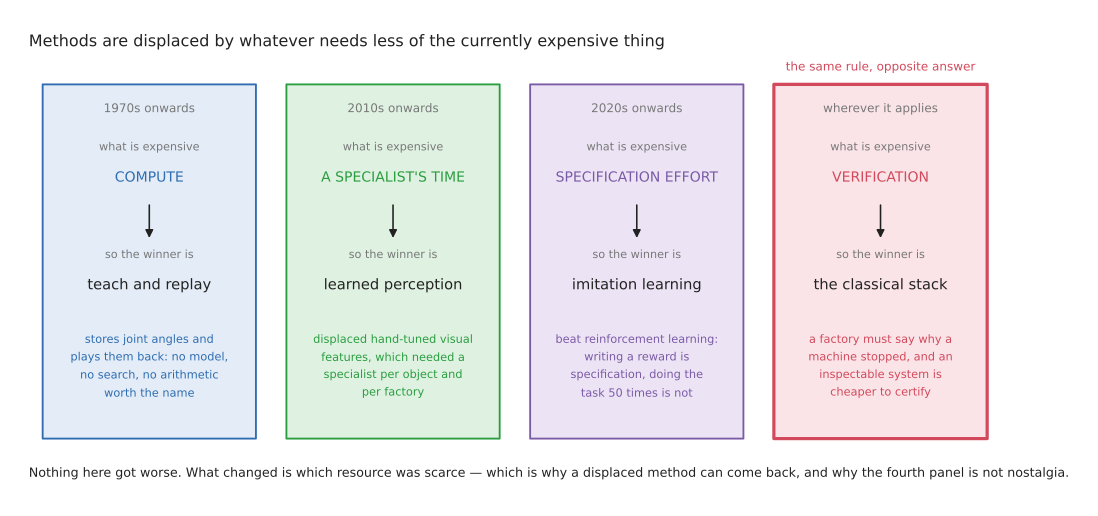
Three eras make the point clearly enough.
When compute was the expensive thing, the methods that won were the ones that computed almost nothing at all. Teach-and-replay simply stores a list of joint angles and plays them back, needing no model of the robot, no search through possible paths, and no arithmetic worth the name. That is why it won in the 1970s, and — this is the part people tend to find surprising — it is also why it has never gone away. Its cost profile is unbeatable, and nothing that has happened since has made it any worse at what it does.
When hand-written perception was the bottleneck, the thing that had become expensive was a specialist's time. Hand-designed visual features had to be tuned by a computer-vision engineer for each object, for each lighting condition, and for each factory they were installed in. Learned perception needed a great deal of data instead, and no specialist, and by the middle of the 2010s data had become the cheaper of those two things. That is the entire reason bin picking of mixed items turned from a research problem into a product. It was not that the networks were clever. It was that the engineering cost per object fell to roughly zero.
Now the expensive thing is human specification effort — somebody sitting down and writing out what the robot should do, in a form precise enough for a machine to execute. Every current shift points in the same direction: away from methods where a person has to describe the behaviour, and towards methods where the behaviour comes out of examples instead. This is why imitation learning beat reinforcement learning for arms, despite being the theoretically weaker of the two. Writing a reward function is specification work, and doing the task fifty times yourself is not.
There is a corollary here that keeps you honest, and it is worth stating plainly. A method that needs less of what is expensive can still be worse in every other respect and win anyway. And in the places where verification is the expensive thing — a factory that has to certify in advance what a machine will do — the classical methods are still winning, because an inspectable system costs far less to verify than a learned one. That is not nostalgia on anyone's part. It is the same mechanism producing the opposite answer under a different cost structure, and it is why the deployed systems look nothing like the papers.
2. The five forces driving 2026#
Five specific pressures are doing the work at the moment, and each of them predicts several of the individual changes described further down.
The first force is that data is the binding constraint, and everybody knows it. The single most sobering result anywhere in this repository is that ALOHA Unleashed collected 26,241 demonstrations — roughly a hundred times the original ALOHA's fifty per task — and did not end up with higher success rates than the original. That is a scaling curve flattening out in public view. If more data of the same kind does not help, then the field has to go and find different data, and that single pressure explains four separate directions at once: learning from ordinary human video, data-generation tools that multiply demonstrations, cheap hardware that lets far more people collect data in the first place, and world models that learn from video with no action labels at all.
The second force is that pretrained perception made generalisation purchasable. You can now download a model that segments objects it has never seen, and another that estimates their pose without having been trained on them. The consequence of that is structural rather than incremental: the part of a robot system that used to require bespoke engineering for every customer turned into a dependency you install. That is what turned modular learned-perception pipelines into the most deployed use of machine learning on arms, and it is why that rather unglamorous family keeps winning against end-to-end approaches.
The third force is consolidation into one maintained home, and it is badly underappreciated — it explains more apparently dead repositories than any technical argument does. A research repository exists in order to support a paper, and once the paper is published the incentive to maintain the code largely disappears. What changed recently is that LeRobot became a single maintained library with a shared dataset format, so the methods moved there and the original repositories went quiet. Those methods are not dead. Their homes changed. Reading a dormant star count as a verdict on a technique is the most common mistake people make in this area.
The fourth force is verification pressure, and it is why adoption is so uneven. A factory has to be able to say why a machine stopped. A method that cannot explain itself therefore carries a verification cost that is often larger than the engineering effort it saves. This force runs against the other four, and it is the reason the timeline below shows classical methods persisting for decades alongside learned ones that are only a few years old. Expect it to be the slowest-moving of the five, and expect regulation such as the EU Machinery Regulation coming in January 2027 to strengthen it rather than weaken it.
The fifth force is that the shape of available compute changed. Massively parallel graphics cards made two things possible that had not been before. The first was simulating thousands of robots at once, which is what made reinforcement learning in simulation practical at all. The second is quieter and arguably more useful: solving motion plans fast enough to replan continuously rather than planning once and executing. A planner that replans fifty times a second is not simply a faster planner — it is a reactive controller, which is a different capability altogether.
3. What has clearly been superseded, and why#
Before working through the individual cases, here is the shape of the whole field on a single axis: roughly when each method became common, and which ones are now on the way out. The long blue bars are the point of the picture, because several of the oldest methods are still entirely current, which is exactly what section 1 predicts.
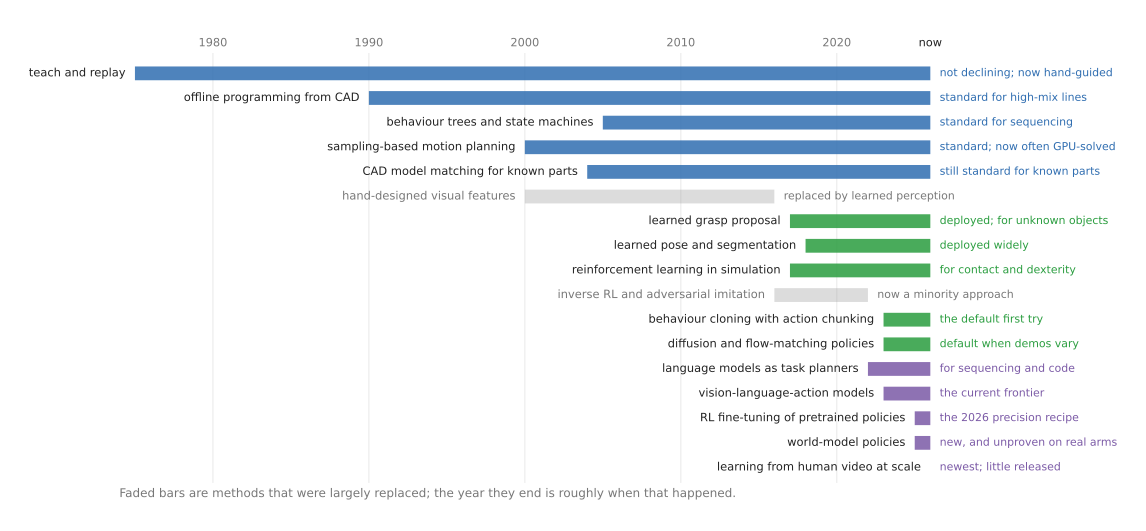
Everything in this section has either an explicit deprecation notice or an archived repository behind it. In each case the reason is the part worth remembering, because the reasons generalise and the specific names do not.
Isaac Gym gave way to Isaac Lab. NVIDIA's own page says that Isaac Gym "is no longer supported", and its example repository has been archived. The reason is not that anything was wrong with it. Isaac Gym was a standalone research prototype, and NVIDIA consolidated its simulation work onto the Isaac Sim platform so that a single physics and rendering stack could serve both research and product. This was a consolidation rather than a capability gap. If you meet a tutorial that uses Isaac Gym, it is out of date.
D4RL gave way to Minari. The offline reinforcement-learning benchmark suite was formally deprecated, and the reason is the same consolidation force again: the Farama Foundation took over maintenance of the scattered reinforcement-learning ecosystem and rebuilt the dataset format properly. The benchmarks did not become wrong. They became unmaintained, and then somebody responsible adopted them.
OpenAI Gym gave way to Gymnasium. Same story, same foundation, and the single most common stale import you will find in old tutorials.
SERL gave way to HIL-SERL, and this one was deprecated by its own authors. It is the most informative deprecation in the list, because unlike the others it is a genuine capability jump rather than a maintenance move. SERL did reinforcement learning on a real robot. HIL-SERL added human intervention, meaning that a person takes over when the robot is about to fail, and those take-overs then become the learning signal. That one change took the method from working on some tasks to 100% success on every task it was tried on, within one to two and a half hours of training on the real robot. When authors deprecate their own work, it is worth believing them.
RT-1 was archived and RT-2 was never released at all. The reason here is not technical: Google's robotics work moved into a closed product line. This is a pattern worth naming rather than a one-off, because the frontier of this field is increasingly announced rather than released, which is why separating announced from downloadable has become a core skill.
ROS 1 gave way to ROS 2, with ROS 1 reaching end of life in May 2025. This was a genuine architectural rewrite, bringing real-time support, security, and a middleware that works properly across multiple machines. The cost of that rewrite has been real, though: several industrial vendor drivers never made the transition, and there is still no maintained open-source ROS 2 driver for FANUC or Motoman, which is a live gap rather than an oversight.
Hand-designed visual features gave way to learned perception, which is simply the second force arriving a decade early. The features were the bottleneck, and they needed a specialist for every deployment.
PyBullet gave way to MuJoCo, and PyBullet now has an enormous tutorial legacy and roughly one commit a year. This one is almost pure licensing history rather than anything technical. MuJoCo was commercial software with a paid licence until DeepMind acquired it in 2021 and open-sourced it in 2022. PyBullet's main advantage had always been that it was free, so the moment the better simulator was also free, the reason to choose PyBullet evaporated. Nothing about PyBullet got worse.
The one everybody gets wrong#
CAD model matching was not replaced by learned grasping. It was replaced for mixed and unknown items only. If you know the part you are picking, the industry still matches its model, and the major 3D-vision vendors describe their products in exactly those terms.
The reason comes down to what each method hands back to you. When you match a CAD model against a depth picture, what you get is the object's full position and orientation — where it sits along three axes, and how it is turned about each of them, which together are called its six degrees of freedom. But you also get something less obvious and considerably more useful: a number describing how closely the model actually fitted the measured points. That number is a self-check. If the fit is poor the number is large, and the system can stop and say so rather than picking up something it has misunderstood.
A learned grasp proposer hands back something different. It gives you a ranked list of places where the gripper could close, each with a confidence score attached to it. A confidence score is the network's own opinion about its own answer, and a network that is wrong is quite often confidently wrong, which makes that score a much weaker guarantee than a measured geometric fit. Under verification pressure — the fourth force — the answer you can check wins over the answer that generalises better.
Both methods are entirely current in 2026, and which one you use is decided by whether the object is in your catalogue, not by which one is more modern.
4. What is quietly fading rather than deprecated#
Nothing in this section carries a deprecation notice. Each of these is simply not being developed any more, and the reason differs from case to case in ways that matter for whether you should still use it.
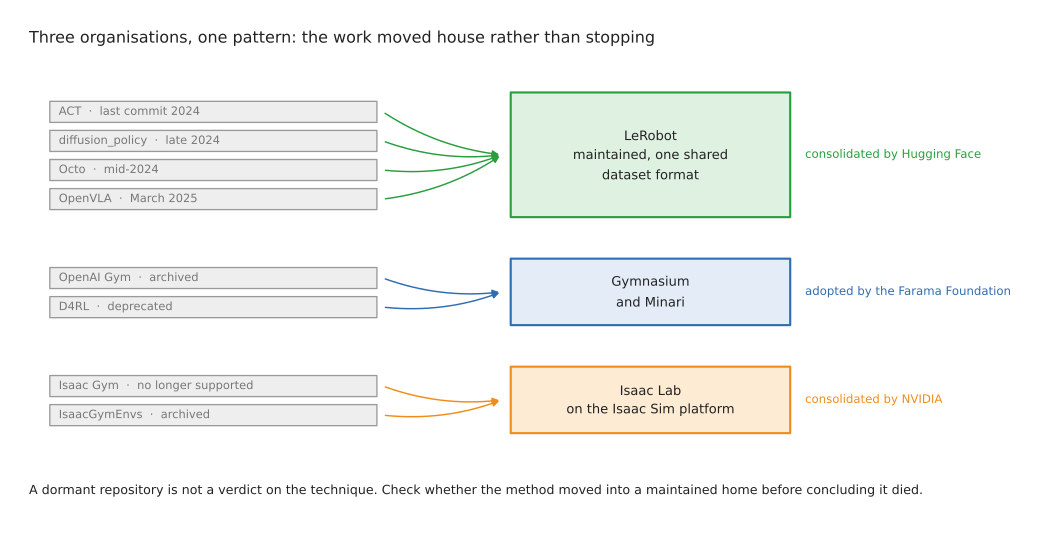
The imitation-learning originals. ACT has had no commits since 2024, diffusion_policy since late 2024, Octo since mid-2024, and OpenVLA since March 2025. The reason in every one of those cases is the third force, consolidation: the methods themselves are alive and maintained inside LeRobot. Use LeRobot's versions and treat the originals as historical references. OpenVLA is the interesting case among them, because it is still the most-downloaded robotics model and the baseline in most papers, and yet it is absent from LeRobot's policy list entirely. It is a reference point rather than a foundation.
The classical grasping repositories.
Contact-GraspNet has not been touched
since 2024 and depends on a long-dead generation of TensorFlow;
GraspNet-1Billion is most valuable now as a dataset rather
than as code; and Dex-Net along with its gqcnn implementation have been dead since
2022. The reason here is different from the one above and the distinction is worth
drawing. The research line moved on, to diffusion models that generate grasps, of
which NVIDIA's GraspGen is the current
example. Meanwhile the commercial line moved closed: AnyGrasp has real traction and
ships as a licence-gated binary, and it is not open source despite appearing to be.
Treat this whole corner as concepts and datasets rather than as code to build on.
Inverse reinforcement learning and adversarial imitation. The flagship library imitation has had no commits since January 2025. The generality of the approach is real, and so is its fragility, and the preference-learning branch of the work found a better home tuning language models instead. Surveys still treat the family as live, so calling it declining is fairer than calling it dead — but do not expect to meet it inside a working arm system.
Task and motion planning. PDDLStream last committed in 2023. It is the most capable purely-programmed approach there is for long tasks, and it also demands the most before it will do anything, because somebody has to write a symbolic model of the domain. Industry uses behaviour trees instead, for the straightforward reason that a tree is free to write, and the research energy moved to language models doing the same sequencing job with far less modelling effort.
Industrial ROS glue. The ROS-Industrial vendor drivers for FANUC, Motoman, ABB
and KUKA are all dormant ROS 1 code. moveit_calibration, which most tutorials still
recommend, has had no commits in a year, so use
industrial_calibration or
OpenCV's hand-eye function directly instead. The reason in this case is the least
satisfying in the whole document and the most commonly encountered: this is
unglamorous maintenance work with no paper attached to it and no vendor obliged to
do it.
5. What is not moving at all, and why that matters#
A document about change ought to say what has not changed, because that list is where the durable skills are.
Force control. The mathematics of impedance and admittance control has been settled for decades, and it is still the answer to contact-rich assembly. The reason nothing has displaced it is simply that the physics did not change and the theory was already correct. Every major vendor sells this as a product. A learned policy that outputs positions still needs this underneath it, which means that learning to do it well has a longer shelf life than anything in section 6.
Behaviour trees. Still standard for sequencing, and the only competitor is a language model choosing which subtree to invoke — with the tree still underneath, doing the actual running. Nothing has beaten them at being inspectable while remaining readable at fifty branches.
Teach and replay, which is growing rather than shrinking. Collaborative-robot hand-guiding made it easier rather than obsolete: you guide the torch along the seam and press start. That amounts to more teaching being done by less specialised people, which is a cost structure moving in the right direction rather than the wrong one.
Motion planning. Healthy and standard, and the only axis on which it is moving is speed.
Calibration. Still the unglamorous thing that decides whether a cell works at all, still mostly hand-rolled, and still what separates a demonstration from a deployment.
Four of those five sit in the programmed family, and all five are things you can learn once and then use for a decade. Section 6 below is where the excitement is. This section is where the compound interest is.
6. What is arriving now, and what it can actually do#
Each of the following says what the new capability lets you do that the previous generation could not, and then why it emerged, which in every case is one of the five forces. Treat the whole section as a weather report rather than a forecast: several of these will not survive contact with real deployments.
Reinforcement learning as polish, not as training#
This is the most important arrival of the year, and the learned-methods document explains how it works. What belongs here is why it appeared and why you should believe it.
It appeared because demonstrations and practice fail in exactly complementary ways. Demonstrations give you the shape of a task cheaply but not the last few percent of reliability. Practice cannot find the shape on its own, because a coordinated behaviour is almost never stumbled upon by chance, but it polishes beautifully once the shape is already there. Pair them and each covers the other's weakness.
You should believe it because nobody designed the pairing. It was discovered independently by four separate groups in a single year, on four unrelated tasks: laundry and box assembly, shoe-lacing, precision insertion, and a garment-folding competition. Convergence like that is the strongest evidence this document contains, and it is a better reason to trust a method than any single headline result.
Flow matching, and an honest doubt about it#
Flow matching is now the action-generating component inside essentially every large policy, and it too is explained in the learned-methods document. It is listed here for a different reason: it is the clearest example in the field of something that everybody adopted before anybody justified it.
A 2026 study called MINERVA found that flow matching gave no detectable advantage over plain regression on its benchmarks, while being several times slower to run. That does not make it wrong. It makes it an open question that the field has stopped asking, which is worth noticing, because a method can spread through a field on elegance and convenience rather than on measured benefit.
World models#
These learn to predict what will happen next and then act through that prediction, which — and this is the crucial part — means they can learn from data that has no action labels attached to it at all, such as ordinary video.
The reason is the first force. If robot demonstrations are the binding constraint, and collecting more of them has stopped helping, then the way out is to learn from data that is not robot demonstrations. Video is abundant; action-labelled robot episodes are not.
They are now a first-class category in LeRobot and have not yet been proven on production arms. Worth watching, but not worth betting on.
Learning from human video, and recording without a robot#
This uses people doing tasks as training data. The scaling behaviour looks promising, almost nothing has been released, and so the honest status is "interesting" rather than anything stronger.
The reason is the same data constraint taken to its logical conclusion, and the numbers make the motivation obvious. Open X-Embodiment, the famous pooled corpus, contains about 2.4 million robot episodes, set against an effectively unlimited supply of video showing humans manipulating things.
The practical spin-off from this research is more immediately interesting than the research itself. Grabette (Apache-2.0, €490) is a handheld recorder — cameras, an inertial sensor and a gripper encoder — that you hold in your own hand while doing the task, with browser-based reconstruction producing six-degree-of-freedom trajectories in LeRobot format. Its ancestor is UMI. What this means in practice is that you can collect training data before owning a robot at all, which removes the single most common blocker for somebody trying to learn this.
Verification at run time#
Instead of trusting the policy's first answer, this generates several candidate actions and checks them before acting on any of them. At least one 2026 result claims that scaling up the checking beats scaling up the policy.
The reason is the first force again, approached from a different angle. If a hundred times the data buys no improvement, then spending compute at run time rather than at training time is the obvious remaining lever, and there is a suggestive precedent in how much language models gained from reasoning at test time. It also sits well alongside the fourth force, because a system that checks its own candidates is a system that can explain why it rejected one.
Data generation as a first-class tool#
This turns a handful of demonstrations into thousands, by re-composing them around wherever the objects happen to be, and then trains on the result.
It is the purest expression of the first force, and it involves a rather pleasing inversion: programming is being used to manufacture the data that training needs. The classical stack earns its keep by generating exactly what the learned stack is short of.
The open tools are MimicGen and its two-arm successor DexMimicGen, both of which are research-only under NVIDIA's licence, so check carefully before building anything commercial on them.
Small models for cheap hardware#
This gives you a pretrained vision-language-action policy that you can actually fine-tune and run on consumer hardware, rather than one that needs more memory than a consumer card has.
The reason it exists is that a community with tens of thousands of shared datasets and hundred-dollar arms needed a model sized for it, and the large policies are not. This is democratisation arriving as a technical requirement rather than as a slogan.
The open tool is SmolVLA, which sits inside LeRobot and was trained on community data. For anyone learning on a cheap arm, it is the realistic entry point to the whole vision-language-action family.
Tactile foundation models#
These aim at a single model that works across many different touch sensors, rather than one model per sensor type.
The reason is that touch data has always been locked to the specific geometry and physics of one sensor, so nobody could pool it — which is exactly the fragmentation that pretrained vision models escaped a decade ago. Whether touch has enough shared structure for the same trick to work is genuinely unknown at this point.
7. How to tell a real shift from a fashion#
Five questions, arranged roughly in order of how much signal each one carries.
Did the authors deprecate their own previous work? This is the strongest signal there is, because researchers do not willingly retire their own contributions. SERL giving way to HIL-SERL is the model case.
Did independent groups converge on the same shape of solution? Four different groups arriving at demonstrate-then-polish, on four different tasks, within a single year, is worth considerably more than any one impressive result.
Is there a checkpoint you can download, or only a paper? Several of 2026's most impressive models have no released code and no released weights. Read about them by all means, but do not plan on using them. Checking this before anything else will save you more time than any other habit in this list.
Did the benchmark move, or only the leaderboard? A new number on an old benchmark is incremental progress. A new benchmark, or a paper that reports success rates per stage rather than as a single total, usually signals that the field has noticed it was measuring the wrong thing.
Does the new thing need less of what is currently expensive? This is the mechanism from section 1. If a method is better but needs more demonstrations, more specification or more verification, it will lose to a worse method that needs less of those things — and you are better off planning for that than being surprised by it.
There is also one anti-signal worth holding on to. A dormant repository proves nothing by itself. Check whether the method moved into a maintained home before concluding that it died.
8. What this means for what you learn#
Learn the things in section 5 first. Force control, behaviour trees, motion planning and calibration have not changed in a decade and will not change much in the next one, and they are also what people are actually paid to do.
Within the learned family, learn the loop rather than the architecture. Collect data, train, evaluate, work out what failed, then collect more of whatever failed. The architecture will be different in eighteen months. The loop will not. This is also why the cheap hardware matters more than it appears to, because going round that loop once will teach you things that no paper can.
Assume that the specific model names in section 6 will be wrong within a year, and that the reasons behind them will not be. If you remember one thing from this document, make it the question rather than any of the answers: what does this need less of?
Back to the overview, or on to the programmed methods and the learned methods. For what changes when two arms have to cooperate, see the two-arm folder.