This page is about 3D maps that carry meaning. In a plain point cloud each point only says where a surface is. In a 3D feature map, each point also says what kind of thing it is part of. That means the arm can ask in words where the handle of the mug is, and get back a place in 3D. So the page answers three questions. Where does the meaning come from, and how does it get into 3D? And when is a map like this worth building, instead of simply asking an image model about the latest photo?
It is for a reader who has read the chapter overview and scene reconstruction. It also helps to have read open-vocabulary models, because this page uses the same image models, such as CLIP. The page explains what it needs from them.
Contents#
- What it is
- What goes in and what comes out
- How it works inside
- How it is trained
- Well-known models · 5.1 F3RM · 5.2 LERF · 5.3 ConceptFusion · 5.4 ConceptGraphs · 5.5 GraspSplats · 5.6 OpenScene · 5.7 How to choose
- Where this is going
- Where to read next
1. What it is#
Since the introduction promised a map that carries meaning, this section says what that means exactly. A 3D feature map is a 3D map in which every point stores a list of numbers describing what the point is part of. That means the map can be searched by meaning rather than by position.
For example, a floor plan of a shop shows where the walls and shelves are, which is like a plain point cloud. Now write a label on every shelf, such as "milk", "bread" and "soap". You can then find the bread by reading the labels, without knowing its position in advance. A 3D feature map does the same for the space around a robot arm, except that its labels are lists of numbers rather than words. That lets it answer questions in words nobody wrote down in advance, such as "something to drink from".
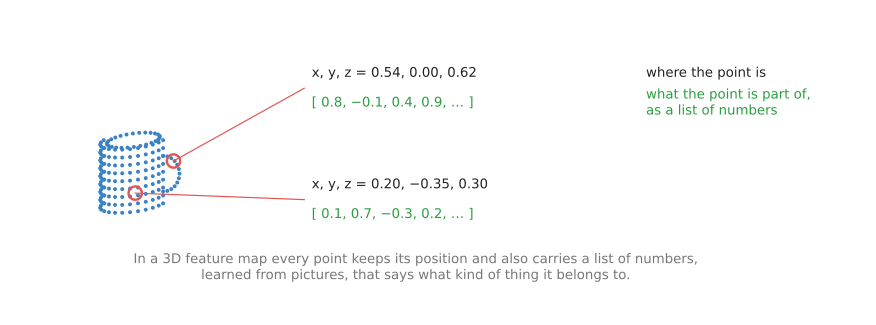
Each circled point has its x, y and z, and also a list of numbers that says what
kind of thing it belongs to.
A list of numbers like this is called a feature, which is where the page gets its name, and a real feature has a few hundred numbers in it. Two points on similar things, such as two mug handles, have similar lists. But two points on different things, such as a handle and a table, have very different lists.
2. What goes in and what comes out#
A feature map is built once and then asked many times, so the two halves are worth separating. To build the map, three things go in.
- Photos of the scene from several places.
- The camera pose for each photo, and usually a depth picture too. On an arm with a wrist camera, the joint readings give the poses, as on the scene reconstruction page.
- An image model that has already been trained, such as CLIP or DINO, because the map borrows all of its meaning from that model.
What comes out is the map itself, which is a point cloud, or a fitted scene like a NeRF, where every point has its feature.
To use the map, only one thing goes in, and that is a question, usually a few words such as "the handle" or "the red cup". What comes out is a score for every point, which says how well that point matches the words. The arm then takes the points with the highest scores as its answer.
3. How it works inside#
Step 1: a list of numbers for every pixel#
All the meaning in the map comes from an image model, and two kinds of image model are common.
CLIP, short for contrastive language–image pretraining, is a model with two parts. One part turns a picture into a list of numbers, while the other part turns some words into a list of numbers of the same length. It was trained so that a picture and a sentence describing it get similar lists, which is why a photo of a mug and the word "mug" end up close together. The open-vocabulary models page explains this in more detail.
DINO is instead an image model that learned from photos alone, with no words. Its lists are very good at saying that two pixels are on the same kind of part, such as two mug handles. But it cannot compare those lists with words.
CLIP gives one list for a whole picture, while a map needs one list for every pixel. So the map builder has two choices. It either uses a version of the model made to give a list for each small patch of the picture, or it runs the model on many small crops of the photo and gives each pixel the lists of the crops it falls in. F3RM takes the first route and ConceptFusion takes the second, cutting the crops out with a segmentation model. F3RM can also use DINO's lists in place of CLIP's, and section 5.1 says how.
Step 2: lift the lists into 3D#
Now that every pixel of every photo has a list, the next step puts those lists onto points in 3D.
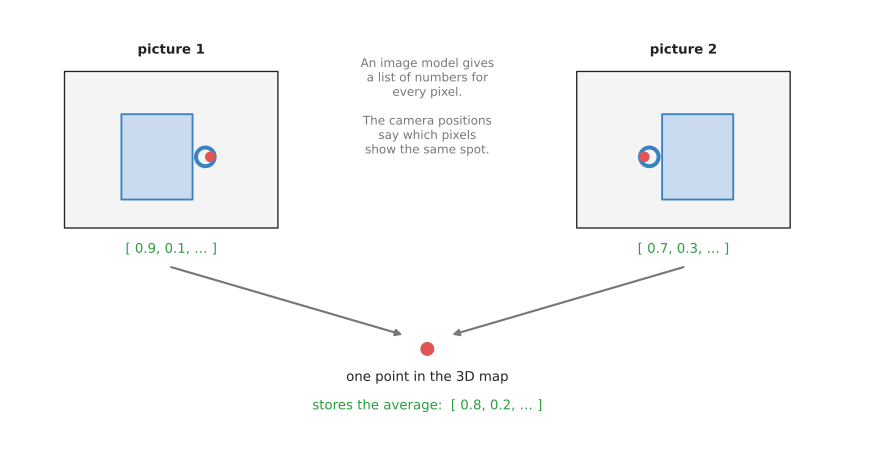
The same spot on the handle shows up in both photos, so the map stores one point for it, with the average of its two lists.
There are two ways to do this, and the first is fusion, which works directly on point clouds.
- Use the depth picture to turn each pixel into a 3D point, as for any point cloud.
- Give that point the pixel's own list.
- When the same spot shows up in another photo, average the new list with the old one.
Averaging helps because the image model makes small mistakes that differ from photo to photo, which means the average over many views is steadier than any single view. ConceptFusion in section 5.3 is the plainest example of this route, and OpenScene in section 5.6 does the same to a finished room scan.
Fusion does not have to end with one list per point. ConceptGraphs, which section 5.4 recommends for anything larger than a table, merges the points of each object it finds and keeps a single list for that whole object, together with a note of where the object sits relative to the others. A room then holds a few hundred lists rather than a few hundred thousand.
The second way is a feature field, and it works like a NeRF from the scene reconstruction page. A NeRF answers what colour any spot is, while a feature field also answers what list of numbers that spot has. It is fitted in the same way, because the program draws the lists from a camera pose, compares them with the image model's lists for the real photo, and then adjusts. Copying what one model knows into another model in this way is called distillation. LERF in section 5.2 is where this route became well known, and F3RM in section 5.1 is the version built for a robot arm.
A feature field does not have to be built on a NeRF. The same scene reconstruction page describes 3D Gaussians, which store a scene as many soft coloured blobs and fit much faster than a NeRF, and a blob can carry a list of numbers just as a point can. GraspSplats in section 5.5 builds its map that way, which is why section 5.7 points to it for scenes the robot keeps changing.
Step 3: ask with words#
Once the map holds its lists, the software does three things to ask a question.
- Give the words, such as "handle", to the text part of CLIP, which gives back one list.
- Compare that list with the list of every point in the map, which gives one number per point. That number is high when the two lists are alike.
- Colour the points by that number, or simply keep the points that score highest.
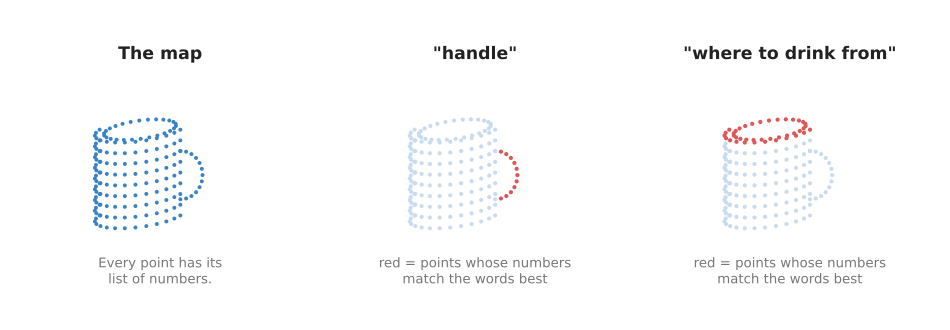
The same map answers "handle" with the handle and "where to drink from" with the rim, and nobody labelled either part in advance.
The map was built only once, so after that each new question is quick, because it is only one comparison per point.
4. How it is trained#
Because the meaning is borrowed, most 3D feature maps need no new training of their own, and all the learning sits in the image model they borrow from.
That image model was trained long before, on a huge collection of pictures. CLIP was trained on about 400 million pictures with captions, collected from the internet, and no robot data was involved at all. So the map builder simply uses what CLIP already learned.
The map itself is then built for one scene, in one of the two ways in section 3. Fusion needs no fitting at all, because it only averages, while a feature field is fitted like a NeRF, which takes seconds to minutes on a graphics card.
So there are three stages in all, and only the first is training in the usual sense.
- Train the image model once, on internet pictures, although someone else has usually done this already.
- Build the map for this scene.
- Ask as many questions of it as you like.
5. Well-known models#
This section names the systems that build a 3D feature map and let you ask it questions, and it says plainly which of them you can install. Only one is published as a package. The rest are repositories that came with a paper, and one of them cannot legally be used in a product at all.
The table below has two columns. The left column names the system and says how current it is. The right column holds everything else about it: how it stores the map, what it is best at, which image model it borrows its meaning from, its licence, how you obtain it, and when to pick it.
Read the licence and the install together in each row, because those two decide whether a system is a candidate for your work. These systems hold almost no numbers of their own, since the meaning comes from an image model somebody else trained, so each row names that image model instead of giving a parameter count. Every licence was read from the project's own licence file.
| System | What decides it |
|---|---|
| F3RM, most used in 2026 for arms | This system stores the map as a feature field, fitted like a NeRF, and it is the best here at grasping a named object or part with a robot arm. It keeps no weights of its own and uses the CLIP ViT-L/14@336px image model, the licence is MIT, and you install it with pip install f3rm or clone the repository. Pick it when you have an arm, a wrist camera and an NVIDIA graphics card. |
| LERF, historical | This system stores the map as a feature field as well, fitted like a NeRF, and it is best at looking at a scene and seeing what matches a word. It uses CLIP ViT-B/16, or ViT-L/14 in its lerf-big size, the licence is MIT, and you clone it and install it as a Nerfstudio method. Pick it when you want to see the idea working, with no robot. |
| ConceptFusion, historical | This system keeps one feature per point, fused as the camera moves, and it is best at asking with words, a click or a sound. It uses OpenCLIP with the Segment Anything Model for the masks, the licence is MIT, and you clone it along with a branch of another library. Pick it when you want the fusion route and no fitting. |
| ConceptGraphs, most used in 2026 for rooms | This system keeps one feature per object, plus a record of their relations, and it is best at whole rooms and at questions about which object is where. It uses OpenCLIP with a detector and the Segment Anything Model, the licence is MIT, and you clone it, which is the longest install here. Pick it when the scene is a room and relations matter. |
| GraspSplats, worth betting on | This system stores the map as 3D Gaussians carrying part-level features, and it is best at re-fitting a scene fast and at following objects that move. Its size is not stated, because the features come from the feature splatting code. It has no licence file and it needs research-only code, so pick it when you are doing research and not shipping. |
| OpenScene, historical | This system keeps one feature per point of a finished room scan, and it is best at naming every point of a scanned room. It uses OpenSeg or LSeg pixel features, the licence is Apache-2.0, and you clone it, after which a pre-trained 3D model downloads itself. Pick it when you have a room scan and want it labelled. |
5.1 F3RM#
F3RM is most used in 2026 for robot arms, because it is the only system here that is published as an installable package and comes with the robot side of the problem already written.
Size not stated, because it trains no weights of its own; a big card, or a small one if you fit the field without the viewer; MIT for the code, with OpenAI's CLIP weights underneath.
F3RM stands for Feature Fields for Robotic Manipulation. William Shen, Ge Yang and four colleagues at MIT published it at the Conference on Robot Learning in 2023 (paper, code, package). It fits a feature field, as section 3 described, and then adds the part a robot needs. From a few demonstrated grasps it searches for the gripper position and rotation whose surroundings carry the features the demonstrations had, and you can also ask in words which object to pick.
The one idea F3RM is built on is that a grasp can be described by what the space around the gripper means. The field answers, for any place in the scene, both what colour that place is and what list of numbers belongs to it. So a gripper pose can be turned into a set of places: a fixed pattern of sample points attached to the gripper's own body, which move wherever the gripper moves. Read the field at those places and you have a description of what this particular grip would be holding, written in the image model's numbers rather than in geometry.
That is what the robot half of the system does. You demonstrate a grasp a few times, and for each demonstration the sample points are put where that pose put them, the field's lists at those places are read, and they are strung together into one long list. The demonstrations' long lists are averaged into a single description of the task. At run time the search runs the other way. It first throws away the parts of the scene whose lists sit closer to words you said you did not want than to the words you asked for, then tries many rotations at the places that survived, and then adjusts position and rotation with an optimiser until the lists read at the sample points match the task description as closely as they can. What comes out is a full pose, three numbers of position and three of rotation.
The difference from LERF, which section 5.2 covers and which F3RM is built on, is almost entirely in that second half. LERF keeps the same kind of meaning in the same kind of field and stops: you type a word and the matching part of the scene lights up. Nothing in it turns a lit-up region into a place to put fingers, because a region has no direction, and a gripper that does not know which way to turn its wrist cannot grasp. The two also fill their fields differently. F3RM takes dense features from CLIP in one pass, using what the paper calls the MaskCLIP reparameterisation, a way of reading a list out of CLIP's last layer for each patch of the photo instead of one list for the photo, while keeping those lists comparable with words. LERF instead cuts crops at many sizes and learns a field whose answer depends on the size you ask about.
What the field costs is that nothing can be asked of it until it has been fitted. The scene has to be photographed first, the fit has to run, and the answer describes the scene as it was when the photos were taken, which is what GraspSplats in section 5.5 exists to fix. Where the design pays off on an arm is on parts rather than objects. Asking for "the mug" returns a cloud of matching places, and any grasp inside that cloud counts as a hit, which is no help when only one approach works, such as a full mug that has to be lifted by its handle. Two demonstrations of hooking a finger through a handle give a task description that scores one approach direction above all the others, so the search returns a wrist angle and not a region.
The obvious alternative is LERF, which F3RM is built on and which is better known. You would pick F3RM because of that pose search, as LERF stops at showing you a heat map and leaves every robot question to you. F3RM also distils DINO features as an alternative to CLIP with one command-line flag, and DINO is the better of the two at telling parts apart.
What it costs you is a pinned software stack. The README states that the code is tested on Nerfstudio 0.3.3 and 0.3.4 only, and that pin is what most often goes wrong, so follow the repository's own conda recipe rather than installing on top of an environment you already have.
Fitting a field is one command, and the package also exposes the per-patch feature step on its own, which is what you need to build your own map.
# Install the CUDA steps from the README first; this then adds Nerfstudio and F3RM.
pip install f3rm
ns-train f3rm --data <folder of photos with known camera poses>
import torch

from f3rm.features import clip
from f3rm.features.clip import tokenize
from f3rm.features.clip_extract import CLIPArgs, extract_clip_features

device = torch.device("cuda")

# One list of numbers per patch of each photo, not one per photo.
patches = extract_clip_features(["frame_1.png", "frame_2.png"], device)
patches /= patches.norm(dim=-1, keepdim=True)

model, _ = clip.load(CLIPArgs.model_name, device=device)   # ViT-L/14@336px
words = model.encode_text(tokenize("the handle of a mug").to(device))
words /= words.norm(dim=-1, keepdim=True)

scores = patches @ words.T        # one score for every patch of every photo
print(scores.shape)
The library gives you dense patch features, and it skips CLIP's usual centre crop so that
the whole photo is covered. What you still supply is the camera poses, the depth, and the
step that turns patch scores into a place in 3D, unless you let ns-train f3rm fit the
field and do that for you.
5.2 LERF#
LERF is historical. It is the system the feature field idea became well known through, and the one to read before F3RM.
Size not stated, because it trains no weights of its own; a big card, with a lerf-lite
size for a small one; MIT for the code, with OpenAI's CLIP weights underneath.
LERF stands for Language Embedded Radiance Fields. Justin Kerr, Chung Min Kim, Ken Goldberg, Angjoo Kanazawa and Matthew Tancik at the University of California, Berkeley published it at the International Conference on Computer Vision in 2023 (paper, code). It adds a language field beside the colour field of a NeRF, so you type a word in the viewer and the matching part of the scene lights up. An earlier system, CLIP-Fields, had already fitted a CLIP-style field as a robot's memory of a room (paper), and its licence is MIT as well.
LERF is built on one idea about a mismatch. CLIP describes a whole picture at once, and it was never trained to describe a single pixel. So asking CLIP what one point in space means is asking it a question it cannot answer. LERF's reply to that is to stop asking about points. Its field answers about a volume: you give it a place and also a size, and it gives back the list of numbers for a region of that size around that place.
Inside, the size is carried through everything. Before the fit, the program cuts every photo into crops at many sizes and stores CLIP's list for each crop, which gives an image pyramid. During the fit, a sample taken along a ray through a pixel asks the field at a size worked out from how far along the ray that sample sits, and the answer is compared with the pyramid's list at the same size, interpolated between the nearest crops. The colour side of the NeRF is unchanged and is fitted alongside it. A second borrowed model, DINO, is fitted as well, not to answer any question but to steady the language field, because the authors found that without it the match maps came out patchy where a part of the scene had few views or did not stand out from its background.
What the extra size dimension buys is that one field answers both "the kitchen counter" and "the salt grinder on it", and the paper is explicit that this needs no region proposals and no masks. That is the contrast with ConceptFusion in section 5.3, which has to cut each photo into regions before it can describe anything, and with F3RM in section 5.1, which reads one list per patch at a single fixed size. What the size dimension costs is that every answer now depends on a number most people do not think to set: ask at too large a size and a small object is answered by the shelf it is standing on.
On an arm, the honest comparison is at the two ends of that size range. A tray of small parts photographed from across the cell is the case where being able to ask at a small size matters, and a question about the whole workbench is the case where being able to ask at a large one does. Everything after the answer, though, is still yours: the field gives a score for each place and no pose, which is why this page sends you to F3RM as soon as there is a gripper involved.
You would run LERF rather than F3RM when there is no robot in the picture, because it is
the simpler of the two to install and it ships three sizes: lerf, lerf-lite for small
graphics cards, and lerf-big, which uses the larger CLIP image model.
What it costs you is the same Nerfstudio stack as F3RM, and one surprise that wastes an afternoon. The viewer shows raw match scores, and the README says values below 0.5 are already irrelevant, so you must set the range to -1 to 1 or turn normalisation on before the pictures mean anything.
git clone https://github.com/kerrj/lerf && cd lerf
python -m pip install -e . && ns-install-cli
ns-train lerf --data <folder of photos with known camera poses>
You supply the photos and their poses, which Nerfstudio can work out from the photos themselves. LERF gives back a fitted scene and a viewer, and nothing that a robot can act on.
5.3 ConceptFusion#
ConceptFusion is historical, and it is the clearest example of the fusion route from section 3.
Size not stated, because it trains nothing at all; no memory figure is published, and you need a card for CLIP and the Segment Anything Model; MIT for the code.
Krishna Murthy Jatavallabhula and sixteen colleagues published it at Robotics: Science and Systems in 2023 (paper, code). It cuts each photo into regions, gives each region a CLIP feature, spreads those features back over the pixels, and fuses them into one point cloud as the camera moves. Because the question and the map meet in CLIP's numbers, you can ask with words, by clicking a point, or with a sound.
ConceptFusion answers the same mismatch LERF answers, in the opposite way. If CLIP can only describe a whole picture, then give it whole pictures. Cut the photo into regions, hand each region to CLIP on its own as though that region were a picture of its own, and you have one list per region instead of one list per photo. Every pixel then takes the list of the region it fell inside.
The regions come from the Segment Anything Model, which proposes masks without being told what to look for. A region's own list describes the region in isolation, which throws away the rest of the scene, so the system also takes one list for the whole photo and mixes the two together, and the paper's claim for that mixing is that it needs no training and no fine-tuning of anything. Then comes the step the method is named after. Each pixel has a depth, so it is already a 3D point; the point takes the pixel's list; and when a later photo sees the same spot, the stored list and the new one are combined, in the same pass in which ordinary mapping software combines the geometry. Nothing is fitted and nothing learns.
Against a feature field that is a different bargain. F3RM and LERF interpolate, so their fields answer at places no camera ever measured, which is useful and is also a guess. ConceptFusion holds a list only where a pixel landed, and its map is usable while the camera is still moving, because there is no fit to wait for. The cost is that the answer is only as fine as the regions. A mug is likely to be one mask, so every point of the mug carries nearly the same list and the handle is never described separately, which is precisely what a field asked at a small size can do.
Because the question and the map meet inside CLIP's numbers, the question does not have to be words, and this is the one entry on the page where that is true. There are versions of CLIP that put sounds into lists of the same kind, and a photo was always in the same space to begin with. On an arm that is worth having when the thing you want has no good name: one particular bracket in a tray of similar brackets is far easier to point at, or to show a picture of, than to describe in a sentence.
The obvious alternative is a feature field such as F3RM. Fusion wins when you cannot wait for a fit, because the map is ready as the camera moves and every point in it was measured rather than interpolated. The reason it is marked historical is that its own authors moved on: ConceptGraphs, below, is by many of the same people and is the one still being maintained.
What it costs you is an install made of other people's branches, and a repository that says so. The README states that the released code departs from the paper, since it uses the Segment Anything Model instead of Mask2Former for the regions and drops the uniqueness term the paper describes. It needs a specific branch of the gradslam library, and your data has to be in that library's dataset format, which is the real work.
# This branch of gradslam fuses features; the main branch cannot.
git clone https://github.com/gradslam/gradslam
cd gradslam && git checkout conceptfusion && pip install -e . && cd ..

git clone https://github.com/concept-fusion/concept-fusion
cd concept-fusion/examples
python extract_conceptfusion_features.py     # regions from SAM, then CLIP per region
python run_feature_fusion_and_save_map.py    # fuses them into saved-map/
You supply the photos, the poses, the depth, and a dataset class if your recording is not one the library already reads. The two scripts give back a point cloud where every point carries a feature.
5.4 ConceptGraphs#
ConceptGraphs is most used in 2026 for anything larger than a table, because keeping one feature per object instead of one per point is what makes a whole room affordable.
Size not stated, because it trains nothing of its own; no memory figure is published, and you need a card for the detector, the Segment Anything Model and CLIP; MIT for the code.
Qiao Gu, Ali Kuwajerwala, Sacha Morin and thirteen colleagues published it in 2023 (paper, code). A detector and the Segment Anything Model cut each photo into objects, the objects are matched across photos and merged into one three-dimensional object each, and each object keeps one CLIP feature and a note of how it sits relative to the others. A language model can then read that record and answer questions about position.
The one idea here is about what to keep. A map with a list of numbers on every point stores nearly the same list hundreds of times over, because every point of the mug is on the mug. So keep one list per object instead, and keep a note of how the objects sit relative to one another. What you get is a graph, which is the word for a set of things with connections between them: the objects are its nodes and the relations are its edges.
Building that graph inverts the order of the fusion route. ConceptFusion in the section above fuses first and names nothing, so its map is a cloud of points that happen to carry meaning. ConceptGraphs cuts each photo into objects first, gives each object its CLIP list and its own small cloud of points, and then does the work the other route never has to do: deciding whether the object in this photo and the object in that photo are the same object, merging the two when they are and starting a new node when they are not. Once the nodes exist, a model that writes words describes each one, and a language model reads those descriptions together with the nodes' positions and writes the edges, such as one object being on top of another.
What the graph buys is a map a language model can read. A few hundred lines of objects and relations fit inside a prompt, and a few hundred thousand points carrying a few hundred numbers each do not, which is why this is the route taken for a request such as "put the thing from the chair onto the table". What it costs is everything below the level of the object, as the paragraph after this one puts in terms of the mug's handle. The merging step also has thresholds that decide whether two views of a mug become one node or two, and those are numbers you have to set against your own recordings rather than defaults you can trust.
On an arm the line falls between finding and grasping. If the request is "fetch the bottle from the second shelf", the useful work is deciding which blob is a bottle and which shelf it is standing on, and a graph answers that in a form a planner can act on directly. If the request is "hold the pan by the handle", the graph has nothing to say and F3RM's field does.
The obvious alternative is a dense map such as ConceptFusion or OpenScene. ConceptGraphs wins on memory and on relations, because a room becomes a few hundred objects rather than a few hundred thousand points carrying a few hundred numbers each. It loses where parts matter, since a mug is one object in the graph and its handle is not in it at all, which is what F3RM is for.
What it costs you is the longest install on this page: a detector, the Segment Anything
Model, a pinned gradslam, PyTorch3D and the faiss search library, on Python 3.10. The
deeper cost is that the map holds only what the detector found, so an object it missed is
not in the graph and no wording of the question will find it. The repository's ali-dev
branch holds a newer real-time version that reads recordings from an iPhone.
# First, detect and segment the objects in every frame of one scene.
python scripts/generate_gsa_results.py --dataset_root $REPLICA_ROOT \
    --dataset_config $REPLICA_CONFIG_PATH --scene_id room0 --class_set none --stride 5

# Then build the object map from those detections.
python slam/cfslam_pipeline_batch.py dataset_root=$REPLICA_ROOT \
    dataset_config=$REPLICA_CONFIG_PATH scene_id=room0 stride=5 \
    gsa_variant=none class_agnostic=True skip_bg=True sim_threshold=1.2 dbscan_eps=0.1
You supply a recording in one of the dataset formats it reads, and the thresholds, which decide whether two views of a mug become one object or two. It gives back a file of objects with their features, their point clouds and their relations.
5.5 GraspSplats#
GraspSplats is worth betting on, because fitting a scene as 3D Gaussians is far faster than fitting a NeRF, and speed is what a map needs when the robot keeps moving things. The simulation chapter in Book 3 describes the same shift for reconstruction in general.
Size not stated, because the features come from the feature splatting code it builds on; CUDA 11.8 and no published memory figure; no licence file at all, over research-only code.
Mazeyu Ji, Ri-Zhao Qiu, Xueyan Zou and Xiaolong Wang at the University of California, San Diego published it in 2024 (paper). It fits a scene as 3D Gaussians that carry features, so it can answer questions about parts and not only about whole objects, and it then follows the Gaussians of an object as that object moves, so the map does not go out of date the moment the arm touches something.
The idea GraspSplats is built on is that the features should live on pieces you can move. A NeRF is a function fitted to a scene, so the scene exists only as the weights of a network, and there is no part of it you can take hold of and call "the mug". 3D Gaussians are the opposite. The scene is a pile of soft blobs, each with a position of its own, and a blob is a thing you can point at, delete or shift. Give every blob a list of numbers and you have the same open-ended meaning a feature field has, kept on movable pieces instead of inside a function.
The rest follows from that. The blobs are fitted from photos with the depth camera's measurements used to steer the geometry, rather than leaving the geometry to the photos alone, which is part of why the fit finishes in a fraction of the time a NeRF takes. The features come from a vision-language model and are attached to the blobs finely enough that a question can name a part and not only an object. And when something moves, nothing is re-fitted: point trackers follow the object and that object's blobs are moved to where it went, which also covers an object whose parts move relative to each other, such as a drawer or a pair of scissors.
So what this buys over F3RM is the two things F3RM structurally cannot do, a scene cheap enough to re-fit and a map that survives the arm touching something, and both come from the same property, that the scene is made of pieces with positions rather than a function with weights. On an arm the difference shows on the second grasp, not the first. A field fitted before the arm moved describes the scene before the arm moved, so once the mug has been picked up and put down the map still has it in its old place and the next question returns a stale answer. Either you photograph the cell and fit again, which with a NeRF is a pause you can feel, or your map carries the mug to where the mug now is.
The obvious alternative is F3RM, which is easier to install. You would choose this line of work for the two things F3RM cannot do: re-fit a changed scene quickly, and keep up with objects that move.
What it costs you is a licence problem that no amount of engineering fixes. The repository contains no licence file at all, so no rights are granted to anyone, and it builds on a fork of Inria's Gaussian-splatting code, whose licence allows research and evaluation only and requires Inria's written consent for commercial use. LangSplat, the best-known general-purpose version of the same idea, carries that same Inria licence. Treat all of this as reading and experiment, and check the licence of every submodule before anything ships.
# The feature splatting it depends on, at the branch GraspSplats needs.
git clone --recursive https://github.com/vuer-ai/feature-splatting-inria.git
cd feature-splatting-inria && git checkout roger/graspsplats_part
pip install -e submodules/diff-gaussian-rasterization    # compiled against CUDA 11.8
pip install -e submodules/simple-knn
You supply photos of the scene, a graphics card with CUDA 11.8, and the calibration between the camera and the arm. The GraspSplats repository itself holds the robot side, including the tracking of objects that move.
5.6 OpenScene#
OpenScene is historical on this page, but it is still the easiest way to see open-vocabulary 3D labelling without owning a robot.
Size not stated, although this is the one system here that trains a 3D network of its own; a laptop for the interactive demo, and a card with no published figure for the full run; Apache-2.0 for the code.
Songyou Peng, Kyle Genova and four colleagues published it in 2022 (paper, code). It takes a finished room scan, gives every point of it a feature copied from a pixel-level image model, and then trains a 3D network to predict those features from geometry alone, so at question time no photos are needed.
The idea behind that is one no other system on this page tries: a point's meaning can be predicted from its shape alone. Every other entry here needs the photos at question time, or needs them to have been present when the map was built and keeps only what they said. OpenScene uses the photos once, to teach a 3D network what the lists ought to look like, and then has no further use for them.
The first half is the fusion route again with a different image model. A pixel-level model, OpenSeg or LSeg rather than plain CLIP, gives a list for every pixel. Each surface point of a finished room scan is projected into the frames that saw it, and the lists from those frames are averaged into one list for that point. The second half is the new part. A 3D network is trained on the bare points, with no colour and no photos, to produce the list the fusion produced for each point, and the target is only that its list should point the same way as the fused one. After training it reads a plain point cloud and outputs lists in CLIP's space for it, so a scan with no photos attached can still be asked questions.
The two halves then disagree in a useful way, and the repository keeps both. The paper found the fused 2D lists better on small objects, because a small thing is clear in a photo and ambiguous in geometry, and the 3D network better on objects with a distinctive shape, because a shape is unmistakable even where the photo of it was blurred or badly lit. The ensemble option takes, for each point, whichever of the two lists responds more strongly to the words being asked. No other system here can make that choice, because the others have only one source of meaning to begin with.
On an arm this is usually the wrong tool, and it is worth saying why rather than only that. It expects a finished scan of a building-sized space, and it labels points instead of proposing grasps or following things that move. The situation where it wins is the one where the photos are gone: a scan handed to you as bare geometry, or a laser scan with no usable colour, is something only a distilled 3D network can answer questions about, and F3RM, ConceptFusion and ConceptGraphs would all have nothing to start from.
The obvious alternative is ConceptFusion, which fuses features as the camera moves. OpenScene is the better choice when you already have a room scan and want every point labelled, and it is the worse choice on a robot, because it expects whole-building datasets rather than a wrist camera's view of a table.
What it costs you is the shape of its data. The evaluation runs on room-scan datasets, so putting your own recording through it is a day of conversion, and its pixel features come from OpenSeg or LSeg rather than plain CLIP, which is one more model to obtain. The repository has an interactive demo that the README says needs no graphics card at all.
# Downloads a pre-trained 3D model and labels every point of a scanned scene.
sh run/eval.sh out/replica_openseg config/replica/ours_openseg_pretrained.yaml ensemble
You supply the processed scan and the fused 2D features, both of which the repository documents how to obtain. It gives back a labelled point cloud and, with one option changed, the per-point features as a NumPy file you can query yourself.
5.7 How to choose#
For a robot arm on a table, start with F3RM, because it is installable, it was built for exactly that case, and it answers questions about parts of objects as well as whole ones.
Three things change that choice. If the scene is a whole room and the questions are about which object is where, use ConceptGraphs, and accept that it knows objects rather than parts. If the arm keeps moving things and you are doing research rather than shipping a product, follow the feature splatting line that GraspSplats belongs to, after reading the Inria licence. If you already have a finished room scan and only want every point labelled, use OpenScene.
Two of these are worth skipping unless you are reading rather than building. LERF teaches the idea and leaves the robot work to you, and ConceptFusion has been overtaken by ConceptGraphs from the same authors.
Whatever you choose, remember that a map records what the camera saw on the day it was built, so the first question to answer is how often your scene changes.
6. Where this is going#
This section is about the next few years of maps that carry meaning. It was written on 4 October 2026, and every link in it was checked on that day. It sorts claims the way Book 3's frontier chapter does in its section on four kinds of claim. A demonstration is a recording of something working once, under conditions the publisher chose. A product announcement says that a thing can be bought or downloaded, which you can go and check. A research result is a measured number on a stated task. A projection is a statement about a date that has not arrived, and it is the weakest kind. Where a sentence below is my own judgement rather than a report of somebody else's claim, it says so.
How it got here#
The first maps of this kind were a function fitted to a scene, so asking one a question meant reading values out of a network's weights. The work since has gone in two directions, both about making the map usable by something else. One replaced the fitted function with a pile of blobs that have positions, as section 5.5 describes, because a blob can be moved and a function cannot. The other threw most of the per-point lists away and kept a small graph of objects and relations, as section 5.4 describes, because a graph is something a language model can read. The second of those decides what these maps are for.
Where it is used in industry today#
No product sells a 3D feature map, and I could not find a robot whose documentation advertises one. There are three things you can download, one of them with a robot you can order.
NVIDIA's nvblox is a graphics-card reconstruction library under the Apache 2.0 licence, and its documentation includes an example of deep feature reconstruction that shows "how to integrate foundation-model features into an nvblox reconstruction", using an image model called AM-RADIO to produce the features. It gets features into a real-time reconstruction, which is the hard engineering. It does not let you ask the map anything in words; the features are only shown by squeezing each list to three numbers and colouring the mesh. So the hard half of a 3D feature map ships in a vendor-supported library today and the question-asking half does not.
NVIDIA's research code goes one step further. mindmap is described by its authors as "a 3D diffusion policy that generates robot trajectories based on a semantic 3D reconstruction of the environment", with code in the same GitHub organisation, built on nvblox. Read its licence before planning anything around it. It is the NVIDIA License, whose section 3.3 says the work "only may be used or intended for use non-commercially", and defines that as "for research or evaluation purposes only". The paper's claim is also weaker than it sounds: it says the approach "is effective at solving tasks where state-of-the-art approaches without memory mechanisms struggle", in simulation, with no success rate in the abstract.
The one case that matches this section's title is
stretch_ai from Hello Robot, mostly under
the Apache 2.0 licence, which runs on Stretch, a mobile manipulator you can order; the
company's Stretch 4 page says "Stretch 4 is
available now!". Its open-vocabulary mobile manipulation
app uses "vision
models such as siglip to generate online semantic memory", takes its instructions from a
language model that writes code, and keeps the memory current from a modified
slam_toolbox pose graph. That is a language-queryable map sitting between a planner
and a scene, on hardware with a price. The nearest research equivalent is
OK-Robot, which reports "a 58.5% success rate in
open-ended pick-and-drop tasks" across "10 real-world home environments", rising to 82
per cent in cleaner settings, with source code under the MIT licence. Those are research
results, and the most honest numbers this idea has.
What is being worked on right now#
The first front is making the map something a planner can read rather than something you query a point at a time. OP3DSG, from June 2026, builds graphs that "jointly model objects, interactive parts, spatial relations, functional relations, and affordances", and uses a language model to prune relations the geometry does not support. Its complaint about the existing work is worth remembering: those systems "remain object-centric and encode limited relational information". That is the gap between what a feature map returns, a place in 3D, and what a planner needs, which is which object, which part, and how they are arranged.
The second front is keeping the map current without running a large model on every frame. TRACKGRAPH, from September 2026, computes masks and CLIP features only at occasional keyframes and carries the masks between them with cheaper dense features, then fuses them into a hierarchical scene graph, measured on the Replica, ScanNet++ and HM3D scan datasets. GaussLite, from June 2026, goes further and lets the question shape the map: given a task such as "prepare to pick up the object on the desk", a language model extracts the target and anchor objects once, and the mapper then spends its detail on those and not on the rest of the room. Both reject the assumption this page is built on, that you build the map first and ask afterwards.
The third front treats the map as memory for a policy rather than as something a person queries. The mindmap work above is one example. GaussMemory, from August 2026, is the clearer statement of it, learning "which objects to track precisely, how aggressively to update them, and what to discard, all learned end-to-end without hand-designed rules". PA3FF, from February 2026, pushes the same idea towards parts, with a dense 3D feature field aimed at the handles and knobs of articulated objects, on the argument that 2D features lifted into 3D are slow, inconsistent between views and too coarse.
The fourth front is the honest competitor to everything on this page: a vision-language model that answers questions about the picture in front of it, with no map. Book 3's frontier chapter covers this under Gemini Robotics 2 and ER 2. Gemini Robotics ER 2 arrived on 30 July 2026 and is in public preview through Google AI Studio and the Gemini application programming interface, which makes it a product announcement you can check in an afternoon. MolmoAct2, from 4 May 2026, is the open counterpart, with Apache-2.0 code. Against that, every system on this page is code you must install and a map you must keep current.
What is still unsolved#
The map still goes stale, which is where section 5.7 ends. TRACKGRAPH and GaussMemory are papers rather than releases, nvblox reconstructs features but its documentation shows no way to ask it anything, and stretch_ai's real-time update is a flag over a modified SLAM package. I could not find any published measurement of how wrong a map's answers become after an arm has been working in a scene for an hour.
The features also do not hold relations. "The mug behind the box" and "the cup that is not the red one" are not nearest-neighbour searches in CLIP's space, because CLIP was trained to match a picture with a caption and not to count, compare or negate. SaaF, from July 2026, names two symptoms of this in the splat-based language fields it compares against: "reduced discriminability among similar objects due to feature compression", and "poor handling of ambiguous queries". I did not find a 3D feature map that reports answering a negation correctly, and the move to graphs in the first front above is largely an admission of this.
The evaluation measures the wrong thing for a robot arm. Replica, ScanNet++ and HM3D are scanned buildings, and the score is whether the right region was retrieved for a phrase. A map that names the mug correctly and puts it two centimetres from where it is counts as a success there and as a failed grasp on your arm.
Licensing remains a real barrier. Section 5.5 covers the Inria terms that the splatting line inherits and the missing licence file in GraspSplats, and mindmap adds NVIDIA's non-commercial terms to the list. Three of the most interesting systems here cannot be shipped by anybody but their authors.
The next two to three years#
Five expectations follow, each with its reason, because the reason is the part worth reading. All five are my own judgement unless a sentence says otherwise.
I expect maps built on 3D Gaussians to displace maps built on fitted fields. The reason is the one section 5.5 gives, that a scene made of pieces with positions can be re-fitted quickly and can be carried when an object moves, and both of those are what a map on a working robot needs. The 2026 papers above are nearly all splat-based, and Book 3's frontier chapter reports splatting as the method that made rebuilding a room from photographs practical at all. This is a direction rather than an announcement, and no vendor has committed to it.
I expect the per-point feature map to shrink into a graph of objects and parts carrying a few attributes each, queried by a language model. The reason is that the consumer decides the format. The thing asking the question is now a planner that reads and writes text, as language models as planners describes, and a graph of fifty objects fits inside a prompt while a million points with several hundred numbers each does not. OP3DSG and ConceptGraphs are already that shape, and SaaF's finding about compression says the per-point route pays for its size by losing the ability to tell similar objects apart.
I expect the map's job to narrow to memory, meaning what is not in view right now. The reason is that for anything the camera can currently see, one pass of a vision-language model gives a fresher answer than any stored map, and that model is a service you can call today while the map is code you must build and maintain. Both mindmap and GaussMemory already describe their contribution as memory rather than as querying.
I expect the reconstruction half to arrive in vendor libraries before the question-asking half does, and nvblox is most of the way there already. The reason is where the engineering difficulty sits: reconstructing a scene on a graphics card at camera rate, carrying a list of numbers per voxel, and exposing all of it through ROS 2 is the hard part, and it is Apache-2.0 today, while a text query over features that are already in the map is a small addition. NVIDIA has announced nothing of the kind, so this is a projection of mine with no date behind it.
What I do not expect is an agreed format for these maps. The reason is that nobody agrees what belongs in one: whose features, per point or per object, with parts or without, with relations or without. A format gets standardised after that argument ends, and the argument is currently getting livelier rather than quieter.#
7. Where to read next#
- Open-vocabulary models explains CLIP, Grounding DINO and SAM, which are the image models these maps borrow from.
- Scene reconstruction explains the NeRF fitting that feature fields build on.
- Language models as planners shows how a language model breaks a request such as "tidy the table" into steps, each of which can be a question to a map like this.
- Foundation models in Book 3 covers the large models that link words, pictures and arm movements in one network.
- Go back to the chapter overview to see how this page fits with the other three.