This page is about the simplest kind of grasp model, which looks at one picture taken from above and draws rectangles on that picture. Each rectangle says where the two jaws of a gripper should close. The gripper then comes straight down and closes there.
So the page answers these questions, one section at a time. What does such a model take in, and what does it give back? How does it work inside, and what was it trained on? Which real models do this, and when is this kind the right choice rather than the wrong one?
It is for a reader who has read the grasp models overview, and who already knows what a pixel is and what a depth picture is. Both of those are covered by the camera basics page in Book 2. The page inside a neural network explains the convolutional layers that this kind of model is built from.
Contents#
- What it is
- What goes in and what comes out
- How it works inside
- How it is trained
- Well-known models
- Where this is going
- Where to read next
1. What it is#
Since the introduction called this the simplest kind of grasp model, this section says what it actually produces. A top-down grasp detector draws grasp rectangles on a picture taken from above, and nothing else.
Imagine you look down at a table from a ladder, where you see a mug from the top as a ring with a handle sticking out. Someone asks you to show where to pinch the mug with a pair of tongs. So you draw a short line across the mug, with a mark at each end where the tongs touch. That drawing is all a top-down grasp detector gives. It draws that kind of mark on the picture, many times over, and gives each one a score.
The word detection is borrowed from object detection, because the two jobs have the same shape. An object detector finds objects in a picture and draws a box around each one. That means a grasp detector finds grasps in a picture and draws a rectangle for each one, in exactly the same way.
2. What goes in and what comes out#
Now that the answer is a rectangle, it is worth being exact about the numbers on each side. The input is one depth picture taken by a camera that looks straight down. Each pixel of a depth picture holds a distance from the camera rather than a colour. Because a tall object is close to the camera, its pixels hold small numbers, while the table is further away and its pixels hold larger numbers. Some models also take the ordinary colour picture, but many use depth alone.
The output is a list of grasp rectangles, where a grasp rectangle is a rectangle drawn on the picture with a jaw at each short end. Each rectangle therefore carries three pieces of information about the grasp.
- The centre: the pixel where the middle of the gripper should go, as an
xand ayon the picture. - The angle: how far the gripper should turn around the up-down line before it closes.
- The opening width: how far apart the jaws should be just before they close.
That is four numbers in all, because the centre is two of them: x, y, angle and
width. A fifth number, how far down the gripper should go, is read from the depth
picture at the centre pixel. The direction the gripper comes from is not a number
at all, since it is always straight down, along the line the camera looks.
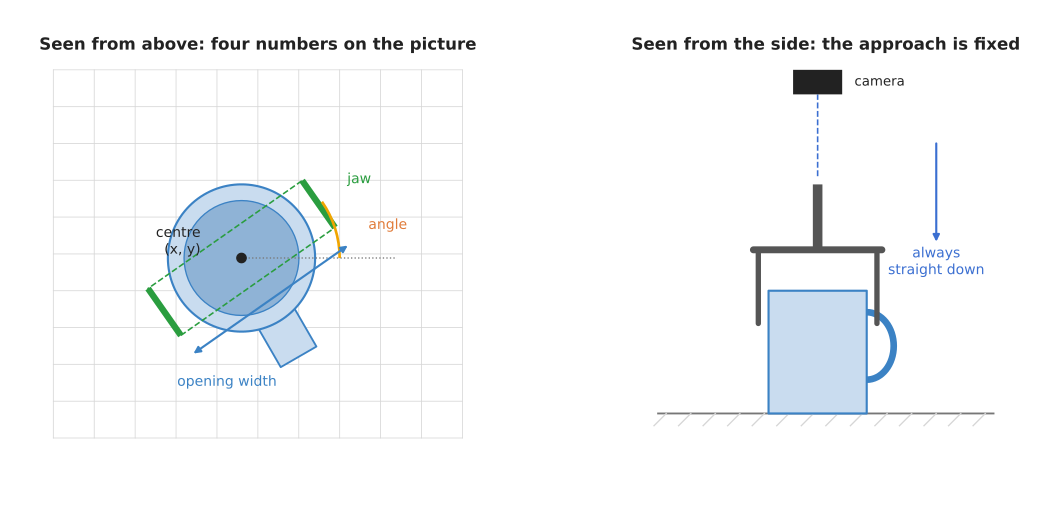
On the left are the four numbers drawn on a picture of a mug. On the right is the same grasp seen from the side, where the camera looks down and the gripper comes down along the same line.
Most models also give a score for each rectangle, which is a number between 0 and 1. A high score means the model thinks a grasp there is likely to hold. So the robot usually tries the rectangle with the highest score.
3. How it works inside#
Since the last section described the rectangles that come out, this section describes how they are produced. There are two main ways to build this kind of model, and one variation on the newer of the two. The older way finds one rectangle for the whole picture, while the newer way paints an answer onto every pixel instead. The variation scores a grasp at every pixel rather than painting one. Every model named below is also in section 5, which says which of them to use.
One rectangle per picture#
The earliest models of the older way looked at many small patches of the picture, one at a time, and asked a network "is there a good grasp here?" This was slow, because the picture has thousands of patches. Lenz, Lee and Saxena's patch classifier worked that way, and section 5.5 describes it. A later model looked at the whole picture once and gave back the four numbers of one rectangle directly, which was Redmon and Angelova's detector in section 5.4. That was fast, but it could only give one grasp per picture. Both models are named here because they are the clearest way to see where this kind came from, and section 5 marks both of them as historical rather than as models to install.
A map for every pixel#
Instead of one answer per picture, the newer way gives an answer for every pixel at once, and it works in three steps.
- The depth picture goes into a convolutional neural network (CNN), which is a network built from small pattern detectors that slide across the picture. The inside a neural network page explains how they work.
- The network gives back three new pictures, each the same size as the input, and
these are called maps.
- The quality map holds, for each pixel, how good a grasp centred on that pixel would be.
- The angle map holds, for each pixel, which way the jaws should close.
- The width map holds, for each pixel, how far the jaws should open.
- A short piece of ordinary code finds the pixel with the highest quality and then reads the angle and the width at that same pixel. Those three values, plus the pixel's own position, are the grasp.
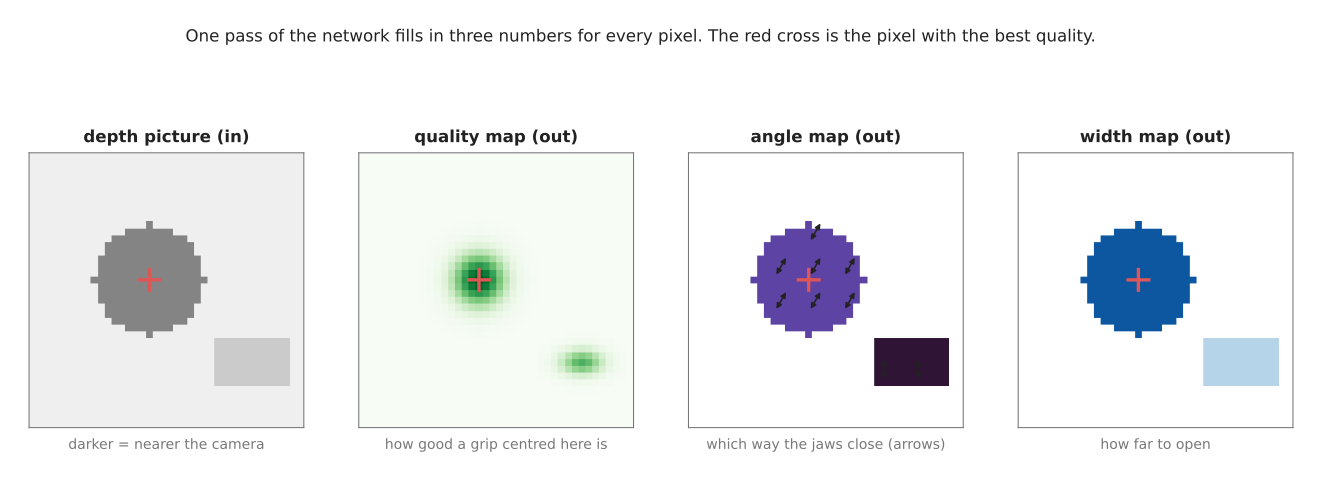
The network fills in a quality, an angle and a width for every pixel in one pass, and the red cross marks the best pixel, which is in the middle of the mug.
It is worth being exact about what an answer for every pixel means, because it is the idea this whole family turns on. A 300 by 300 depth picture has 90,000 pixels. The quality map is a picture of the same size, so it holds 90,000 numbers, one for every pixel of the input, and the number at a pixel answers one question: how well would a grasp centred on this pixel hold? The angle map and the width map hold 90,000 numbers each, in the same way. Nothing inside the network chooses a grasp. The network fills in the whole table of answers, and ordinary code reads the largest one afterwards.
That is also why the search disappeared. The patch classifier searched because it could answer only one question per run, so covering 90,000 possible centres meant running it 90,000 times, and the patches it cut out overlapped almost completely, so nearly all of that work was the same work done again. A convolutional network does the overlapping work once. Its small pattern detectors slide across the whole picture, and what they compute at one place is reused by every answer that needs it, so one pass fills every cell of all three maps. The search was not replaced by a cleverer search. It was removed by arranging for every candidate's answer to come out of the same pass.
Because the network generates a grasp for every pixel rather than checking grasps one at a time, this design is called generative. Its big advantage is speed, since one pass through a small network gives every possible grasp in the picture. A model this fast can run again while the arm is moving, so the grasp can follow an object that is pushed or slides. GG-CNN and GR-ConvNet are both built this way, and section 5.1 and section 5.2 recommend them.
A score for every pixel, and a height as well#
This variation starts from a scorer rather than from a map painter. A small network that gives one proposed grasp a score can be run as a convolution over the whole depth picture, and then one pass scores a grasp at every fourth pixel and at each of 16 different gripper heights. The answer is the best pixel, angle and height together, rather than a height read out of the depth picture afterwards. FC-GQ-CNN works this way, and section 5.3 says when to choose it. The scorer it is built from is a kind of model in its own right, and the grasp quality models page describes that kind.
4. How it is trained#
Because the maps described above are not obvious from the picture alone, the model has to learn them from pictures in which people or programs have already marked good grasps.
A grasp dataset here is a set of depth pictures, each with a list of good grasp rectangles drawn on it. During training the network sees a picture, paints its three maps, and is told how far its maps are from the marked rectangles. Then it changes its weights a little to be less wrong next time, and the how a model learns page explains this loop in full. Since those marked rectangles have to come from somewhere, two datasets are used more often than any others.
- The Cornell grasping dataset has under a thousand pictures of about 240 everyday objects, and people drew the good and bad rectangles by hand. It is small, but most early models were tested on it.
- The Jacquard dataset has more than 50,000 pictures of about 11,000 objects. The pictures were made in a simulator, and the grasps were tested in the simulator too, so no person drew them at all.
These datasets are small compared with the ones that other kinds of model use. That is possible because the task itself is narrow, since the network only has to learn which shapes in a depth picture two jaws can close around and nothing more.
To make the data go further, the pictures are turned, shifted and cropped during training. This is because a mug turned by 30 degrees is still a mug, and its good grasps turn with it. Reusing one picture many times in this way is called data augmentation.
5. Well-known models#
So far this page has described the method. This section names the models that implement it, so that you can choose one and start work instead of reading five papers first. The last sub-section is a short rule for choosing, and a reader in a hurry can read only that.
Read the table one row at a time. The left column names the model, the year it was published and how current it is. The right column holds everything else: what the model is best at, how many weights it has, the licence on its code, and the one condition that should make you choose that row rather than another. The weights are counted because that number decides whether the model runs on a computer with no graphics card. Each licence is the licence on the code, and Book 3's models that grasp read every one of them from the project's own licence file in September 2026.
| Model | What decides it |
|---|---|
| GG-CNN (2018), most used in 2026 | It is best at running many times a second on a small computer. It has 62,420 weights, and its code licence is BSD-3-Clause. Pick it when the arm has to keep looking while it reaches. |
| GR-ConvNet (2020), most used in 2026 when depth is not enough | It is best at reading colour and depth together. It has 1,900,900 weights, and its code licence is BSD-3-Clause. Pick it when a depth camera alone sees your objects badly. |
| FC-GQ-CNN (2019), historical | It is best at choosing the gripper's height as well as the pixel. Its size in weights is not stated, and its code licence is a University of California Regents grant for education, research and not-for-profit use only. Pick it when you are doing research and want the sampler and the search as well as the network. |
| Redmon and Angelova's detector (2015), historical | It is best at nothing you would use today. Its size in weights is not stated and its licence is not stated. Never pick it, and read the paper instead to see where the single-pass idea came from. |
| Lenz, Lee and Saxena's detector (2015), historical | It is best at nothing you would use today. Its size in weights is not stated and its licence is not stated. Never pick it, and read the paper instead to see what the first deep version cost. |
The two 2015 rows are in the table because this page would be dishonest without them, not because you should install them.
5.1 GG-CNN, the small network that can run on every frame#
Most used in 2026 of the models on this page, because it is the smallest of them, its licence lets you sell what you build, and it installs from ordinary Python packages with no compiled extensions.
Size xs, a laptop, BSD-3-Clause.
GG-CNN is the generative grasping convolutional neural network. Douglas Morrison, Peter Corke and Jürgen Leitner published it at the Robotics: Science and Systems conference in 2018, in a paper called Closing the Loop for Robotic Grasping. It takes one 300 by 300 depth picture and paints the quality, the angle and the width maps that section 3 described. The repository also holds a second and slightly larger version called GG-CNN2.
The one idea GG-CNN is built on is that a grasp should be read off the picture rather than searched for. The paper calls it a one-to-one mapping from the depth picture to the grasp: every pixel of the input has its own cell in each output map, and no candidate grasp is ever proposed, scored or thrown away.
Inside, the network is six layers and nothing else. Three convolutions shrink the picture, with strides of 3, 2 and 2, so by the middle of the network the picture is twelve times smaller in each direction. Three transposed convolutions then grow it back to the size it came in at, a transposed convolution being the growing twin of a convolution: where one turns several neighbouring pixels into one, the other turns one pixel into several. Four small output layers read the last grown picture. One gives the quality map, one the width map, and the other two give the angle, because the network does not output an angle at all. It outputs the cosine and the sine of twice the angle. A parallel-jaw grasp looks the same if you turn it by half a turn, so a single angle runs out of range and jumps back to the other end as the jaws turn past that limit, and a network cannot learn a value that jumps, while a cosine and a sine move smoothly all the way round. The code after the network turns the pair back into an angle, and GR-ConvNet in the next sub-section uses the same pair for the same reason. The rest of GG-CNN is as plain as a network gets: the widest layer carries 32 channels, nothing skips from the shrinking half to the growing half, and there is no normalisation anywhere.
What that buys is one pass over a tiny network, which finishes in time for the next camera frame, and that was the problem the paper set out to solve. What it costs is detail. Because the picture in the middle of the network is twelve times smaller and nothing skips past that middle, the maps come back blurred, which is why the library smooths all three maps before it looks for the peak. The deeper cost is that each pixel gets one angle and one width. Where two different grasps would both work at the same centre, the network cannot hold both, and a value trained towards two good angles settles somewhere between them, which is not a good angle at all.
On a robot arm the difference shows up when the object moves. If the gripper nudges the mug on the way in, or the part is on a belt that creeps, GG-CNN can look again on every camera frame and move its target with the object. FC-GQ-CNN in section 5.3 answers a richer question, but it pushes sixteen copies of the picture through its network for one answer, so by the time it replies the mug has moved.
The obvious alternative is GR-ConvNet in the next sub-section, which paints the same three maps from a much larger network. Choose GG-CNN instead when the arm has to keep looking while it reaches. The two models answer the same question in the same form, so the whole of the choice is how much machinery sits between the picture and the answer, and GG-CNN's is small enough to answer again before the camera sends the next frame. The table above gives both weight counts if you want to see how far apart they are.
What it costs you is mostly age. The repository was written for Python 3.6 on Ubuntu 16.04 and was last pushed in July 2020, so the install takes more work than the model does. Nothing in it is a compiled extension, so that install is still possible on a current machine. The thing that most often goes wrong is the depth picture itself, because the network wants one channel of 300 by 300 pixels holding metres, and if you hand it millimetres or a 480 by 640 picture it still answers and the answer means nothing.
GG-CNN is not on the Python package index. You clone the repository and download the released weights, which hold the whole saved model, so no code rebuilds the network. The two imports below name folders inside the clone.
import torch
from models.common import post_process_output              # in the cloned repository
from utils.dataset_processing.grasp import detect_grasps

net = torch.load("ggcnn_weights_cornell/ggcnn_epoch_23_cornell")
net.eval()

with torch.no_grad():
    # depth has shape (1, 1, 300, 300): one 300 by 300 depth picture, in metres
    pos, cos, sin, width = net(depth)

# The network does not output an angle. It outputs the cosine and the sine of twice
# the angle, and this call turns that pair back into an angle. It also smooths all
# three maps, which stops the peak jumping between neighbouring pixels.
q_img, ang_img, width_img = post_process_output(pos, cos, sin, width)

# Finds the peaks of the quality map and reads the angle and the width at each peak.
grasp = detect_grasps(q_img, ang_img, width_img=width_img, no_grasps=1)[0]
print(grasp.center, grasp.angle, grasp.length)   # pixel, radians, opening in pixels
The library gives you the network and the two steps around it that you would
otherwise get wrong, which are the angle arithmetic and the peak finding. What you
have to supply is the cropping and resizing to that exact shape, the conversion from
the winning pixel to a gripper pose in the robot's own frame, and the cut-off on the
quality map. That last one is a real decision, because detect_grasps accepts peaks
above 0.2 by default, and a low cut-off means the model always answers even when
nothing in the picture can be grasped.
5.2 GR-ConvNet, the same three maps from a larger network#
Most used in 2026 when depth alone is not enough, because it is the only model on this page that reads the colour picture as well and still carries a licence you can ship.
Size xs, a laptop, BSD-3-Clause.
GR-ConvNet is the generative residual convolutional neural network. Sulabh Kumra, Shirin Joshi and Ferat Sahin published it in 2020, from the Multi-Agent Bio-Robotics Laboratory at the Rochester Institute of Technology, in a paper called Antipodal Robotic Grasping using Generative Residual Convolutional Neural Network. It paints the same quality, angle and width maps as GG-CNN, from a 224 by 224 input with four channels, which are red, green, blue and depth.
The one idea GR-ConvNet is built on is that the three maps do not have to come from a small network, and that the picture they are painted from does not have to be depth alone. Its paper describes the input as an n-channel picture, which means that the first layer is written to take as many channels as you give it, and the released weights take four.
Inside, it keeps GG-CNN's shape and changes every proportion of it. Its three shrinking convolutions use strides of 1, 2 and 2, so the picture in the middle is four times smaller in each direction rather than twelve. Between the shrinking and the growing halves sit five residual blocks of 128 channels. A residual block is a pair of convolutional layers that adds its own input back to its output, and the addition is what lets a stack this deep train at all, because it gives each block an easy path to pass its input straight through, so the block only has to learn the change it wants to make. Every layer is followed by batch normalisation, which rescales the numbers passing through so that they stay in a useful range, and dropout sits in front of the outputs. Those outputs are the same four maps as GG-CNN's, with the angle arriving as the same cosine and sine pair.
What that buys is detail and colour. Shrinking by four instead of twelve, and putting most of the weights into a middle that never loses more resolution, means the peak of the quality map lands where the grasp is rather than near it. Reading colour means the model can see what depth cannot. What it costs is that the colour has to be there and has to be right. You must give it a colour picture and a depth picture of the same moment, lined up pixel for pixel, which a depth camera does only if you ask it to align its two streams, and a model that learned on one dataset's colours has one more thing about your scene that can be unfamiliar. It is also no longer the model you run on every camera frame without a graphics card.
On a robot arm the difference shows up on anything a depth camera cannot see. A paper label, a plastic lid, a knife or a clear bottle lying on a flat table is, in depth, the table: the distance is the same everywhere, so GG-CNN's quality map has no peak to find. GR-ConvNet also has the colour picture, where the edges of those objects are plain, and it puts a rectangle across them. Turn the scene around, into a bin of identical parts all of one colour, and the colour channels say nothing that depth has not already said, and GG-CNN's speed is the only difference left.
The obvious alternative is GG-CNN. Choose GR-ConvNet instead when a depth camera sees your objects badly, because a flat object lying on a flat table is almost invisible in depth and obvious in colour. Its repository also commits its trained weights into Git rather than attaching them to a release, so they are there as soon as you clone it. Those two differences are the whole case for it.
What it costs you is the install and one mistake about units. It was last pushed in November 2021, so it has the same ageing install as GG-CNN, although its requirements file pins nothing and names no compiled extension. The thing that most often goes wrong is the width map, because the library divides the training widths by 150 and multiplies them back afterwards, so the widths that come out are in pixels of a 224 by 224 crop and not in millimetres of your gripper.
The code below is the shortest path through the repository's own run_offline.py.
import numpy as np
import torch
from PIL import Image

from inference.post_process import post_process_output
from utils.data.camera_data import CameraData
from utils.dataset_processing.grasp import detect_grasps

# The weights are committed in the clone, so there is nothing to download.
net = torch.load("trained-models/cornell-randsplit-rgbd-grconvnet3-drop1-ch32/epoch_19_iou_0.98")
net.eval()

rgb = np.array(Image.open("scene_rgb.png"))
depth = np.expand_dims(np.array(Image.open("scene_depth.tiff")), axis=2)

# CameraData crops both pictures to the centred 224 by 224 square the network
# expects, normalises them, and stacks them into the four channels.
img_data = CameraData(include_depth=True, include_rgb=True)
x, depth_img, rgb_img = img_data.get_data(rgb=rgb, depth=depth)

with torch.no_grad():
    pred = net.predict(x)       # a dict with the keys pos, cos, sin and width

q_img, ang_img, width_img = post_process_output(
    pred["pos"], pred["cos"], pred["sin"], pred["width"])
grasp = detect_grasps(q_img, ang_img, width_img=width_img, no_grasps=1)[0]
The library does the cropping and the normalising for you, which is the part GG-CNN
leaves to you, and CameraData is where you say what size your camera gives. What
you have to supply is a colour picture and a depth picture of the same scene, taken
at the same moment and already lined up pixel for pixel, which a depth camera will
do only if you ask it to align its two streams. Everything after the grasp is the
same work as in the previous sub-section.
5.3 FC-GQ-CNN, the Dex-Net top-down policy#
Historical. It is kept here because it explains how the current models work and because it is the top-down model people ask about most, but its licence forbids commercial use and its code needs TensorFlow 1.
Size not stated, a laptop, and a University of California Regents licence for education, research and not-for-profit use only.
FC-GQ-CNN is the fully convolutional grasp quality convolutional neural network, published in 2019 by the AUTOLAB group at the University of California, Berkeley, as part of Dex-Net 4.0. It started as a scorer rather than a detector. Dex-Net 2.0 cut a 96 by 96 patch around one proposed grasp and gave that grasp a single number, which the grasp quality models page describes in full. The fully convolutional version runs that same small network as a convolution over the whole depth picture, so one pass scores a grasp at every fourth pixel and at each of 16 different gripper heights.
The one idea it is built on is that you can keep the scorer and delete the search. The scorer answered one question: given this patch and this gripper height, does the grasp hold? Running it over a scene meant proposing patches and searching through them. FC-GQ-CNN rewrites the scorer so that one pass over the whole picture answers that question everywhere at once, and the search becomes a lookup in a table the network has filled in.
The rewrite is the part worth understanding, because it is not the design GG-CNN uses. A patch scorer ends in fully connected layers, which accept an input of one fixed size only, and that fixed size is what forces the patch. Those layers can be rewritten as convolutions that compute exactly the same thing, and a network made only of convolutions does not care how large the picture is, so the same weights now turn a whole depth picture into a grid of scores. That grid is coarser than a pixel, because the shrinking inside the network leaves one answer for every fourth pixel in each direction. The angle is not a number this network predicts either. Its last layer has one output channel for each slice of a half turn, so the angle is whichever channel scored highest, and the number of channels is the finest angle it can say.
The gripper's height is handled outside the network, and this is the part nothing else on the page does. The code looks at the depth picture, takes the nearest point on an object and the furthest point in the scene, and cuts the range between them into sixteen heights. It then copies the depth picture sixteen times, once per height, and sends all sixteen copies through the network together. What comes back is one score for every combination of a row, a column, an angle slice and a height. The grasp is the combination that scored best, so the height was chosen by a score rather than read off the surface the camera happened to see.
What that buys is the height and an honest number. The score was trained against Dex-Net's labels, so it estimates the chance that the grasp holds, rather than reproducing a quality that somebody drew on a picture. What it costs is sixteen passes instead of one, a grid that answers every fourth pixel instead of every pixel, an angle no finer than the output channels allow, and a network built for one picture size. On a robot arm the case where all that pays is a grasp below the surface: a mug held around its body under the rim, or a part sitting in a recess. GG-CNN reads the height at the winning pixel, which is the height of the rim, so its jaws close in the air above the body. FC-GQ-CNN has a height slice down at the body and a score for it, so it can choose it.
The obvious alternative is GG-CNN, which also answers for every pixel in one pass. Choose FC-GQ-CNN instead for one reason, which is the height. Everything else about it is harder than GG-CNN, so the height has to be worth the trouble, and it is worth the trouble only when the surface the camera sees is not where you want the jaws.
What it costs you is everything else. The code pins TensorFlow at 1.15 or below and its own packaging names Python 3.5 to 3.7, so it needs an environment of its own. Its own installer looks for an NVIDIA card and falls back to the processor-only TensorFlow when it finds none, which is why a laptop is enough to run it, though sixteen passes on a laptop are sixteen times the wait. Commercial use needs a separate agreement from Berkeley's technology licensing office, whose contact the licence names. The thing that most often goes wrong is the picture size, because the fully convolutional network is built for one fixed height and width, and you have to write your own picture's size into the configuration before the policy is created.
The library is gqcnn, which you clone
rather than install, and the code below is the shortest path through its own
examples/policy.py.
import numpy as np
from autolab_core import (CameraIntrinsics, ColorImage, DepthImage, RgbdImage,
                          YamlConfig)
from gqcnn.grasping import FullyConvolutionalGraspingPolicyParallelJaw, RgbdImageState

config = YamlConfig("cfg/examples/fc_gqcnn_pj.yaml")   # names the weights folder
camera_intr = CameraIntrinsics.load("data/calib/primesense/primesense.intr")

depth_im = DepthImage(np.load("data/examples/clutter/primesense/depth_0.npy"),
                      frame=camera_intr.frame)
depth_im = depth_im.inpaint(rescale_factor=0.5)        # fills the holes in the depth
color_im = ColorImage(np.zeros([depth_im.height, depth_im.width, 3], np.uint8),
                      frame=camera_intr.frame)         # this model ignores colour

# The network is built for one picture size, so tell it yours before it is created.
config["policy"]["metric"]["fully_conv_gqcnn_config"]["im_height"] = depth_im.height
config["policy"]["metric"]["fully_conv_gqcnn_config"]["im_width"] = depth_im.width

state = RgbdImageState(RgbdImage.from_color_and_depth(color_im, depth_im),
                       camera_intr,
                       segmask=depth_im.invalid_pixel_mask().inverse())

action = FullyConvolutionalGraspingPolicyParallelJaw(config["policy"])(state)
print(action.grasp.center, action.grasp.angle, action.grasp.depth, action.q_value)
The library gives you a finished answer rather than three maps, which is the real
difference from the two models above. action.grasp already carries a centre, an
angle and a depth in metres, and action.q_value is the score the network gave it.
What you have to supply is the camera's intrinsic parameters in Berkeley's own
.intr file format, a depth picture in metres, and a mask saying which pixels are
objects. The code above uses the pixels with valid depth as that mask, which works
on a clean table and not in a bin. You also have to set gripper_width in the
configuration to your gripper's opening in metres, because the shipped value is
0.05.
5.4 Redmon and Angelova's single-pass detector#
Historical. It is the ancestor of the three models above, and reading it shows you the one idea they all kept.
Size not stated, nothing to run, and no licence, because neither the code nor the weights were released.
Joseph Redmon and Anelia Angelova published Real-Time Grasp Detection Using Convolutional Neural Networks in 2015. Their network looked at the whole picture once and gave back the four numbers of one grasp rectangle directly, instead of testing candidate patches one at a time. It replaced the patch classifier in the next sub-section because looking once is far cheaper than looking at every patch.
The one idea is to ask the question once. Their own description of the network is a single-stage regression to a graspable rectangle, with no sliding window and no region proposals. A sliding window is the patch search of the next sub-section, and a region proposal is a cheap first pass whose job is to suggest the few places worth looking at properly. This network does neither. The whole picture goes in, and the rectangle's four numbers come out.
Inside, it is a picture-classification network of its day with its last layer changed. A classifier ends in a layer that gives one number per object class, and those numbers are read as a list of guesses. Here that final layer gives the numbers of a grasp rectangle instead, and training pushes those numbers towards the rectangle a person drew on that picture. The paper reports a second version as well, which cuts the picture into a grid of cells and predicts one rectangle inside each cell, and it says the grid version did significantly better, especially on objects that can be held in several different ways.
What asking once buys is the speed that the rest of this page inherited. What the first version costs is choice. One rectangle per picture means the network decides which object to grasp before you ever see its answer, so you cannot ask it for the second-best grasp and you cannot ask it about one particular object, because a single rectangle is the only sentence it can say. The grid version is the first step away from that, and GG-CNN's maps are where that step ends up, with a cell for every pixel instead of a cell for every grid square.
On a robot arm the limit bites as soon as two objects are on the table. With GG-CNN you can take the outline of the object you want from a seeing model, keep only the part of the quality map that lies inside that outline, and take the peak there, which is how a top-down detector is pointed at a chosen object. With one rectangle per picture there is nothing to mask, and cropping the picture before the network sees it is the only control you have left.
The reason not to use it today is that there is nothing to install. No maintained implementation exists, so read the paper for the idea rather than the code.
5.5 Lenz, Lee and Saxena's patch classifier#
Historical. It is here because it is the first deep learning grasp detector, and because knowing what it cost explains why the maps in section 3 exist at all.
Size not stated, nothing to run, and no licence, because neither the code nor the weights were released.
Ian Lenz, Honglak Lee and Ashutosh Saxena published Deep Learning for Detecting Robotic Grasps in 2015, from Cornell University. Their system cut many small rectangles out of the picture, asked a small network of each one whether a grasp there would hold, and kept the best answer. The Cornell grasping dataset that section 4 described was built for this work.
The one idea is that grasping can be treated as a question asked about one candidate at a time, and that the measurements for answering it should be learned rather than thought up by a person. That second half was the new part in 2015. The systems before it described each patch with quantities somebody had designed, such as edges or gradients, and this work let the network decide what to measure.
Inside, there are two networks in a row rather than one, and the paper calls the arrangement a cascade. The first network is small, so it is cheap to run, and its job is to throw away the candidates that are obviously bad. The few survivors go to a second and larger network, which gives the answer that counts. The other piece of the paper is about the input, which carries colour and depth channels together. During training the weights were penalised in groups, grouped by which input channel they read, so that the network could not lean on the colour channels and leave the depth ones unused.
What the cascade buys is a separate, honest answer for every candidate, and the freedom to ask about any candidate at all, including one your own code invented for reasons of its own. What it costs is the running. Asking about every rectangle in a picture means thousands of network runs, and because neighbouring rectangles overlap almost completely, nearly all of that work is the same work repeated. The cascade reduces the bill rather than removing it, and it adds a weakness of its own, because anything the cheap first network discards is gone before the good network ever sees it. Everything on this page since has been an argument about how to get all of those answers out of one run instead.
On a robot arm this shape is still the right one whenever the candidates have to come from you. If your gripper is an unusual shape, or a rule in your task says the jaws must come down on one named part of the object, a model that paints its own maps has no way to be told, while a scorer that answers about the candidates you hand it does. That is the arrangement the grasp quality models page is about, and this is where it started. There is nothing to install: read the paper, and use the dataset.
5.6 How to choose#
Start with GG-CNN. It is the smallest, its BSD-3-Clause licence lets you sell what you build, it needs no compiled extensions, and it will put a grasp rectangle on your screen the same day.
Four things change that choice.
- If a depth camera sees your objects badly, which happens with flat, thin, shiny or see-through things, use GR-ConvNet, because it reads the colour picture as well. You pay for that with a much larger network, and with a colour picture that has to be lined up with the depth one.
- If the right place to close the jaws is not at the surface the camera sees, such as below the rim of a mug or inside a recess, use FC-GQ-CNN, because it chooses the gripper's height itself. Use it only for research, because its licence forbids anything else.
- If your gripper's opening is far from the one in the training data, no released set of weights is right for you, and the width map will be wrong rather than approximate. Both GG-CNN and GR-ConvNet ship a training script and both read the Jacquard dataset, so retraining is the answer and not a workaround.
- If anything in your scene needs a grasp that is not straight down, no model on this page can express it. Read the six-degree-of-freedom grasps page instead, and weigh that choice first, because it costs you a graphics card and usually a licence.
One thing should not change your choice, and that is the age of these models. The newest usable one was published in 2020. That is because research attention moved to six-degree-of-freedom grasps, and not because the planar models stopped working. A flat table has not changed since 2020, and neither has the answer to it.
6. Where this is going#
The sections above describe a method that has stopped changing, and this section says what that means for the next two or three years. It was written on 4 October 2026, every link in it answered on that day, and where I counted something I say how, so that you can run the count again.
Book 3's frontier chapter sorts forward-looking statements into four kinds of claim, and this section uses those words. A demonstration is a recording of something working once, under conditions the publisher chose. A product announcement says that something can be bought or downloaded, so you can go and check it. A research result is a measured number on a stated task. A projection is a statement about a date that has not arrived, and it is the weakest of the four. Where a sentence below is my own judgement rather than somebody else's claim, it says so.
The arc that brought this method here was short. In 2015 a network was asked about one cut-out patch at a time, so covering a picture cost thousands of runs. By 2018 a network of the same kind painted an answer for every pixel in a single pass, and the search was not made faster but removed. That is the whole shape of the change, and it finished there, because four numbers drawn on a picture cannot describe a grasp arriving from any direction but straight down. Asking the next question meant changing the representation, and that is the six-degree-of-freedom page rather than this one.
Where this method is used in industry is mostly not published, and that has to be said before any company is named. A vendor selling a picking cell publishes throughput, uptime and the kinds of item it handles, not the shape of its model's output. I looked for a vendor stating in its own words that it predicts grasp rectangles and did not find one, so the honest statement is that nobody has published it.
The clearest documented line from this page to something you can buy runs through Ambi Robotics. The University of California, Berkeley's own licensing office states that the company "grew from the Dexterity Network (Dex-Net) project at UC Berkeley", and names Ken Goldberg and Jeff Mahler among its founders. Dex-Net is the work behind FC-GQ-CNN in section 5.3. The company's own site today names four products, AmbiSort A-Series, AmbiSort B-Series, AmbiStack and AmbiOS, which sort parcels from a bulk input flow into sacks and containers and stack them. Those are product announcements, because you can ask to buy them. What the site does not say is which representation the model inside uses now, so the lineage is documented and the present-day method is not. Treat it as history rather than as evidence that a grasp rectangle is running in a warehouse today.
One fact about this method's place in industry is checkable, and it points downwards. Planar detection reached ordinary robot software through MoveIt, the motion planning framework for the Robot Operating System, usually written ROS. PickNik Robotics published deep_grasp_demo, which wrapped Dex-Net's depth-picture scorer and GPD's point-cloud scorer as grasp generators inside the MoveIt Task Constructor. GitHub's own application programming interface reports that repository as archived, with its last push on 12 August 2026 and 146 stars, and I read that on 4 October 2026. Archived means read-only, so nobody will update it for a newer MoveIt. That is a withdrawal of tooling rather than of the method, and it is the strongest single piece of evidence that nobody with a maintenance budget is carrying planar grasp detection forward.
What is being worked on right now, in this exact area, is very little, and the way to see that is to count rather than to assert. The table below is a search of GitHub repository descriptions and readme files, restricted to repositories pushed to since 1 January 2026, run on 4 October 2026. Read the left column as the phrase searched for, the middle as how many repositories matched, and the right as the star count of the most-starred match, which is the column that matters, because a count of repositories with no stars is a count of coursework.
| Phrase in the readme, pushed to in 2026 | Repositories | Stars on the top match |
|---|---|---|
| "grasp rectangle" | 33 | 1 |
| "GG-CNN" | 28 | 6 |
| "6-DoF grasp" | 221 | 19,892 |
Two cautions apply before anything is read into that table. The star count in the last row belongs to a paper-list repository rather than to a grasp model, so that row is inflated by reading lists and is not a like-for-like comparison of working code. And a search of words is not a search of methods, so a planar model whose readme never uses the phrase is missed. What survives both cautions is the first two rows: new planar grasp code in 2026 is student work and single-author projects, and none of it has an audience.
The repositories this page recommends tell the same story in dates. GitHub reports the last push to GG-CNN as 21 July 2020, to GR-ConvNet as 9 November 2021, and to gqcnn as 25 April 2024. Nobody has abandoned them in the sense of taking them down, and all three still have hundreds of stars, but nobody is developing them. The training data has not moved either. The Jacquard dataset is still up and still the large one, the Cornell grasping dataset's original download page no longer answers, and I found no replacement for either.
The research effort that touches this method's niche is not about the method at all. It is about making models small enough to run on the computer bolted to the robot, and Book 3's frontier chapter records both halves of that: quantisation work reporting four-bit weights and activations, and NVIDIA's announcement of 15 July 2026 putting new Jetson edge computers in the first quarter of 2027 with 16 gigabytes of memory on the entry part. The date has not arrived, so that half is a projection. It matters here because the pressure it describes is the pressure this method was already the answer to.
Three things here are still unsolved, and the first has been unsolved since 2018. The width map belongs to one gripper. No released planar model takes the gripper's opening as an input, so a gripper unlike the training gripper gets a width map that is wrong rather than approximate, and the only fix is retraining. The six-degree-of-freedom family has begun to answer this, because GraspGenX takes the gripper as part of the question. The planar family has not answered it at all.
The second is the depth camera. A planar model's only input is a depth picture, so what the camera cannot measure, the model cannot grasp, and shiny, transparent, thin and dark objects are still what a depth camera measures worst. No work on the network changes that, because the information is missing before the network runs.
The third is measurement, and it is the one that would matter most if anybody fixed it. Papers on this method report how far a predicted rectangle is from a labelled rectangle on Cornell or Jacquard. That measures agreement with a label rather than whether an object was lifted, and the two come apart whenever the label set is incomplete, which it always is, because a mug has many good grasps and the dataset drew a few. Book 3's frontier chapter counts one in five robotics abstracts now mentioning a benchmark, in its measured research directions, and planar grasp detection has received none of that attention. No public benchmark for it states a real-robot protocol.
Now for the next two to three years. Everything in the rest of this section is my expectation and not an announcement, and each one gives the reason, because a prediction without a reason is worth nothing.
I expect the planar method to survive, and to survive because it is cheap and predictable rather than because it is advancing. The reason is a price comparison that does not depend on anybody's roadmap. GG-CNN is 62,420 weights and runs many times a second on a computer with no graphics card. Every six-degree-of-freedom model in this chapter needs an NVIDIA card, according to Book 3's what runs without CUDA, most need a segmentation model in front of them, and several carry licences you cannot ship. A fixed camera looking down at a flat conveyor is a problem whose geometry does not change from year to year, and the cheapest adequate answer to an unchanging problem usually stays in place. Advancing and useful are different claims, and this page is about a method that is the second without being the first.
I expect it to stop being a model you install and become a function inside something larger. The reason is the archived MoveIt integration above, the absence of any maintained planar package to replace it, and the shape of what did ship in 2026, where a project like GraspGen delivers the sampler, the scorer and the gripper handling in one piece rather than as parts you wire together. A method with no packaging is still used, but it is used by people who copy a file into their own repository. To check this prediction, watch whether a planar grasp package appears in a ROS 2 distribution's package list. My expectation is that none does.
I expect your own work on this method to be retraining rather than choosing, and the reason is the width map. The failure you will meet is a gripper whose opening differs from the training gripper's, no released model can be told about yours, and both GG-CNN and GR-ConvNet ship a training script that reads Jacquard. That makes retraining the normal path rather than the fallback. This one is easy to falsify: if a planar model appears that takes the gripper's geometry as an input, the paragraph is wrong, and the six-degree-of-freedom family has already shown that the idea works.
I expect cheap edge hardware to keep the price gap open rather than close it, and the reason is arithmetic. Fitting a quantised vision-language-action model into 16 gigabytes is an achievement; a 62,420-weight convolutional network fits in any computer sold in the last decade. Each generation of edge hardware that makes a large model barely possible also makes a small model free, so the planar method's advantage is not eroded by hardware improving.
What I do not expect is a new flagship planar model, or a planar benchmark with a real-robot protocol, and the reason is where the attention is. Book 3's frontier chapter measures vision-language-action models rising from 0.52 per cent of robotics abstracts in 2024 to 10.78 per cent by 23 September 2026, and 33 repositories whose best match has one star is not a community that produces a flagship. If I am wrong, the route will not be a standalone paper. It will be a per-pixel grasp head added inside a larger model by somebody who needs a grasp every frame and cannot afford to generate one, and then this method will have survived by being absorbed rather than by being developed.
7. Where to read next#
- Six-degree-of-freedom grasps removes the straight-down limit.
- Grasp quality models scores top-down grasps one at a time instead of painting maps.
- Object detection is the seeing model that this kind borrows its name and its methods from.
- Book 3's models that grasp lists the code and the licences.
- Book 3's grippers and hardware explains parallel-jaw grippers and how far they open.