The reinforcement learning page assumed that somebody can write a rule for the score. The two pages before it assumed that somebody can tell a good recording from a bad one. So this page answers the question both of those left open: how can a robot tell, by itself, whether an attempt at a task went well? The models that do this job look at the camera pictures of an attempt and give back a judgement. Some say "success" or "failure", some say how far along the task is, and some are large models that answer a question in words. This page calls all of them judge models, whatever form their answer takes.
The page is for a reader who has read reinforcement learning policies. That page needs a reward, which is a number that says how well an attempt went, and it assumes someone can write a rule for that number. This page is about what to do when nobody can write the rule, because the only way to tell is to look. Every new word is explained where it first appears.
Contents#
- What it is
- What goes in and what comes out
- The four kinds of judge
- A second worked example: where to put the cut-off
- Well-known models and libraries
- Where this is going
- Where to read next
1. What it is#
The introduction called these models judges, so here is the idea in one sentence. A judge model is a network that looks at what the camera saw during an attempt, and gives back a number that says how well the attempt is going.
For example, think of a cooking teacher and a student, where the student cooks and the teacher does not cook at all. The teacher only tastes, and says "good", "not yet" or "nearly there", and the student gets better from those words. So a judge model matches the teacher, while the movement model, which this chapter calls the policy, matches the student.
But why would you need a network for this at all? For some tasks a short rule is enough, because in a simulator the program knows exactly where every object is. There, "the peg is in the hole" is one line of code. On a real arm, nobody tells the program where the peg is, and there is only a camera picture. Questions like "is the towel folded neatly?" or "is the mug in the bowl?" have no simple rule on a picture. So people train a network to answer the question instead.
2. What goes in and what comes out#
Section 1 said that a judge looks at pictures, and this section says exactly which ones. A judge model takes in pictures from the robot's cameras. It can take one picture, such as the last one of an attempt, or it can take the whole video of the attempt. Some judges also take a goal, which is a picture of the finished task, or a sentence such as "put the mug in the bowl".
It gives back a number, and what that number means depends on the kind of judge. The table below shows the three common kinds of answer. Read each row as one kind of answer and an example of it.
| What comes out | What it means | An example |
|---|---|---|
| a success score from 0 to 1 | how sure the judge is that the task is done | 0.93: "almost certainly done" |
| a progress score for each frame | how far along the task is, from 0 (start) to 1 (done) | 0.50 halfway through a fold |
| an answer in words | a yes or no, or a short explanation | "No, the mug is still in the gripper." |
Notice that the judge does not move the arm. It is used beside the policy, to score it, to stop it, or to train it.
3. The four kinds of judge#
Section 2 listed three kinds of answer, and those answers come from four kinds of judge model that people use on arms. They differ in what they are trained on, and in how much work they need before they can be used.
A success classifier. A classifier is a model that puts an input into one of a few groups, and here the groups are "success" and "failure". You train it on pictures of your own task, each marked by a person as success or failure. Then it gives a score from 0 to 1 for any new picture. It is small and fast, but it only knows your one task. HIL-SERL, the real-arm learning system in the reinforcement learning page, uses one of these as its reward, and its classifier is the judge that sub-section 5.1 recommends.
A progress estimator. This gives a score for every frame of the video, and not just for the last one. The score then rises as the task gets closer to done. The best-known ones are trained on large amounts of video of people doing everyday tasks. They turn each picture into a short list of numbers, called an embedding, and an embedding is made so that similar pictures get similar lists. The progress is then read from how close the current embedding is to the embedding of the goal picture, and section 4 works through this with real numbers. VIP, in sub-section 5.5, is where that method comes from, and Robometer in sub-section 5.2 is the one you can download and use today. SARM in sub-section 5.4 is the same idea with the task split into named stages, so that the score says which stage the arm is in as well as how far through it is.
A vision-language model used as the judge. A vision-language model is a large model that takes pictures and a question in words, and answers in words. So you ask it "Is the red mug in the bowl?" and it answers, and you can also ask it to rate progress. It needs no training on your task, but it is slow, and it can be wrong in ways that are hard to predict. TOPReward, in sub-section 5.3, is the packaged version of this kind, and it reads the reward out of how likely the model thought one word was rather than out of the sentence it wrote.
A reward learned from demonstrations. This is called inverse reinforcement learning. Normal reinforcement learning starts from a reward and learns a movement, while inverse reinforcement learning goes the other way. It starts from recorded movements by a person, and learns a reward that would explain why the person moved that way. The idea is that the reward carries over to new situations better than the copied movement does. But it is rarely used on real arms today, and the learned methods document explains why. GAIL, in sub-section 5.6, is the version of it you can run.
4. A second worked example: where to put the cut-off#
Section 4 scored progress, and this example scores success, which brings a choice with it. A success classifier gives a score rather than a yes or no. So you have to choose a cut-off, which is the score above which you count the attempt as a success. This choice matters more than it seems at first.
This example uses made-up scores for 100 attempts that really succeeded and 100 that really failed, and they were drawn at random in Python with a fixed seed. The counts below come from that run, and there are two kinds of mistake:
- A false success is a failed attempt that the judge calls a success.
- A missed success is a real success that the judge calls a failure.
The table shows what three cut-offs give. Read each row as one choice of cut-off, and the two numbers as the mistakes it makes out of 100 of each kind.
| Cut-off | False successes (of 100 failures) | Missed successes (of 100 successes) |
|---|---|---|
| 0.5 | 10 | 7 |
| 0.7 | 2 | 21 |
| 0.9 | 0 | 69 |
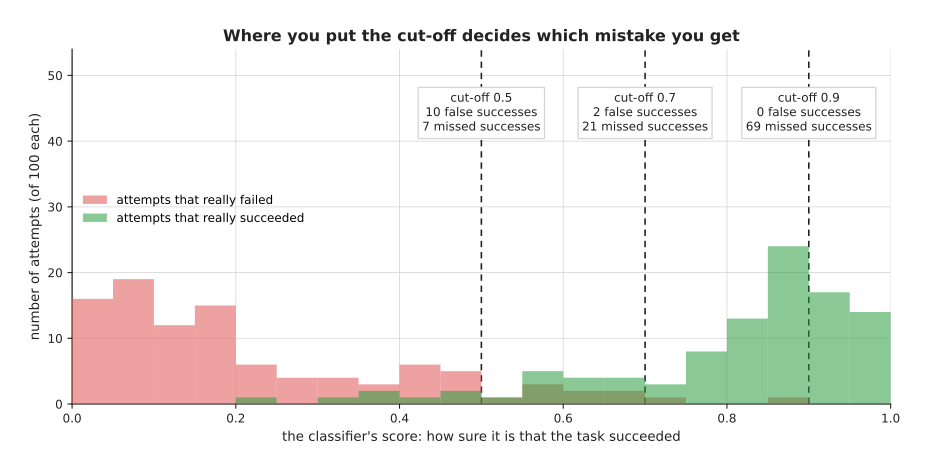
The picture shows the same scores as two piles. Red is the failures, which mostly score low, and green is the successes, which mostly score high. But the piles overlap in the middle, so wherever you put the line, some attempts land on the wrong side.
Which of the two mistakes is worse depends on the job. For reinforcement learning a false success is worse, because the policy is rewarded for failing, and it will learn to fail in exactly that way. For deciding when a task is done a false success is also worse, because the robot moves on and hides the mistake, whereas a missed success mostly costs time. So people usually pick a cut-off towards the high end. But a very high cut-off, such as 0.9 here, throws away most real successes, and then the policy is rarely rewarded at all.
5. Well-known models and libraries#
Section 3 described the four kinds of judge, and this section names the judges themselves. Most of the published work in this area is research code, so each model below says plainly whether you can run it today, and the first one is the one most people should start with.
Read the table one row at a time. The left column names the judge and says how
current it is. The right column says whether you can run it today and what that
would cost you: what the judge is best at, what you have to download or train,
its licence, and when to pick it. What you download or train is given in place of
a parameter count, because it matters more here. Where a row says not stated,
the project does not publish that figure, and every licence was read from the
project's own licence file or model card.
| Judge | What decides it |
|---|---|
| The HIL-SERL reward classifier, most used in 2026 | You can run it, but you train it yourself rather than download it, starting from a ResNet-10 encoder. It ships in LeRobot and is Apache-2.0 as part of it. It is best at one task, on your own arm, with a fast answer. Pick it when you are training with reinforcement learning on a real arm. |
| Robometer, worth betting on | You can run it today, because it is an 8.9 GB checkpoint on a 4-billion-parameter backbone, and it comes through LeRobot and is Apache-2.0 on its model card. It is best at progress and success on a task it has never seen. Pick it when you want a score without collecting or marking anything. |
| TOPReward, worth betting on | You can run it today, and there is no reward model to download at all, because it has no weights of its own and uses an 8-billion-parameter vision-language model instead. It ships in LeRobot and is Apache-2.0 as part of it. It is best at the same job as Robometer. Pick it when you already run a vision-language model and want a score from it. |
| SARM, worth betting on | You can run it, but you train it yourself, starting from CLIP ViT-B/32 features. It ships in LeRobot and is Apache-2.0 as part of it. It is best at long tasks made of several steps. Pick it when one attempt passes through stages you can name. |
| VIP and LIV, historical | These are research repositories rather than packages, so running them is work, and their size is not stated. VIP is Creative Commons Attribution-NonCommercial 4.0 and LIV, which came after it, is MIT. They are best at progress from videos of people, which is where the idea started. Pick them when you are reading the research rather than shipping. |
| GAIL, historical | You can run it, and you train it yourself, from the imitation library, which is MIT. It is best at a reward learned from recorded movements. Pick it when you are comparing inverse reinforcement learning for yourself. |
5.1 The HIL-SERL reward classifier, which you train on your own pictures#
This is the judge most used in 2026 for work on a real arm, because it is small, it is fast enough to answer at every step, and you know exactly what is in its training data.
Size xs, a small card, Apache-2.0 for the code as part of LeRobot, and the weights are yours, because you train them.
HIL-SERL is the real-arm learning system from the University of California, Berkeley, published in 2024, and its reward is a small image classifier rather than a written rule. The classifier ships inside LeRobot, Hugging Face's robot learning library. It is a classifier head on top of a pretrained picture encoder, and the encoder the configuration names by default is a ResNet-10, which is a small network already trained on ordinary photographs.
The one idea here is that the judge is a single yes-or-no question, learned from your own examples and nothing else. It is shown one picture and it answers how much that picture looks like a finished task. It does not know what the task is, what came before the picture, or how a half-done attempt differs from a hopeless one.
What that means inside is that almost all of the model was trained by somebody else. The ResNet-10 already turns a picture into a list of numbers that tells one kind of photograph from another, and your own training is mostly a matter of drawing a line through that list, with your successes on one side and your failures on the other. Nothing in the model represents time or order, so the tenth frame of an attempt and the three hundredth are judged separately and could easily come out the other way round. And the labelling is all yours: every picture is marked success or failure by a person, by hand.
What the idea buys is speed and certainty about what the judge knows. A small head on a small encoder answers fast enough to be asked at every control step, which is what reinforcement learning on a real arm needs, and every picture it learned from is a file you can open. What it costs is that a yes-or-no judge has nothing to say about how close an unfinished attempt came. A learner therefore gets nothing at all until it stumbles on a success, which is the problem the progress models below exist to solve. The line it draws is also only as good as the failures you showed it, so a new way of failing can land on the success side.
The difference shows up the moment the reward is needed inside a learning loop. On a peg insertion that practises for an hour, this classifier answers at every step and never holds the loop up, where Robometer in sub-section 5.2 takes a sizeable fraction of a second for one answer and cannot be asked that often. The difference runs the other way when you want to know how far an attempt got. Ask this classifier about an attempt that lifted the towel and then dropped it, and the only answer it has is "not done".
Why pick it rather than Robometer or a vision-language model, which need no training at all? Because of speed first: a large model takes from a fraction of a second to a few seconds for one answer, which is far too slow for a reward at every control step, and this classifier keeps up. Because it judges your task, in your room, under your light, rather than a general idea of success. And because you can see every picture it learned from, so when it is wrong you know where to look. The reason not to pick it is that it knows one task and nothing else.
What it costs you is the recordings. You collect pictures of your own attempts and mark each one as a success or a failure, and the failures are the part people forget. A classifier trained only on successes has nothing to contrast them with, and one trained on failures that all fail the same way learns only that way, so you have to make the arm fail in several different ways on purpose. The thing that most often goes wrong afterwards is the cut-off, which section 5 was a whole worked example about.
The library is LeRobot. Training runs from a configuration file, as its HIL-SERL guide describes, and the command is one line.
# the configuration names the dataset you recorded, the encoder to start from,
# your camera keys and the number of training steps
lerobot-train --config_path path/to/reward_classifier_train_config.json
Using the trained classifier is a few lines of Python.
from lerobot.rewards import RewardClassifierConfig, make_reward_model

config = RewardClassifierConfig(
    pretrained_path="your-name/mug-in-bowl-reward",  # the classifier you trained
    num_cameras=2,
    device="cuda",
)
reward_model = make_reward_model(config)

# batch holds one or more camera images under keys that start with
# "observation.image"; the threshold is the cut-off from section 5
reward = reward_model.predict_reward(batch, threshold=0.7)
What LeRobot supplies is the encoder download, the rescaling of the pictures, a
set of optimiser settings that work, and the accuracy printed beside the loss
during training, which is the number you actually watch. What you supply is the
marked recordings, the camera keys, and the threshold. Note that
compute_reward uses a fixed cut-off of 0.5, so if you want a different one, as
section 5 argues you often should, call predict_reward with your own
threshold.
5.2 Robometer, a reward model you download rather than train#
This one is worth betting on, because it is the first general-purpose reward model that arrives as an ordinary download, and a general success detector is the missing piece in every scheme that practises without a person watching.
Size l, a big card, Apache-2.0 for the code and the weights.
Robometer is a video-and-language reward model from the paper Robometer: Scaling General-Purpose Robotic Reward Models via Trajectory Comparisons, and it became downloadable in LeRobot version 0.6.0 on 6 July 2026. You give it frames from an attempt and the written instruction for the task, and it predicts how far along each frame is and how likely that frame is to be a success. It is a Qwen3-VL-4B-Instruct vision-language model with three small heads added, which its LeRobot page describes.
The one idea is in the paper's title, and it is about the training signal rather than the network. Asking people to mark an attempt as a success means asking them where the line is, and they disagree. Asking which of two attempts got further is a much easier question, and the same question works on any task, so answers to it can be gathered across many datasets at once. Robometer's third head exists to learn from exactly that.
Inside, the three heads sit on the same backbone and are trained together, with their three errors added into one. A progress head predicts how far along each frame is, a success head predicts whether each frame is a success, and a preference head predicts which of two attempts completed the task better. The frames are not handed in as a block: a special token is inserted after each frame, and the numbers the model is holding at those token positions are what the progress and success heads read, which is how one answer per frame comes out rather than one answer per attempt. Progress is also not predicted as a number at all. The head gives a score to each of ten evenly spaced values between 0 and 1, and LeRobot turns those scores into one value by taking their weighted average. Compare that with sub-section 5.1: the classifier takes one picture and gives one number, while this takes a run of frames and a sentence and gives a pair of numbers for every frame. The preference head is kept in the checkpoint so it loads, and LeRobot never calls it.
What the design buys is that the labelling has already been done, by somebody else, on tasks that are not yours, and that the written instruction is what lets the result be pointed at a task nobody labelled. What the design costs is that frames are expensive, because each one adds both a picture and a token to what the backbone has to hold, and the default reads at most eight frames of an attempt. Eight frames of a one-minute attempt can step straight over the moment things went wrong.
The difference shows up when you have five hundred recorded attempts and no labels. Give Robometer the instruction and it ranks all five hundred overnight, where the classifier of sub-section 5.1 cannot start until you have marked pictures from each of those tasks by hand. The difference runs the other way inside a control loop, where eight frames and a large backbone are simply the wrong tool, and in the worry below, because a judge that was never checked against a careful person on your task is still a guess.
Why pick it rather than the classifier in section 5.1? Because you collect and mark nothing. It scores a task it was not trained on, which is exactly what the classifier cannot do, so it suits sorting a pile of recordings or scoring an evaluation that runs overnight. Why not pick it? Because nobody has yet published how often it agrees with a careful person on a task it was not trained for, which the repository's frontier document states, and because a model judging a model is a mistake with a long history.
What it costs you beyond the line above is that the LeRobot integration is inference-only, so you cannot train the model further there, and the published checkpoint is a single file, lerobot/Robometer-4B, that has to come down before anything runs.
The library is LeRobot again.
from lerobot.rewards.robometer import RobometerConfig, RobometerRewardModel

cfg = RobometerConfig(
    pretrained_path="lerobot/Robometer-4B",
    device="cuda",
    reward_output="progress",   # or "success" for a 0 or 1 answer
)
reward_model = RobometerRewardModel.from_pretrained(cfg.pretrained_path, config=cfg)
What LeRobot supplies is the download, the frame and text preparation for the
Qwen backbone, and one compute_reward call that returns the last frame's
progress clamped between 0 and 1. What you supply is the frames, as whole numbers
in an array shaped time by height by width by colour, and the task instruction as
a sentence. The instruction is not a formality: it is the only thing telling the
model what success means, so "put the red mug in the bowl" and "tidy the table"
will be scored differently.
5.3 TOPReward, which asks a vision-language model how likely success is#
This one is also worth betting on, for a different reason: it needs no reward model at all, so it improves whenever the vision-language model you already use improves.
No weights of its own, and the Qwen3-VL-8B-Instruct model it reads by default is size l and wants a big card. Apache-2.0 for the LeRobot code, and the licence on the weights is whichever model you point it at.
TOPReward comes from the paper TOPReward: Token Probabilities as Hidden Zero-Shot Rewards for Robotics and ships in LeRobot. It builds a prompt that shows the video, states that the robot completed the task, and ends with "The answer is: True". Then it reads how likely the model thought that last word was. That likelihood is the reward. Nothing is fine-tuned, which is what zero-shot means: the model is used as it comes.
The one idea is that the judge already exists and nobody has to build it. A large model that has read a great deal about the world already has an opinion about whether a mug is in a bowl. You do not need a head trained to report that opinion; you need a way of asking that gives you a number instead of a sentence.
What that changes inside is that there is nothing new inside. A language model works out a probability for every word that could come next, and then picks one; the sentence it writes is the part people read, and the probabilities are thrown away. TOPReward writes the claim itself, ending the prompt with "The answer is: True", and then reads the probability of that last word rather than letting the model choose it. So the measurement is taken from machinery that was already running. Compare that with sub-section 5.2, where three heads were added and trained on robot video so that the numbers come from parts built for this one job. Here, nothing in the system was ever trained to referee a robot.
What the design buys is that there is nothing to download, nothing to keep up to date, and nothing to retrain: swap in a better vision-language model next year and the judge gets better by itself. What it costs is three things. The answer comes out as a log-probability, which is a convenient way to rank attempts against each other and an awkward thing to put a fixed cut-off on, unlike the 0-to-1 score of the two judges above. The wording of the prompt is now part of your system, so a different sentence gives a different reward, and nothing warns you that it has changed. And the opinion you are reading was formed by a model trained to describe pictures, not to referee robots.
The difference shows up when a vision-language model is already loaded on the machine, because you are using it to turn instructions into tasks. Then this reward is one more call to a model that is already resident, where Robometer would be a second multi-gigabyte model competing for the same card. The difference runs the other way when the two disagree on your task. Robometer's heads were trained on robot video for this exact question while this one borrows a general opinion, and only a measurement against your own eyes tells you which to believe.
The idea has a history, and these are the papers people cite for it. VLM-RMs, from Vision-Language Models are Zero-Shot Reward Models for Reinforcement Learning, showed in 2023 that CLIP, a model that scores how well a picture matches a sentence, works as a reward with no training for simple tasks in simulation. RoboCLIP scored a whole attempt against one demonstration video. SuccessVQA fine-tuned a vision-language model on marked examples of the question. Generative Value Learning asked a large model to rate every frame, shuffling the frames first so that it could not simply assume later frames are further along. TOPReward is the same family, and it is the packaged one.
Why pick it rather than Robometer? Because there is no checkpoint to download and nothing to keep up to date, and because you can swap the backing model for a better one later. Why pick Robometer instead? Because its heads were trained on robot videos for this exact job, where TOPReward borrows a general model's opinion. Which of the two is more accurate on your task is something you have to measure, and neither paper settles it for you.
What it costs you beyond the line above is that its default backbone is larger than Robometer's, so this is not the cheap option even though nothing is trained, and the LeRobot port supports the Qwen backbone only.
from lerobot.rewards.topreward import TOPRewardConfig, TOPRewardModel

cfg = TOPRewardConfig(
    vlm_name="Qwen/Qwen3-VL-8B-Instruct",   # any model you can run locally
    device="cuda",
)
reward_model = TOPRewardModel(cfg)
What LeRobot supplies is the prompt building, the masking that isolates the last word, and the reading of its probability, which is the whole trick and is fiddly to write yourself. What you supply is a machine that can hold the model, the frames, and the instruction. There is also a script that labels a whole dataset offline and writes the scores to a file, which is the sensible way to use a slow judge.
5.4 SARM, which judges a long task one stage at a time#
This one is worth betting on for long tasks, because a single progress number for a task with four steps in it is a weak signal, and this is the packaged model that fixes that.
Size not stated, a small card, Apache-2.0 as part of LeRobot, and you train the weights yourself on a CLIP ViT-B/32 encoder.
SARM, which stands for stage-aware reward modelling, comes from the paper SARM: Stage-Aware Reward Modeling for Long Horizon Robot Manipulation, and it ships in LeRobot. It predicts which stage of the task the arm is in and how far through that stage it is, and combines the two into one progress score between 0 and 1. You name the stages in words, such as grabbing the near side of a towel and making the first fold.
The one idea is not a new network. It is a better answer to the question "how far along is this frame?", which somebody has to answer before a progress model can be trained at all. The obvious answer is the frame number: frame 50 of 200 is a quarter of the way through. That answer is wrong whenever two recordings of the same task take different lengths, which they always do, because then the same moment of the same task is labelled a quarter in one recording and a third in another, and the model is trained on the disagreement.
What that changes inside is that one network makes two predictions instead of one. It predicts which of your named stages the frame belongs to, and how far through that stage the frame is, and the two are combined into a single score between 0 and 1. The labels come from the stage names rather than from frame numbers: a vision-language model reads each recording and marks where each named stage starts and ends, and progress is then measured inside each stage, so the first fold being half done means the same thing in a slow recording and a quick one. Compare what the judges above ask you to supply. Sub-section 5.1 needed one mark per picture, success or failure. Sub-section 5.2 needed comparisons between whole attempts, collected by somebody else. This needs a list of stage names from you, and then one model call per recording to find where they are.
What the design buys is a score that still means something in the middle of a long task, and one that survives demonstrations of uneven quality, which is what its paper claims and tests on folding a shirt. The same score can then be turned back on your training data, reweighting the recordings so that frames where the arm was really making progress count for more. What it costs is that pass of annotation, a model call for every recording, and the judgement of whether the task has stages at all.
The difference shows up on a four-step task that stopped after three. SARM says which stage the arm reached and how far into it, so you know it made both folds and then dropped the corner. Robometer gives one middling number, and a middling number cannot tell you whether the attempt drifted from the start or nearly finished. The difference runs the other way on a single continuous reach, which has no stages to name, and there the annotation pass buys nothing at all.
Why pick it rather than Robometer, which also gives progress? Because Robometer scores the whole task, so a long attempt that finished three of four steps and then stopped looks much the same as one that drifted. SARM knows the steps are there, and because it normalises each stage by how long that stage usually takes, the same point in two recordings of different lengths gets the same score. Why not pick it? Because it has no published general checkpoint to download: you train it on your own dataset, which is the cost section 5.1 described all over again.
What it costs you is annotation. You name the stages, and a vision-language model
then marks where each stage starts and ends in each recording, which is a model
call for every episode. There is a single_stage mode that needs no annotation
at all and treats progress as a straight line from the start to the end of the
episode, and that mode is the honest starting point, because it tells you whether
stages are worth the work.
# mark the stages in each episode, using a vision-language model
python src/lerobot/data_processing/sarm_annotations/subtask_annotation.py \
  --repo-id your-name/towel-folding \
  --dense-only \
  --dense-subtasks "Lift the arms,First fold,Second fold,Third fold" \
  --video-key observation.images.base

# then train the judge on those stages
lerobot-train --dataset.repo_id=your-name/towel-folding \
  --policy.type=sarm --policy.annotation_mode=dense_only \
  --policy.image_key=observation.images.base --steps=5000
What LeRobot supplies is the annotation script, the stage arithmetic, the training, and a way to use the score to weight imitation learning, so that frames where the arm was making real progress count for more. What you supply is the list of stages and the judgement of whether your task really has any. A task that is one continuous motion does not.
5.5 VIP and LIV, where the progress estimator came from#
These are historical. They are where the method in section 4 comes from, and they are research repositories rather than packages.
Size not stated by either project, a laptop, Creative Commons Attribution-NonCommercial 4.0 for VIP and MIT for LIV.
VIP, short for Value-Implicit Pre-training, came from the University of Pennsylvania and Meta in 2022 and was published at the 2023 International Conference on Learning Representations. It learns from videos of people doing everyday tasks to turn a picture into an embedding, and the distance to the goal embedding then works as a progress score, which is the arithmetic section 4 worked through. LIV, short for Language-Image Value learning, came from the same group in 2023 and lets the goal be a sentence instead of a picture.
The one idea is that you can get a progress score without training anything that produces a score. Instead you train a way of turning pictures into numbers such that the distance between two pictures already means something, and then progress is a subtraction you do yourself.
What that changes inside is the training objective, which comes from reinforcement learning rather than from marking examples. VIP takes a video of a person, treats its first frame as a start and its last as a goal, and trains the embedding to obey the arithmetic a value function obeys, which is the rule that the distance still to go shrinks by one step for every step taken. A second part of the objective pulls frames that are next to each other in time together and pushes distant frames apart, which is what keeps the embedding changing smoothly as the video runs. Nothing in that needs an action, a success label or a stage name: only the videos, and the paper's were Ego4D, a large collection of first-person video of people. Compare sub-sections 5.1, 5.2 and 5.4, each of which ends in a head that produces the score. There is no such head here at all, and the last line of the example below gives you the embedding, not a reward.
What the design buys is a judge that asks you to label nothing whatsoever, and an embedding you can use for other things, such as finding the frame in a dataset that looks most like the one in front of you. What it costs is that the reward now rests entirely on the goal picture you choose, and a distance is a blunt instrument: a picture taken under a different light can sit far from the goal even when the task is done. LIV's addition is to let the goal be a sentence instead, which removes the need for a photograph of the finished task.
The difference shows up when you have one photograph of the finished task, nothing marked, and no wish to load a model of several gigabytes. VIP turns that one photograph into a score for every frame of every attempt, where the classifier of sub-section 5.1 would need a few hundred marked pictures first and would then return nothing but "not done" until the very end. The difference runs the other way as soon as the task has to be told apart from a near miss, because a mug beside the bowl and a mug in the bowl are two pictures that sit close together, and a distance will not separate them.
What it costs you is the fitting together, because there is no reward model in these repositories, only the encoder. You write the distance and the progress arithmetic yourself, which is five lines, and you decide what the goal picture is.
import torch
from vip import load_vip

vip = load_vip()   # the model pretrained on Ego4D, a large set of videos of people
vip.eval()

# images are 224 by 224 and the model expects values from 0 to 255
with torch.no_grad():
    embedding = vip(preprocessed_image * 255.0)   # shape [1, 1024]
What the library supplies is that encoder, and its README also points at a
ready-made version inside TorchRL. What you supply is the preprocessing, which
the repository's encoder_example.py shows as a resize to 256, a centre crop to
224 and a scaling back to the range 0 to 255, and then the whole of the reward:
the goal embedding, the distance, and the step-to-step difference.
5.6 GAIL and the imitation library, for a reward learned from movements#
This one is historical too, and it is the fourth kind of judge from section 3, kept because the idea keeps coming back.
Size xs, because the judge you train is small, a laptop, and MIT for the
imitation library.
Generative adversarial imitation learning, written GAIL, is from 2016. It trains
a judge whose job is to tell the person's recorded movements apart from the
policy's, and the policy is rewarded for being hard to tell apart. Maximum
entropy inverse reinforcement learning, from 2008, is the older classic in the
same family, and open versions of both are in
the imitation library, which
is MIT.
The one idea is that nobody ever says what success is. The reward is "look more like the person", and it is measured by a second network that is trying to catch the robot out.
That gives the judge a shape nothing else on this page has, in two ways. First, what it reads is not a picture of a finished task but a movement: the arm's state and the command given at that moment, which is the same pairing a demonstration already holds. So the labelling it asks of you is none at all about success, and instead a set of recordings with their actions in them, which is a different kind of data from the marked pictures of sub-section 5.1 or the stage names of sub-section 5.4. Second, the judge does not stay still. It is retrained as the policy improves, because a judge that has been beaten has to find a new difference to point at. Every other judge on this page is a fixed function once it has been trained, and this one is a moving one by design.
What the idea buys is a reward where nothing can be written down and no finish line exists, and a dense one, since every step either looks like the person or does not. What it costs is that two models are now learning against each other, so a bad result does not tell you which of the two was at fault, and that there is no number you can read off and trust, because the judge's score says only how this policy compares with the policy of a few thousand training steps ago.
The difference shows up when the goal is the manner of the movement rather than its end state. Pouring without splashing, or wiping with even pressure, look the same in a photograph of the finished table, so the classifier of sub-section 5.1 has nothing to learn from, while a judge watching the movements can tell a smooth pour from a jerky one. The difference runs the other way whenever you can photograph success, which is most tasks, and then the classifier is a small fraction of the work.
Why pick this rather than a classifier or a progress model? Only when the thing you cannot write down is the goal itself rather than the finish line, and you believe a learned reward carries over to new situations better than copied movements do. Why not? Because the library's last change was in January 2025, as the repository's learned methods document notes, and because two models now train against each other, so when the result is bad it is hard to say which one was at fault.
What it costs you is a simulator, because the library is built around Gymnasium environments rather than real arms. It is the right place to try inverse reinforcement learning and the wrong place to run a reward in production, and its own documentation is a better guide than anything shortened here, because the training loop has several parts.
5.7 How to choose#
Train the HIL-SERL classifier on your own pictures. That is the default for one task on one real arm, and it is the only judge here whose training data you can look at.
Four things change that answer.
If you have nothing marked and want a score tonight, download Robometer, and read its answers against your own eyes on a handful of attempts before you trust it on hundreds. If you already run a large vision-language model, TOPReward gets the same kind of answer out of it without a second model.
If the task has named steps and you care where an attempt stopped, use SARM, and
start in its single_stage mode so that you find out whether the stages were
worth annotating.
If the reward is needed many times a second during learning, none of the large models will do, and you are back to the small classifier. If a sensor or a measurement can answer "is it done?", use that instead of everything on this page. One more case sits beside all of these. If you work in a simulator, where the program knows where every object is, then Eureka, from NVIDIA in 2023, has a large language model write the reward as code and improve it from the training results. It judges no pictures, and the reward it writes is a rule you can read, so it belongs with the written alternatives rather than with the judges.
6. Where this is going#
Section 5 named the judges that exist today, and this section says where this kind of model is heading. Each statement below says what kind of claim it rests on, using the four kinds the frontier chapter sets out, and where a judgement is mine rather than somebody's claim the sentence says so.
6.1 How it got here#
Judging an attempt from a picture started as something you built per task, and the success classifier of sub-section 5.1 is what that looked like. The shift since then has one direction: the judge stopped being a thing you train and started being a thing you download. Vision-Language Models as Success Detectors, from Google DeepMind in March 2023, made the first version of that argument by asking a large model whether a task was finished instead of training a head to say so. What changed in 2026 is that general-purpose judges arrived as ordinary checkpoints in an ordinary library, which is a difference in kind rather than in quality.
6.2 Where it is used in industry today#
Nobody sells a judge model. I could find no product announcement from any robot vendor offering a reward or progress model as a thing you buy, and the shipping artefacts in this area are open downloads rather than products.
Those downloads are real and they are checkable, which makes them the strongest claims on this page. LeRobot version 0.6.0, on 6 July 2026, put Robometer, TOPReward and SARM into one library with one interface, and Robometer-4B sits on the Hugging Face Hub under Apache-2.0 today. That is a product announcement in the only sense this page cares about: you can fetch the file and run it this afternoon.
Where judges are used in production, the evidence is a demonstration rather than a product. Physical Intelligence's π*0.6 trains a value function from the robot's own experience, and that value function is a judge in everything but name, because the difference between two of its scores is what tells the policy whether the action in between helped. The frontier chapter's section on it records the reported throughput gains and also records that nothing was released. The one judge with a long industrial history is not learned at all: a sensor. A torque reading, a vacuum pressure switch or a part-present beam answers "is it done?" directly, costs nothing to run, and is what a working cell actually uses. Section 5.7 says to prefer that where it exists, and industry agrees with it.
The nearest thing to industrial adoption is a judge used for evaluation rather than for reward. AutoEval runs real-robot evaluations with automatic success detection and automatic scene resets, and RoboChallenge runs submitted policies on operators' own robots and scores them centrally. Both are shipped and open, and both exist because a human scoring attempts by hand is the cost that makes real evaluation unaffordable.
6.3 What is being worked on right now#
The live research thread is the large vision-language model used as a judge, and the reason it is live is that it needs no training data from you. Large Reward Models, whose latest revision is dated 30 September 2026, adapts a vision-language model into an online reward generator and exposes three interfaces from one model: progress estimation, task completion and a comparison between two attempts. It reports improving an imitation-learning baseline on four real manipulation tasks across two robot platforms. That is a research result, and no weights were released at the time of writing. MARVL, from January 2026, attacks the same model's known weakness by fine-tuning it for spatial and semantic consistency and splitting a task into named stages, and it reports beating earlier vision-language-model rewards on the Meta-World simulated benchmark.
The second thread is what trains the judge, and Robometer is the clearest statement of it. Its paper reports a dataset it calls RBM-1M, of more than one million trajectories across many robot bodies and tasks, and it trains on two signals at once: how far along a frame is within one attempt, and which of two attempts got further. The second signal is the interesting one, because asking a person where the line between success and failure sits is a question they answer inconsistently, while asking which of two attempts got further is a question that means the same thing on every task. That lets failed and clumsy attempts become training data instead of being thrown away.
The third thread is the one that matters most to a reader, and it is new: people have started measuring the judges. FailBench, published on 3 September 2026, is a benchmark of 2,197 manipulation attempts drawn from 14 public sources, of which 12 are real and six were not collected for failure detection at all, and 75 per cent of its failures happened naturally rather than being staged. Across 13 vision-language detectors, the best reaches 0.77 mean balanced accuracy. Balanced accuracy here means the average of how often the judge catches a success and how often it catches a failure, so 0.5 is guessing. Three of its findings deserve to be read twice. Detectors fine-tuned for failure detection consistently did worse than general-purpose models, including worse than the models they were fine-tuned from. Performance approached chance, below 0.60, on tasks whose outcome depends on contact rather than on visible object motion. And the errors were biased: when the evidence was ambiguous the judges predicted success, and asking them to reason harder did not remove that. Those are research results on a stated protocol, which is the strongest kind of claim in this sub-section.
The shared evaluation efforts keep improving alongside that. RoboArena ranks policies from double-blind comparisons between pairs rather than from absolute scores, which is the same insight Robometer's preference head rests on, applied to evaluation instead of to training.
6.4 What is still unsolved#
Nobody has published how well a general judge agrees with a careful person. This is the gap to keep in mind whenever you read a reward-model result, and it is narrower than it sounds. FailBench measures a judge against the labels its source datasets already carried, which is not the same thing as putting a judge and an attentive human in front of the same hundred attempts and reporting how often they disagree. For Robometer in particular, which is the model this page tells you to download, no published work gives that figure on a task it was not trained for. Until somebody runs that study, every number a judge produces rests on an unmeasured assumption.
Contact is the second gap, and it is the same gap the whole book keeps meeting. A camera sees where things are and not how hard they are pressed, so a judge looking at pictures cannot tell a screw that is tight from one that is merely seated. FailBench measured exactly this and found near-chance performance on contact-intensive assembly. No amount of better vision fixes it, because the information is not in the picture.
The third is reward hacking, which is what happens when a policy is trained against a judge and finds a way to score well without doing the task. A learned judge is wrong in places, and a reinforcement learning run is a search that will find those places, because finding them is cheaper than doing the work. FailBench's bias finding makes this concrete: a judge that says "success" when the evidence is unclear is a judge that rewards attempts which end ambiguously. I know of no published study measuring how often this happens on a real arm, and that absence is itself worth noting.
6.5 The next two to three years#
Everything in this sub-section is my own expectation unless the sentence names somebody else's commitment.
I expect judges to be published with a measured accuracy number, the way policies are published with a success rate, and the reason is that FailBench has made it cheap to do. Running a benchmark of 2,197 recorded attempts costs computing time and no robot, so there is no good excuse left for shipping a reward model without one. That is my expectation. Neither LeRobot nor any model's authors have committed to it.
I expect the large judge to be used to teach a small one rather than to run on the robot, and the reason is arithmetic that sub-section 5.7 already states. HIL-SERL needs a reward at every control step, and Robometer is an 8.9 GB checkpoint on a 4-billion-parameter backbone. A big model scoring a few thousand recorded attempts once, and a small classifier trained on those scores to answer in milliseconds, is the shape that fits both constraints. Nobody has announced such a tool, so treat this as a prediction about engineering convenience rather than as news.
I expect the most common use of a judge to be filtering data rather than supplying reward, and the reason is that the failure modes cost different amounts. A judge that mislabels one recorded episode costs you that episode. A judge that is wrong inside a reinforcement learning loop teaches the policy to exploit the mistake, as the paragraph above describes. The published work is already moving this way: π0.7 keeps failed and sloppy attempts in its training set with labels saying so, which the frontier chapter records, and a judge is the obvious thing to write those labels with.
I expect comparisons between pairs to displace absolute labels wherever a judge is trained, and here the reason is already measured rather than guessed. Robometer trains on which of two attempts got further and reports that this generalises better than earlier methods, and RoboArena independently chose pairwise comparisons for evaluation after concluding that standard absolute scores do not scale across laboratories. Two groups solving different problems reached for the same trick, which is usually a sign the trick is right rather than fashionable.
I expect the judge to stop being only a camera model, and the reason is sub-section 6.4's second gap. The tasks where a judge is most needed are the contact tasks, which are the tasks pictures cannot settle, and arms already produce force, torque and joint-current signals that none of these models are given. The collision and failure detection page covers judges built on those signals today. Joining the two is an obvious engineering step and I expect somebody to take it, but I know of no announced work on it, so this is the weakest prediction here and I would not plan around it.
7. Where to read next#
This page supplied the score that the earlier methods needed, and the next page supplies the data they needed, so the reading below follows that thread.
In this chapter:
- Reinforcement learning policies is the learner that most often uses a judge model as its reward.
- Learning from human video is the next page, and the progress estimators on this page are trained on the same kind of video.
- The movement models overview compares every kind in this chapter.
In other chapters of this book:
- Vision-language models explains the large models used as judges, with a worked example of success detection.
- Collision and failure detection covers judges that use force and joint signals instead of pictures.
Deeper documents elsewhere in this repository:
- What is being done about evaluation
covers AutoEval,
lerobot-evaland the Robometer reward model. - LeRobot's 2026 releases explains why reward models arriving as downloads matters.
- Interactive imitation gives the evidence for HIL-SERL.