1. Introduction#
Every solution in this book gets the same things. Every solution must give back the same kind of thing. This page says exactly what those are:
- what a solution may read;
- what it is never told;
- what a push does and what it reports;
- what a solution gives back.
The page comes after what is asked for, which says why the arm drags the glasses. It comes before the examiner, which draws the tables and marks the result.
The examiner's code carries out everything on this page. That code is in
code/src/09_pushing-the-glasses-apart/bench/. So all of it is the same for
every solution.
Contents#
- Introduction
- Three calls, in a loop
- What
look()hands over - What a solution is never told
- What
push()does, and what it reports back - What must come out
- Where to go next
2. Three calls, in a loop#
A solution can touch the table only through the examiner. So we start with how it does that.
The examiner offers three calls and nothing else: look(), push() and
take(). A call is a function the solution can run. The three calls form a
loop. A solution looks, decides, pushes, and looks again. The loop ends when
the solution runs out of pushes, not when it decides to stop.
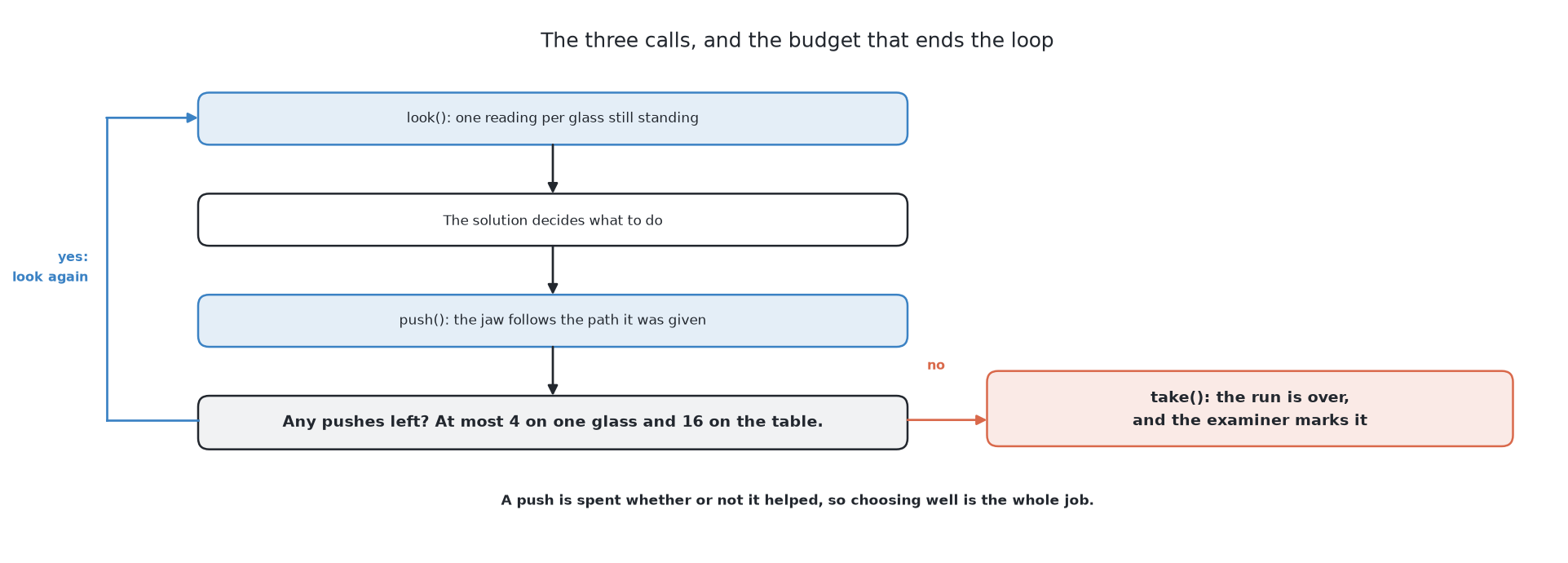
The loop starts with a look, so the next section says what a look returns.
3. What look() hands over#
The loop begins by reading the table. This section says what that reading contains.
look() returns one reading for each glass still on the table. Each
reading says five things about the glass:
- where it stands;
- how tall it is;
- how wide it is at its widest;
- how wide it is at its foot;
- whether it is still standing.
These are the same facts the camera work for telling the glasses apart produces. So this problem can start where that one ended. Here is the start of a look at table 10025. There is one row for each standing glass. Every length is in metres.
[
  {"id": 0, "x": 0.4570, "y": -0.4170, "height": 0.1554, "widest": 0.0740, "foot": 0.0419, "standing": true},
  {"id": 1, "x": 0.5489, "y": -0.2464, "height": 0.1360, "widest": 0.0871, "foot": 0.0462, "standing": true}
]
Each reading has the camera work's measured error. The numbers are not the true ones. The examiner adds a small random error to the position, the two widths and the height. The size of each error comes from what the camera solution really scored, as its own results record. The width error is the largest. The position error is the smallest.
The error is new on every look, so looking twice tells you more. The error is drawn from the table's number and the number of the look. This means the first look at a table is the same for every solution. No solution gets an easier first reading.
Solutions that read pictures also get a picture of the table from above. Four of the seven read pictures, not numbers. They are an imitation policy trained on images and the three vision-language models. A list of numbers is no use to them. So the examiner draws a picture of the same table at the same moment. The information is the same. Only its form is different.
The picture comes from bench/top_view.py. A camera is fixed 750 mm above the
middle of the glass zone, looking straight down. It returns a colour picture,
384 by 384 pixels, that shows the whole zone. This camera is not the one that
film.py uses. The film camera looks down from the arm's side, and it exists
only so that people can watch a run.
Keeping the two cameras apart matters. A solution that reads a picture decides from that picture. If filming a table changed anything in the simulated world, a filmed table could differ from the table that was scored. Then the solutions would no longer be compared fairly. So the films are drawn in a second, separate world that is never simulated. The scored world is the same whether a table is filmed or not. A test checks this. It runs one table both ways and requires every glass to end in the same place.
What a look leaves out matters too. The next section lists it.
4. What a solution is never told#
The readings above are all a solution sees. This section says what the examiner knows but keeps back.
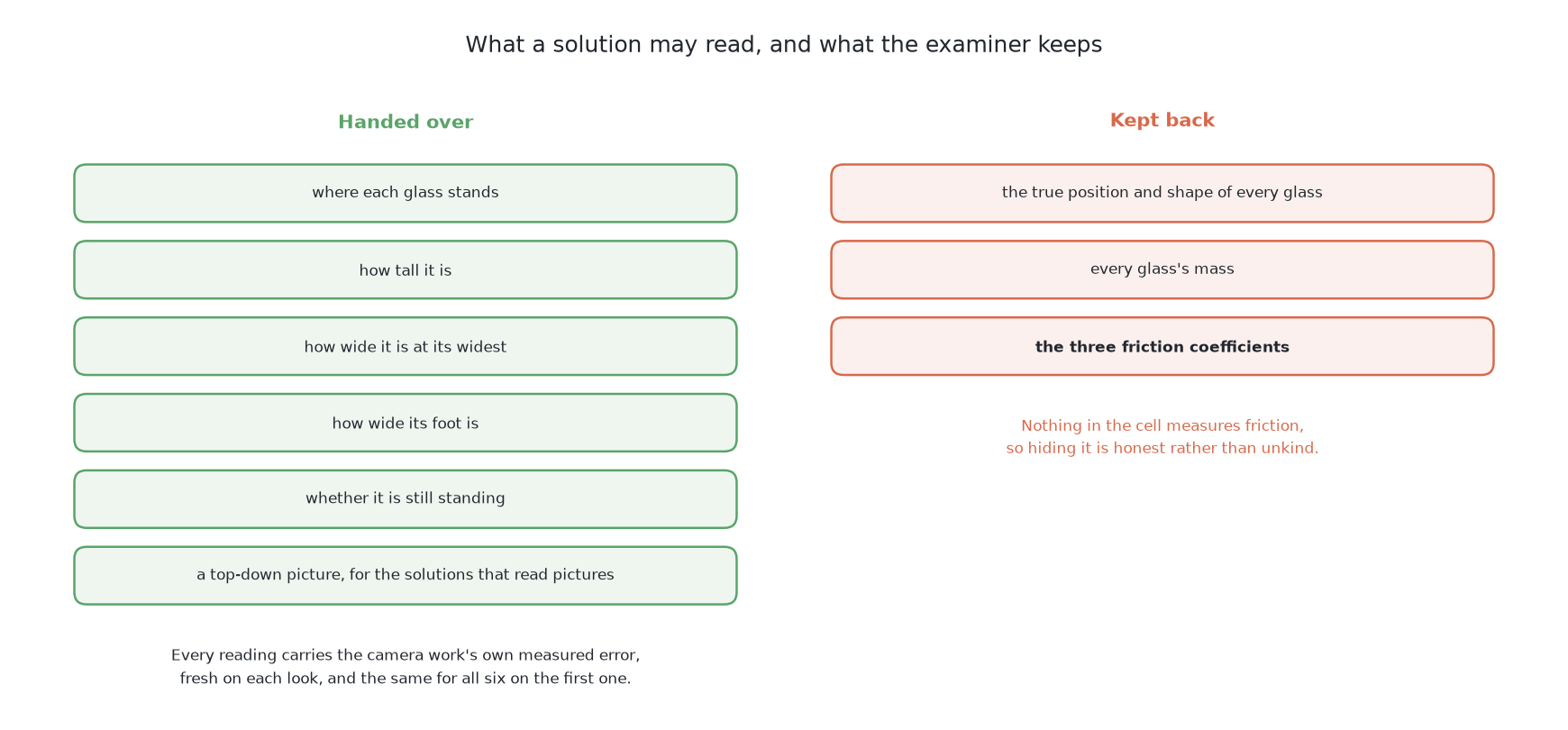
A solution never gets the simulator's record. The examiner knows each glass's true position, true shape and mass. It keeps all of them. Only the scoring code reads them, and only after a run ends. A learned solution may use them as training labels on the training tables. But nothing reads them while a solution is answering. A solution that read the truth would not be answering this problem.
A solution is also never given the friction. Friction is how strongly two surfaces resist sliding over each other. Its size is a number called the friction coefficient, written μ. The examiner keeps three of these numbers private: glass on table, glass on glass, and the hand's pads on glass. Every table uses the same three.
They are hidden because the real cell could not know them either. Nothing in the cell measures friction. There is no sensor for it, and there is no other way to find it. This one missing number is what makes the problem hard. The tipping limit depends on it, as pushing without toppling shows. So a solution must guess the very number that decides whether a glass is safe to push.
Friction cannot be read directly. The only evidence of it comes from pushing, so the next section says what a push reports.
5. What push() does, and what it reports back#
look() tells a solution where things are. push() is the only way to change
them. It is also the only call that brings back anything about friction.
One push runs as a fixed series of steps.
- The closed hand is held level, pointing the way it will move.
- It comes down at the start point the solution chose, to the lowest height the gripper can reach.
- It moves forward very slowly until it feels a small force. This means it has touched something.
- It pushes the asked-for distance at a steady speed.
- It backs off a couple of centimetres.
- It lifts up above the tallest glass.
Three things can stop this early. The hand can touch something on the way down. Then it goes straight back up without pushing. The hand can reach the end of its slow forward move without touching anything. Or the force can pass a much higher limit during the push. This means something is stuck, and the push stops where it is.
The push then reports what it felt. This report is the only thing that comes back. It says five things:
- whether the hand was blocked on the way down;
- how far forward it moved before it touched, or that it never touched;
- whether it got stuck;
- the largest force it felt at any moment;
- how far it really moved after it touched.
Both the request and the report are short enough to show in full. The first object below is the push that solution 1 asks for on table 10025. The second is the report the examiner gives after doing it. Lengths are in metres. The heading is in radians. The force is in newtons.
{"glass": 4, "start": [0.3726, -0.4500], "heading": 1.5708, "reach": 0.0881, "travel": 0.0660,
 "aim": [0.3726, -0.3259]}
{"blocked": false, "touched": 0.0146, "jammed": false, "peak": 1.73, "pushed": 0.0660}
The arm never uses the aim field. The examiner keeps it. Once the glass stops
moving, the examiner measures how far the glass ended from where the solution
expected it.
How the jaw's force is measured#
The force reading is the only input that comes from touch and not from the camera. So this part says which sensor makes it and how.
The sensor is a six-axis force-torque sensor between the arm and the
gripper. The arm ends in a flat plate called the flange. The gripper is not
fixed straight to it. A force sensor sits between them. So anything that pushes
on the hand also pushes on the sensor. "Six-axis" means the sensor reports six
numbers. Three are forces along three directions. Three are twists about those
directions. The cell names this sensor wrist_force in
arm/gripper.urdf.xacro.
In the Gazebo cell it reports 100 times a second.
The camera cannot measure force. The cell's two other sensors are in the finger pads. They only report whether a pad is touching something.
A real sensor of this kind measures how much a piece of metal bends. Inside it is a stiff metal part. Under load it bends a tiny amount, too little to see. Strain gauges are glued to that part. A strain gauge is a thin wire pattern. When it stretches, its electrical resistance changes. So the bending becomes a change in voltage. The maker's calibration turns these voltages into the three forces and three twists.
The sensor feels every load below it, including the gripper's own weight. So that weight is measured once, with nothing touching, and then subtracted. What is left is the force from contact. Force and torque at the wrist gives the published figures of one such sensor.
In the examiner, the force is added up from the physics. The pushing is
tested in MuJoCo, not Gazebo. The
examiner gives the reasons.
MuJoCo has no sensor model to read. So the examiner in
bench.py
does the work itself. Every 2 milliseconds, it finds every contact that
involves the hand. It adds up their forces and reports the total in newtons.
This is what the wrist sensor would read after the gripper's weight is
subtracted. It has no noise and no drift. A real sensor has both.
The push uses that number at three moments.
- The hand comes down at 200 mm per second. Any force above 0.1 newton means it has hit something, and it goes back up.
- The hand moves forward at 10 mm per second. The first force above 0.1 newton is the touch, and the push starts there. The limit is this low because the lightest glass starts to slide under about a quarter of a newton. A higher limit would push that glass along without noticing.
- The hand pushes at 20 mm per second. A force above 20 newtons means something is stuck, and the push stops.
The whole time, the largest force seen is kept. That is the peak force the push reports.
The distances in the report come from the hand's position, not from the sensor. The sensor only says when the force crossed a limit. Where the hand was at that moment comes from where the arm put it. On the real arm, the joint encoders give this. An encoder is a sensor that measures a joint's angle. Measuring by touch explains this split of work.
There is one warning for the real cell. The 0.1 newton touch limit is about the noise level of a typical wrist sensor. Its maker suggests ten times that for finding contact. So a real arm would need a higher limit or a slower approach. The examiner's clean reading is one way it is easier than the real world.
Why the force reading matters#
The force reading is how a solution learns anything about friction. This part explains why.
The rule for whether a glass slides or tips uses three things: the push height,
the foot width and the friction. A solution knows the push height, because it
is the gripper's own number. It can measure the foot width, because look()
gives it. It cannot have the friction. So the rule gives a limit that is only
as good as a guess.
So the force reading is the only way to observe friction at all. Two things depend on the friction: how much force it took to start the glass moving, and how far the glass went. So they are indirect evidence about it. A glass that leaned and fell back also feels different from a glass that slid.
Every solution that does better than a blind nudge does so by using this reading. It either reasons about the reading or learns from it. If the examiner reported only success or failure, the interesting half of this problem would be hidden.
A solution has now read the table and felt its pushes. The last question is what it gives back.
6. What must come out#
The inputs are the same for every solution. This section fixes the output. This is harder, because the solutions do not naturally give back the same kind of thing.
The shared output is a path for the hand. The hand follows one path, then another, until the table is done or the pushes run out.
Some solutions do not think in paths at all. A geometric solution thinks in a
parameterised push. This is a few numbers that describe one push. They
say which glass to move, where to put the hand down and which way to point.
They also say how far to feel forward and how far to push. push() accepts exactly these numbers. push()
then turns them into the steps described above: come down, feel, push, back
off and lift.
So turning a push into a path is a fixed routine that the examiner owns. A solution does not write it. Every parameterised push is turned into a path in the same way, by the same code. So no solution gains or loses anything at this step.
Other solutions think in paths directly. A modern imitation policy does not
give one target at a time. It gives an action chunk. An action chunk is a
short run of waypoints that the network predicts together in one step. These
solutions call follow() instead of push(). follow() takes a Chunk of
waypoints for the hand and carries them out in the same physics. It reports the
same Felt into the same record. So the scores cannot tell which call an
action came through.
The examiner also records the path the hand really followed on every action. It samples the path at a fixed rate. This turns a parameterised push into a demonstration. A policy that gives waypoints can be trained on these demonstrations.
The obvious alternative would be worse. The examiner could make every solution give the same few push numbers. That sounds fair, but it would be unfair. It would break the action chunks that make those policies work. A chunk keeps a policy steady over a whole motion. Without chunks, the policy wobbles from one step to the next. If you force such a policy into three numbers, you measure a damaged version of it. Two kinds of output work because the examiner marks the outcome, not the action.
A solution may also refuse a glass, with a reason. For example, a glass may tip before it slides, or have no clear place to go. The examiner explains why a refusal counts as a result and how it is scored.
take() ends a glass's part in the run. It lifts a glass off the table and
puts it in the rack. That is the earlier job of carrying one glass to the rack,
done for free here. The examiner also records whether the glass really had room
when it was taken. This record shows later whether the arm was right to think
the glass had room.
Those are the inputs and outputs every solution shares. The next page describes the examiner that draws the tables and marks what comes back.
7. Where to go next#
- The examiner draws the crowded tables, runs the physics, and marks every run the same way.
- The target layout works out where the glasses should end up.
- Pushing without toppling gives the height limit and the loop of plan, feel and look again.
← Push the glasses apart — what is asked for · The examiner →