This page is a short summary of the second of the seven solutions. Here, plain geometry lists every safe push, and a small fitted model only puts that list in order. The page says what it does, what makes it different, what it scored and one lesson. The full method is in the chapter on this solution.
Contents#
- What it is
- How it works
- What it needs
- What it scored
- Where it is strong and where it breaks
- When to choose it
1. What it is#
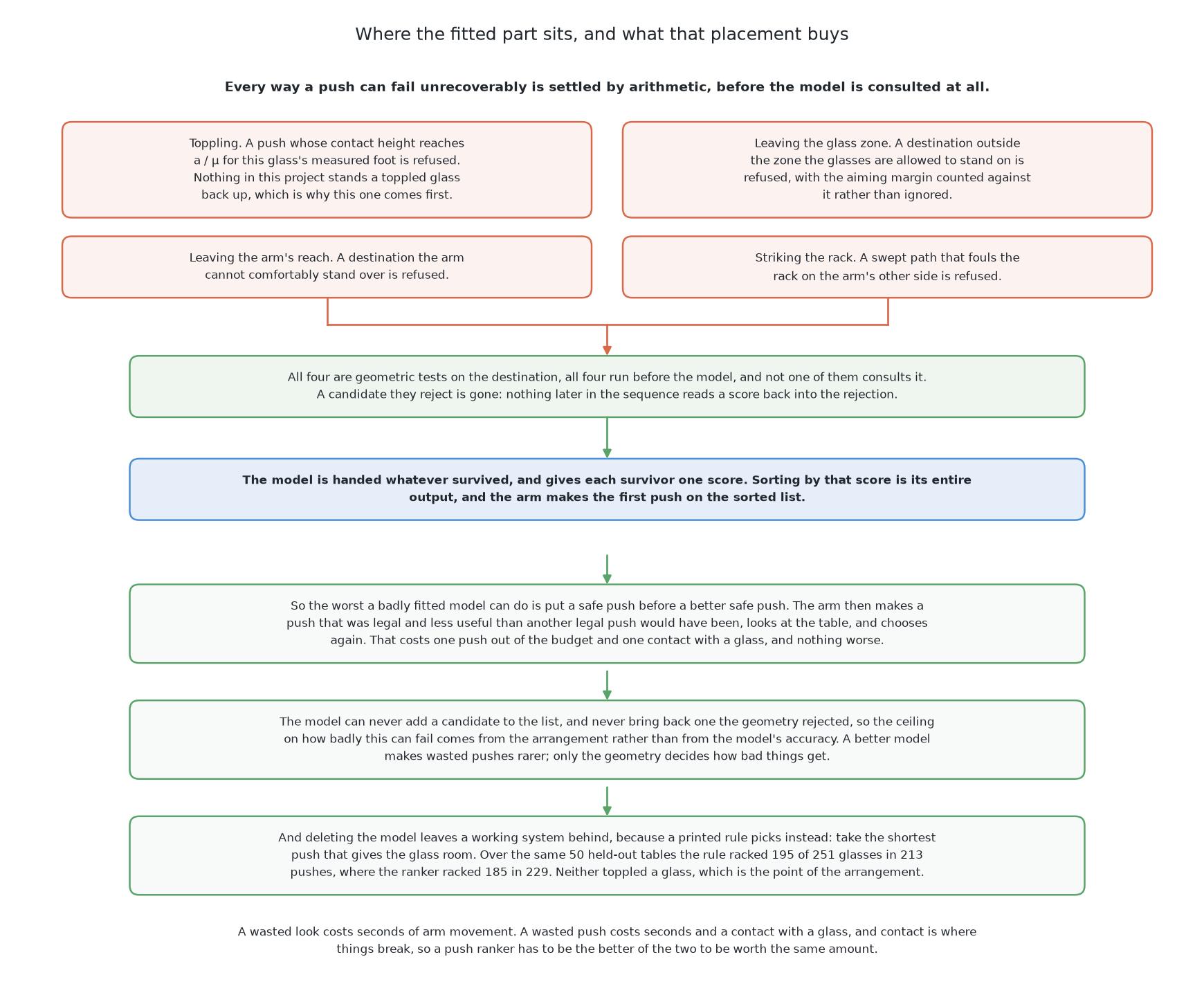
The first question is what this solution changes. One fixed nudge picks one push with a printed rule. This solution lists every safe push, and a fitted model chooses among them. The model cannot add a push, and it cannot bring back a push the geometry rejected. So the worst a bad model can do is waste a push. What it is explains why this arrangement is safe. The next section shows the steps.
2. How it works#
The idea above runs in three steps, and only the last one is fitted. First, the geometry lists many possible pushes. Second, the geometry removes every push that is unsafe. Third, the model scores the pushes that are left, and the arm makes the best one. The model is a set of gradient-boosted trees. These are many small decision trees whose scores are added up.
This solution is also the teacher. Solutions 3 and 6 learn by copying its recorded pushes. How it works explains this. The next section lists what the three steps need.
3. What it needs#
The steps above need little. They need scikit-learn and NumPy, and no graphics card. They need a few thousand training examples, and the examiner labels these for free. The trees fit in seconds. What it needs gives the full list. The next section shows whether the model helped.
4. What it scored#
The real test is to compare the model with the printed rule it was meant to improve. The table below has two rows. The first row is the fitted model. The second row is the same loop with the model deleted, so the printed rule picks instead. Both ran on the same 50 tables.
| tables done | tables wrong | glasses racked | toppled | pushes | |
|---|---|---|---|---|---|
| the fitted ranker | 14 | 1 | 107 | 1 | 182 |
| the same loop, printed rule picking | 14 | 1 | 107 | 1 | 173 |
The model reached the same glasses as the rule, and it used nine more pushes. There are two reasons. First, the safe pushes for a glass all gain about the same room, so there is little to choose between. Second, the model learned "room gained", but the score counts glasses that can be picked up. These are not the same thing, as the picture below shows.
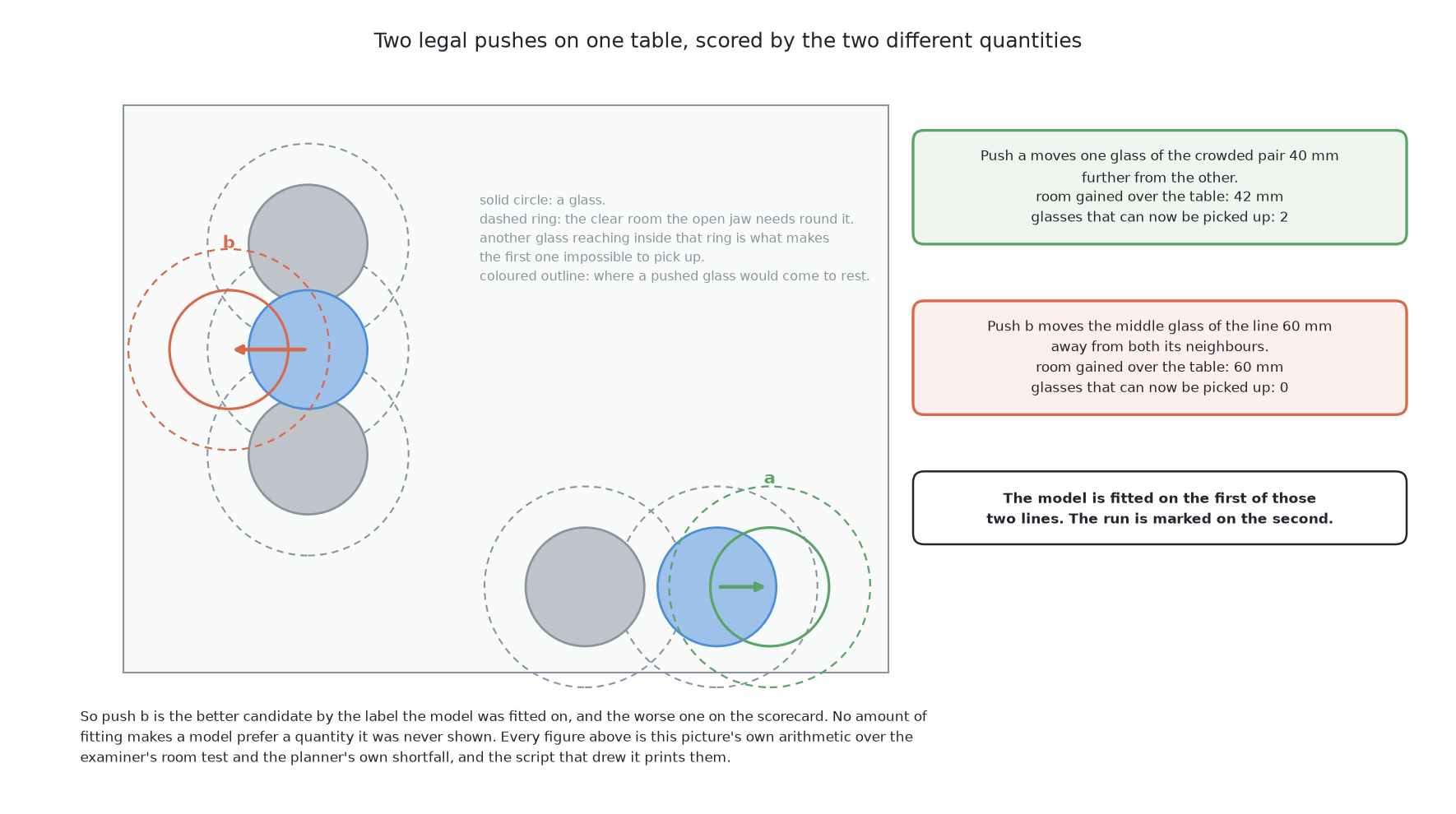
How it compares explains both reasons. The next section weighs its strengths against this result.
5. Where it is strong and where it breaks#
The score above does not tell the whole story. The design is safe, because the model cannot cause a toppled glass. If you delete the model, the printed rule still runs. The weakness is that the model can only pick from the geometry's list. When the model is fitted badly, nothing breaks, so the failure is easy to miss. How it compares covers each point. The last section says when to use this design.
6. When to choose it#
Given that safety, use this design when a mistake cannot be undone. The lesson is to check two things before you fit a ranker. Check that the choices really differ. Check that the label you train on is the thing you are scored on.
The results compares this solution with the world model, which learns what a push does.
The code is in
src/09_pushing-the-glasses-apart/02-geometry-ranked/.
The full treatment starts at
what it is.