This page is a short summary of the first of the seven solutions. This solution fits no model at all. Of the six measured so far, it broke the fewest glasses. The page says what it does, what makes it different, what it scored and one lesson. The full method is in the chapter on this solution.
Contents#
- What it is
- How it works
- What it needs
- What it scored
- Where it is strong and where it breaks
- When to choose it
1. What it is#
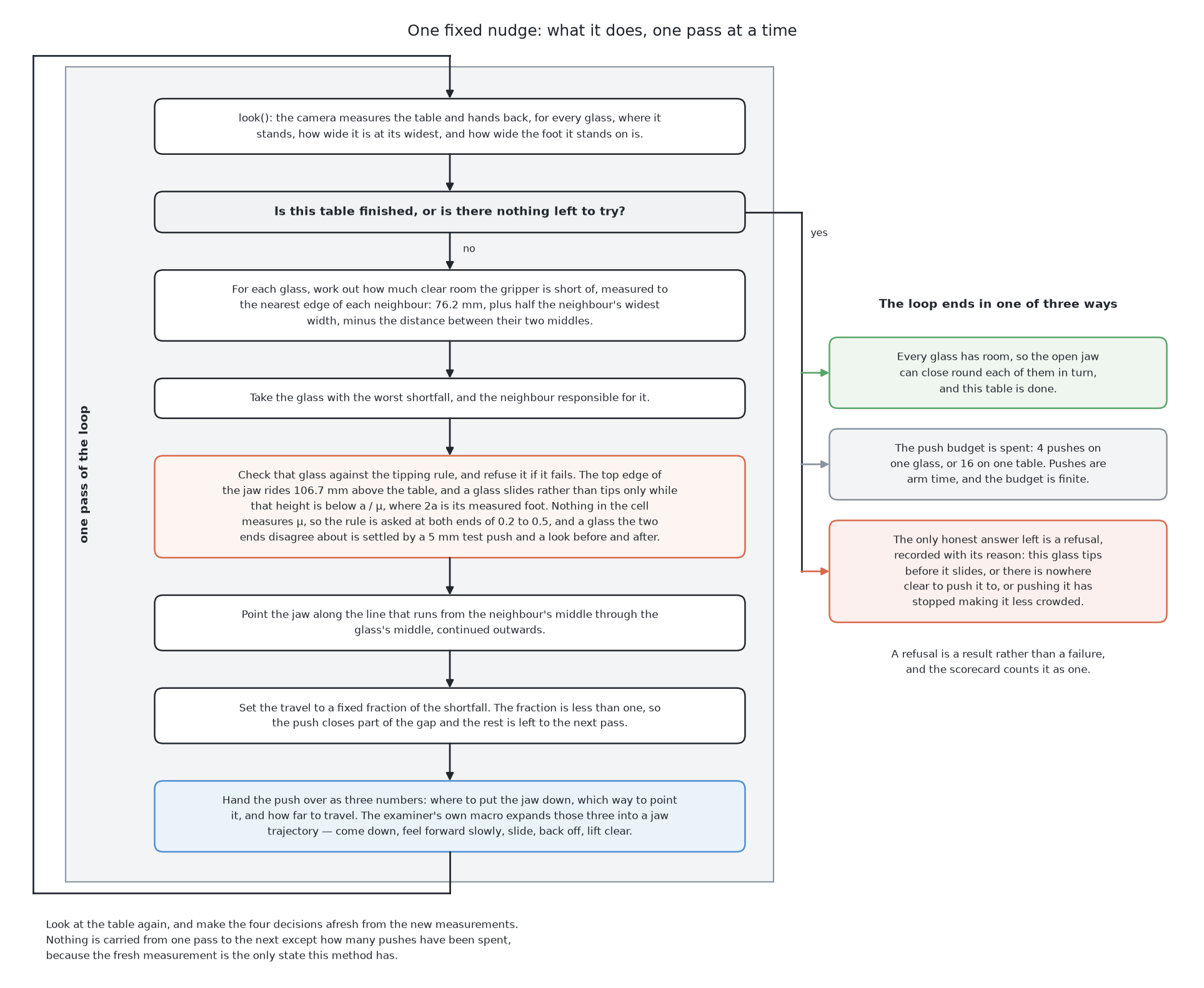
The first question is what this solution does. Nobody knows where a pushed glass will stop, because nobody has measured the friction. This solution does not try to predict it. It pushes a glass a short way, away from the neighbour that crowds it, and then looks again. That direction always helps, and the short distance cannot overshoot.
This makes it the baseline for the other six. Any other solution must beat it, or the extra cost buys nothing. What it is explains this idea in full. The next section shows the loop it runs.
2. How it works#
The idea above becomes a loop of five steps. The arm looks at the table. It picks up every glass that already has room. It refuses every glass that would tip before it slides. It chooses one push. Then it makes the push and looks again.
The choosing step has two versions. The designed rule pushes straight away from the worst neighbour, by a fixed part of the missing room. The planner that really ran searches instead. It tries every heading and takes the shortest safe push that gives a glass room. The scores below come from that planner. What is built and what is a design separates the two.
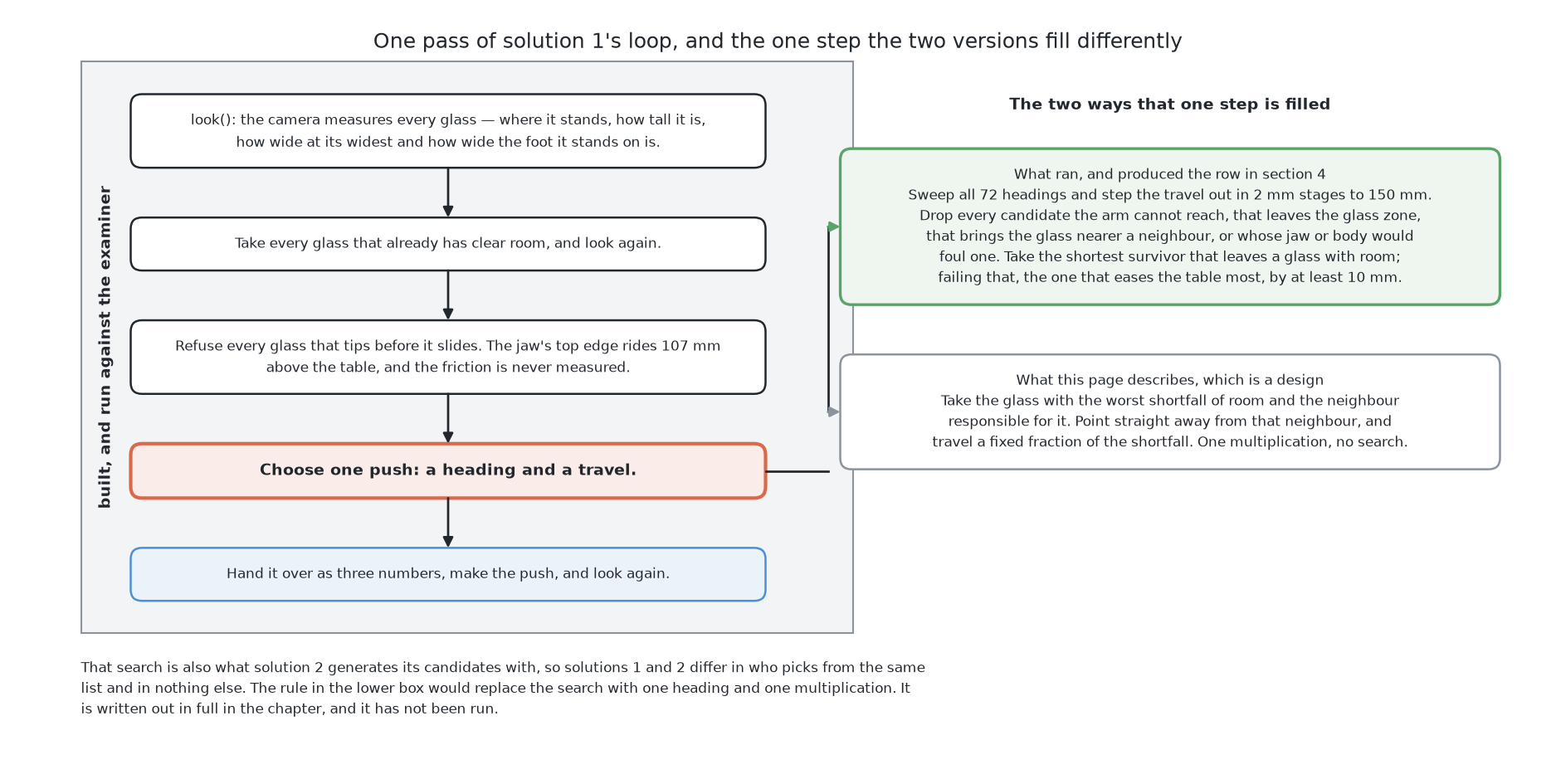
Solution 2 uses the same search to make its list of pushes. The next section shows how little this loop needs to run.
3. What it needs#
The loop above needs only a few things. It needs the measured position, width, foot and height of each glass, and the gripper's own fixed sizes. It needs only NumPy. It needs no training data, no model file and no graphics card. What it needs gives the full list. With so little needed, the next question is how well it scored.
4. What it scored#
The examiner gives every solution the same 50 tables. The examiner describes them. In the table below, read each column as a count over all 50 tables. A table is "wrong" when the run ends in a state the cell should never reach.
| tables finished | tables wrong | glasses racked | toppled | pushes |
|---|---|---|---|---|
| 14 | 1 | 107 | 1 | 173 |
It toppled only one glass, which is the best of the six measured so far. It refused 143 glasses, and most of those refusals come from the gripper, not the method. The hand is too wide to stand beside some glasses. It also cannot push low enough to slide some others. The results compares them all. The next section looks at where this method is strong and where it fails.
5. Where it is strong and where it breaks#
The score above follows from how little the method claims. It cannot be wrong about where a glass will stop, because it never says. Every step is a number you can print and check. Its weaknesses are also clear. The designed rule fails for a glass crowded from two sides, because pushing away from one neighbour pushes towards the other. And neither version uses the force the jaw feels during a push. That force is the only clue about friction. How it compares covers each point. The last section says when to use it.
6. When to choose it#
Given those strengths and weaknesses, build this solution first. It is the cheapest way to get a real push on a real glass. It also sets the score that every other solution must beat. The lesson is simple. If a model cannot beat this fixed nudge, the model adds nothing.
The code is in
src/09_pushing-the-glasses-apart/01-one-fixed-nudge/.
The full treatment starts at what it is.
← How the solutions compare · Geometry generates, a model ranks →