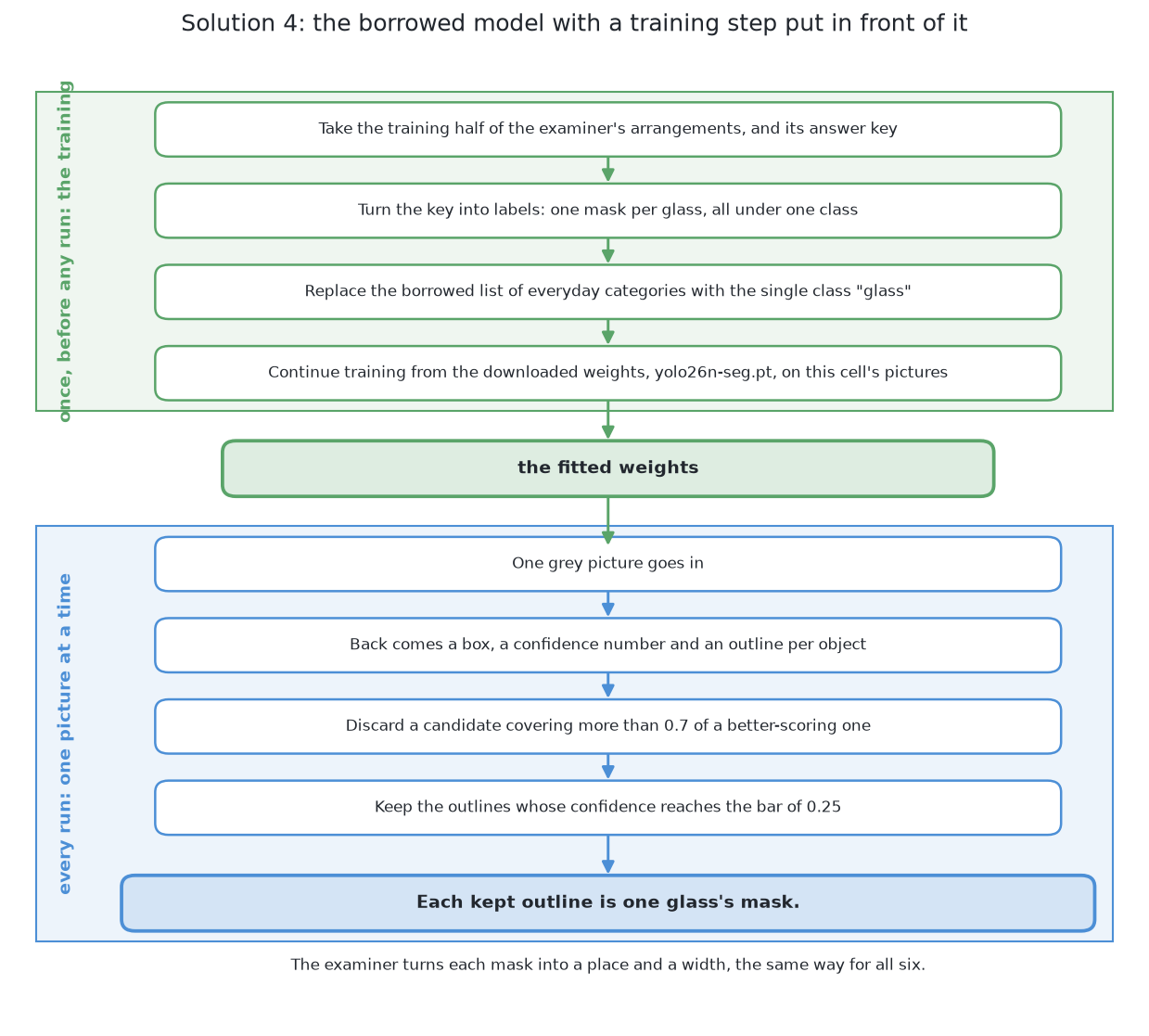
What it uses. It uses the Ultralytics package, with PyTorch running on this machine's built-in graphics. The model is Ultralytics YOLO26-seg. It is the same library, model and downloaded weights as solution 3. Here the model is trained further on this cell's pictures. Its list of everyday names is replaced by one class, "glass". What it does. It finds each glass in a survey picture from the top and returns one outline for each. The examiner turns each outline into a place on the table and a width. What it costs. Labels cost nothing here, because the examiner's id image gives an exact mask for each glass, as what the examiner keeps to itself explains. Training takes real time, but not much. The licence is the expensive part, as what it costs explains.
The cell is described once, in the cell. This page covers only what is special to this solution.
Contents#
1. Introduction#
This chapter answers what this book asks for in a common way. It takes a model that was trained somewhere else, and trains it further on pictures of this cell. This is called fine-tuning. It is the usual way to use a borrowed model for a particular job. It is written out in full here so that its gain can be measured.
This solution is built and marked. Its code is in the robot-arm-projects
repository, in the folder
v5-pick-glasses/02-segment-glasses/04-yolo-fine-tuned/.
Every link to a code file in this chapter opens it on GitHub in a new tab. Its
scores are in
04-yolo-fine-tuned/README.md
and in that folder's results files.
Results and comparison gives them in full.
This solution exists to be one half of a matched pair. Solution 3 is this model with no training in this cell. This solution is the same model with training in this cell. Everything else stays the same:
- The examiner shows both the same pictures, in the same order.
- Both return the same record for each glass.
- The examiner marks both in the same way.
- Both use the same library, the same model and the same downloaded weights.
Only the training differs. The training brings one more change with it. The list of everyday names becomes the single class "glass". This is part of the training, because you cannot train a model on this cell's labels and still ask it to pick an everyday name. So nothing differs between the two except what the training brings.
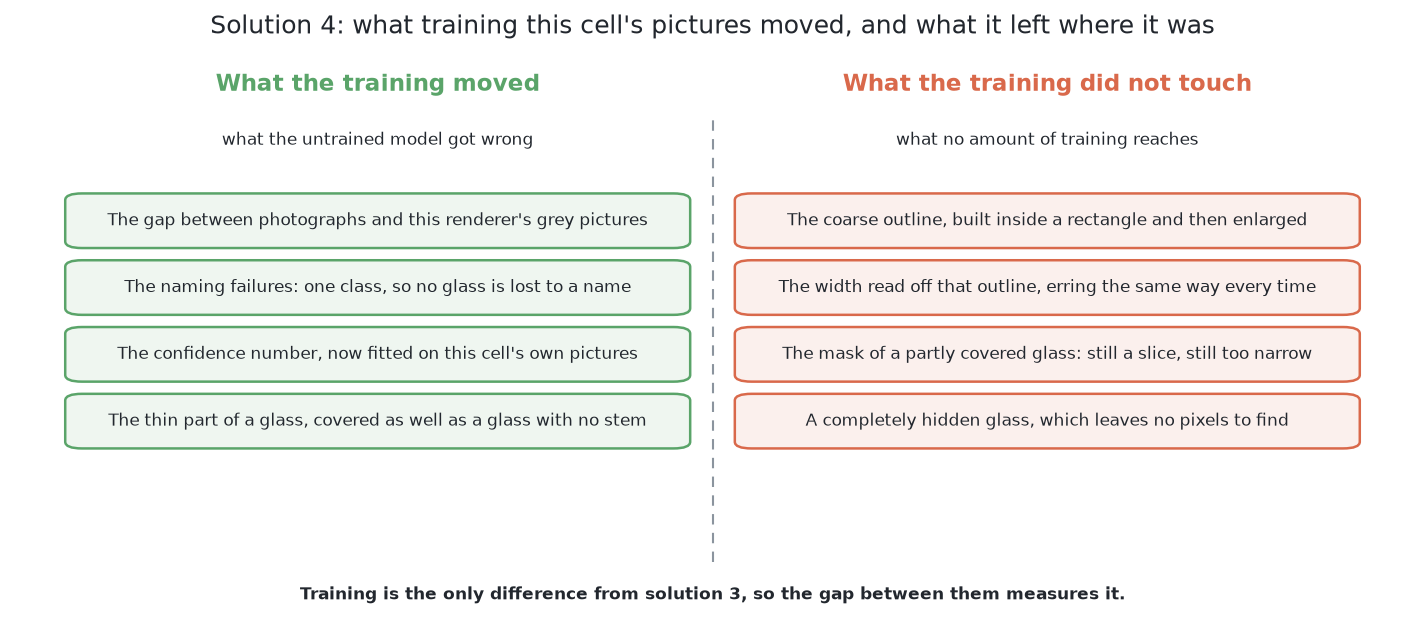
This means the gap between solution 3 and this one measures what fine-tuning gains, and nothing else. On spaced arrangements, solution 3 found 6.4 glasses in every 100. This solution found 99.4. Few pairs of methods can be compared this cleanly.
This chapter explains what fine-tuning is, and why it needs much less data and time than training from random numbers. It shows which failure of solution 3 the single class removes. It shows where the training pictures come from. It shows which weaknesses training fixes and which it does not.
The next section says which problem this solution is meant to fix.
2. The problem this solves#
The introduction set up the matched pair. This section says what the training is meant to fix.
The hard case in this book is the merge. Two glasses that stand apart can still make one joined shape in the picture, as what is asked for explains. A model that finds objects gives one outline per object, not one per joined shape. So it can separate the two.
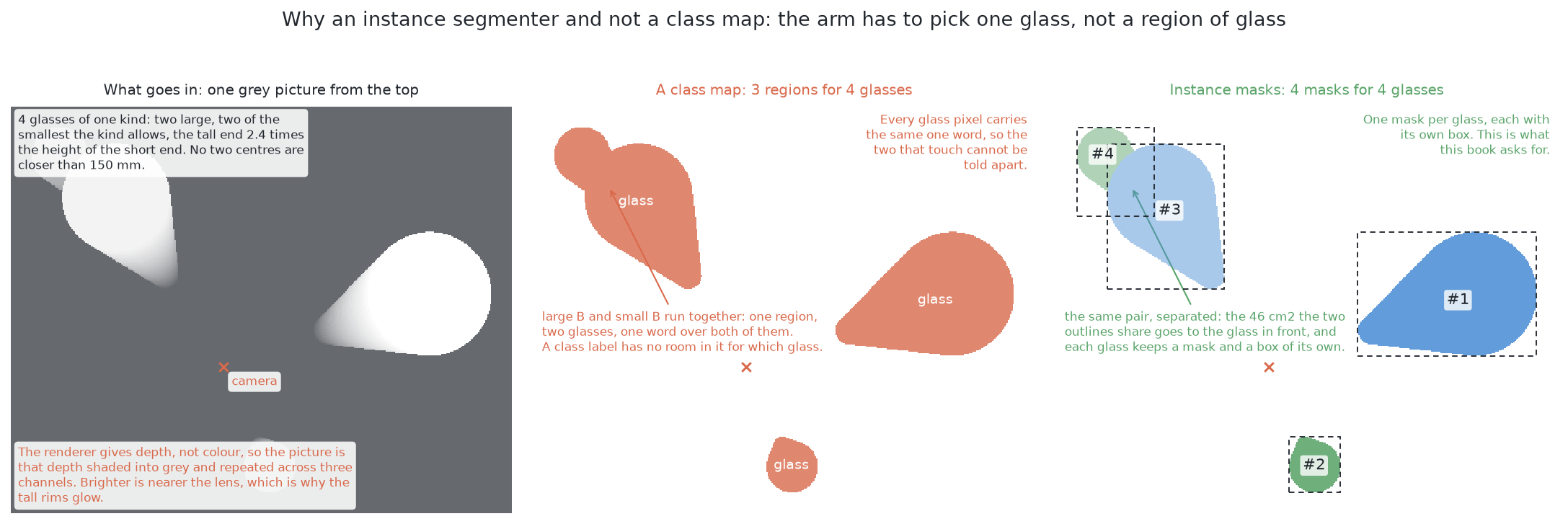
Solution 3 already has such a model, without any training. So the question here is narrower: the finding is already borrowed, so what is still wrong, and does training fix it?
Solution 3 has a domain gap. Its model was trained on photographs, but this cell gives grey pictures shaded from depth, as why it failed explains. This causes three problems:
- The model has much less of the evidence it learned to use.
- Its list of names belongs to somebody else. So it can call a glass by a name the filter drops, or by two names at once.
- Its confidence was learned on photographs, so it is not a probability here.
The marking shows which problem mattered. It was the names. The borrowed model called a glass a sports ball or a frisbee, and the filter dropped almost everything. The single class "glass" removes this failure, because the model no longer chooses a name. Training on this cell's own pictures is the usual fix for all three problems.
The next section shows how this solution does that.
3. The main idea#
The section above named the problems. This section gives the fix in one sentence: keep the borrowed weights, and train them further on this cell's pictures, with one class instead of the general list.
Three things follow from that sentence.
The weights do not start from nothing. A model's weights are the numbers inside it. Starting from random numbers would mean teaching the model everything, even that an edge matters. The borrowed weights already know that. So training starts from them. This is why a model this size can be trained on this machine, which has no separate graphics card. What fine-tuning is explains which parts of the model change.
The pictures are this cell's pictures. Training shows the model the grey pictures. So when it runs, it sees the same kind of picture it was trained on. This is how fine-tuning closes the domain gap.
The class list has one entry. The model no longer decides which everyday object it sees. It only finds objects. Each object it finds is a glass.
Everything else about the model stays the same. Its outline is still built coarsely, so its masks are a little too big. What training closed, and what it left gives the cost. The next page shows the code.
← A borrowed model, as it downloads — results and comparison · The code →