This is where coordinated two-arm work is actually happening. The tasks that justify a second arm — cloth, re-grasping, holding one thing while working on another — are exactly the tasks nobody can write down, and the best-known bimanual system was built for two arms from the start rather than adapted to them.
This document assumes you know the single-arm versions of these methods. It does not repeat them. It says what changes when two arms have to cooperate, and it is unusually specific about evidence, because three claims that sound obviously true about two-arm learning turn out not to be supported and each of them is repeated constantly.
Contents#
- Why copying is the method that fits two arms
- One policy or two, and what the evidence says
- Collecting two-arm demonstrations
- What the numbers actually look like
- Correcting a two-arm policy as it goes
- Why reinforcement learning struggles with coordination
- Pretrained policies, and the data problem
- Learned pieces: which arm takes which grasp
- Where to practise
- What to take from all of it
1. Why copying is the method that fits two arms#
There is a structural reason imitation learning dominates this field, and it is worth stating because it explains the whole shape of the literature.
Copying is the one approach that does not need the coordination to be described. Every other method requires you to say something about how the arms relate: a planner needs the constraint written down, a controller needs the object's frame and the squeeze specified, a behaviour tree needs the waits placed. You never write down that the left hand should hold the shirt taut while the right hand smooths it. You just do it, several hundred times, and the coordination is in the data.
That is why the best-known bimanual learning work is not a two-arm adaptation of a one-arm method — it was built for two arms from the start. And it is why the field jumped from "two arms are too hard" to "two arms fold laundry" without ever solving the coordination problem in the classical sense. It went around it.
The cost of going around it is that you cannot inspect what was learned, and you cannot transfer it. A cooperative controller you write once works for any object; a policy that learned to fold shirts has learned shirts.
2. One policy or two, and what the evidence says#
The normal design is a single network whose output is the commands for both arms at once. For two six-joint arms with a gripper each, that is fourteen numbers per step. The argument is that the coordination then sits inside one prediction, so the policy cannot produce a left-arm motion that contradicts its own right-arm motion.
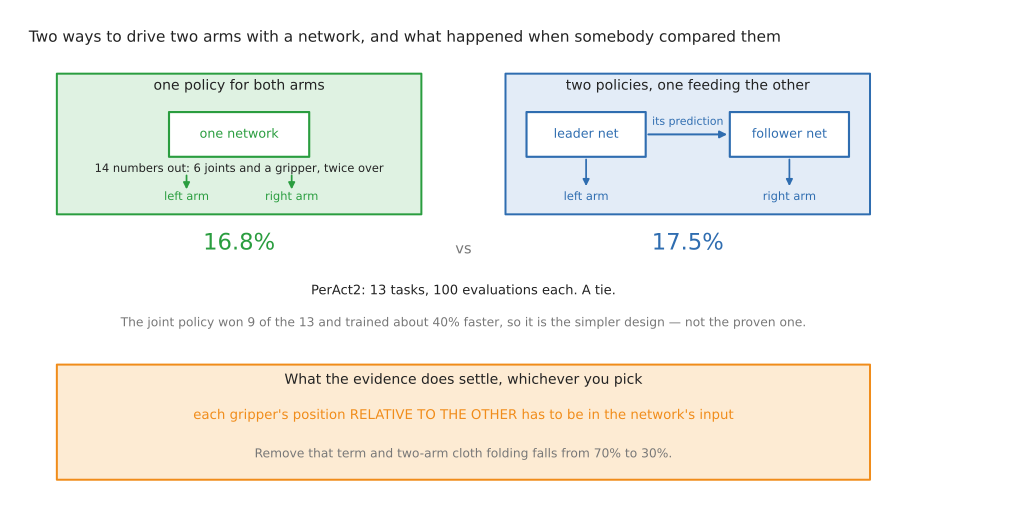
That argument is persuasive and it is what most systems do. It has also been measured, once, cleanly, and the result is a tie. PerAct2 compared a single two-arm network against two separate networks where one arm's prediction is fed to the other, on thirteen tasks with a hundred evaluations each, and got 16.8% for the joint policy against 17.5% for the pair. The joint policy won on nine of the thirteen tasks and trained in about 40% less time, which is a real advantage — but "one policy beats two" is not something the numbers support. Treat the joint policy as the simpler design rather than the proven one.
What is measurably true is that the arms must see each other's state. The one clean bimanual ablation available comes from UMI: removing the term that tells the policy where each gripper is relative to the other dropped two-arm cloth folding from 70% to 30%. Whatever architecture you choose, the coupling between the arms has to be in the input. This is the same idea as the cooperative control formulations arrived at informally — relative pose is the quantity that matters — and it is the closest the learned side comes to using that theory.
A third claim to drop: chunking is not a two-arm technique. Action chunking was demonstrated on a two-arm robot, so it is often said that it exists to keep the arms coherent. The paper does not say that — its argument is about compounding error and applies identically to one arm — and as of 2026 no published study isolates a two-arm-specific benefit. If anything the evidence points the other way: a follow-up that looked specifically at two arms argued plain chunking is insufficient for them, and added machinery for the dependencies between the arms on top. Chunking needing extra help for two arms is not the same as chunking mattering more.
3. Collecting two-arm demonstrations#
Demonstrating is genuinely harder with two arms, and this is the part people underestimate. Somebody has to drive fourteen joints at once, in a coordinated way, for hundreds of episodes, without the fatigue showing up in the data.
The rig choice is not a matter of taste — it has been measured. A controlled study with twelve participants across five two-arm tasks compared three ways of doing it:
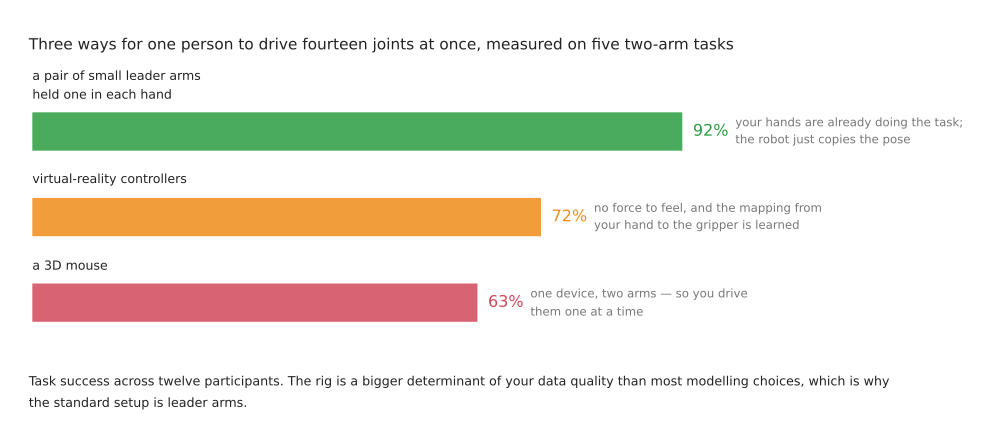
Leader arms at 92% task success, virtual-reality controllers at 72%, and a 3D mouse at 63%. That is why the standard rig is a pair of small leader arms held one in each hand, with the real arms following. The gap is large enough that the rig is a bigger determinant of your data quality than most modelling choices.
You also need cameras that can see the pair. One overhead view plus one camera on each wrist is the usual arrangement, and the reason is specific: the overhead view shows the relation between the arms, which is the thing section 2 says must be in the input, and the wrist views show what each arm is about to touch. Dropping the overhead view to save a camera removes exactly the information the coordination depends on.
This repo covers the practicalities in where the data comes from, which goes through the rigs people actually use and what each one costs.
4. What the numbers actually look like#
This is worth setting out properly, because the headline impression of two-arm imitation is considerably rosier than the tables in the papers.
The original ALOHA work is where "fifty demonstrations is enough" comes from. Over 25 trials per task it reported: sliding a bag closed 86%, slotting a battery 93%, opening a cup 84%, putting on a shoe 92%, preparing tape 64% — and threading velcro 20%, from twice as many demonstrations as the rest. The summary "80–90% success" that gets quoted covers four of those six.
Look at the stages rather than the totals and it is sharper still: the velcro task lifts successfully 92% of the time, grasps 40% of the time, and inserts 20% of the time. The failures are concentrated exactly where the two arms have to agree with each other.
Then the scaling result, which is the most sobering number in this folder. ALOHA Unleashed collected 26,241 demonstrations across five tasks — roughly a hundred times the original's fifty per task, gathered on ten robots over eight months by thirty-five operators. It reported hanging a shirt at 75%, tying a shoelace at 40% on the harder variant, and inserting gears at 95% for one gear, 75% for two and 40% for three. Stacking kitchen items went 95% for one item, 65% for two, 25% for three.
Two things follow, and both matter for anyone planning a project. Success rates did not end up higher than the fifty-demonstration results. And compounding error across a sequence survived both action chunking and diffusion, which were the two techniques meant to address it. Nothing from that work was released.
One more number for calibration. A 2026 evaluation of a frontier vision-language-action model on a simulated ALOHA — run properly, at 300 trials per task with confidence intervals — scored 99% at handing an object from one arm to the other and 6.7% at folding a towel in half. The gap between those two numbers is the gap between a brief closed chain with a clear success condition and a deformable object whose state you cannot even represent.
5. Correcting a two-arm policy as it goes#
The correction rig is the same leader-arm pair used to collect the demonstrations, so a person can grab either arm the moment it goes wrong — which is usually the arm that was not being watched.
The failures worth correcting are mostly coordination failures rather than single-arm ones: the holding arm drifted, the handover released early, the two arms pulled the cloth out of each other's grip. These are hard to anticipate when collecting data and obvious the moment you see them, which is exactly what this method is for.
Status in 2026: this is how a good two-arm policy is made reliable, and the technique has merged with reinforcement learning — the human's take-overs become the learning signal. The strongest published results in this area (HIL-SERL, 100% on every task after one to two and a half hours) are single-arm, so treat the two-arm case as the same method with less evidence behind it rather than as a proven recipe.
Worth learning now? Yes, and it is the highest-leverage thing you can do with a cheap pair of arms. Collecting fifty two-arm demonstrations is a weekend; correcting the resulting policy for an hour will teach you more about where coordination breaks than reading every paper cited here.
6. Why reinforcement learning struggles with coordination#
Two arms make reinforcement learning harder in a way that is worth understanding properly, because it explains why the field went the imitation route.
The robot learns by trying things and keeping what worked. With two arms the space of things to try is the product of both arms' possibilities rather than the sum. That alone would be bad enough.
The real problem is worse and more specific. Most useful coordinated behaviours only pay off when both arms do the right thing at the same time. A handover gives no reward at all unless one arm has arrived and the other releases at the right moment. Random exploration will essentially never stumble on that combination, so there is no gradient to climb — the reward is not merely sparse, it is sparse in a way that requires two independent things to be simultaneously correct.
This is the technical reason coordinated two-arm systems are taught by demonstration rather than by practice: the demonstration supplies the coordinated behaviour that exploration cannot find, and practice is then used to polish it.
Good for: as a second stage after demonstrations, on Group A contact skills. Not as a first stage, and not on its own. Status in 2026: consistent with the single-arm picture — training from scratch is now the exception, and fine-tuning a demonstrated policy is the norm.
7. Pretrained policies, and the data problem#
Are the large pretrained models bimanual? Mostly by accommodation rather than by design, and the data explains why.
It is tempting to assume that a model trained on everything has seen plenty of two-arm work. It has not. Open X-Embodiment, the pooled cross-robot corpus the first generation of these models was built on, labels just two of its seventy-two datasets as bimanual — about 520 episodes out of 2.4 million, roughly two hundredths of one percent. Counting a third, misfiled two-arm dataset barely changes it.
The field's flagship shared corpus is, in effect, entirely single-armed, and that is the plainest available explanation of why two-arm learning lagged behind single-arm learning. If you have read that these models are "bimanual by default because their training data is", that is the claim this number refutes.
That history is visible in how the models are built. Most of them define one long action vector and pad it out to whatever the robot needs, so two arms are an accommodated special case. One model inverts this: RDT was designed bimanual first, splitting its state vector into a right-arm half and a left-arm half, and its documentation instructs you that if your robot has one arm you should write its values into the right-arm portion — single-arm as the padded special case, which is the opposite of everyone else. Its 2026 successor H-RDT continues that line. It is a good illustration that "supports two arms" and "is built for two arms" are different claims.
The data situation is now changing quickly, and this is the most useful thing in this section. Purpose-built two-arm datasets have arrived at a scale the old pooled corpus never had:
- AgiBot World, gathered on a dual-arm platform and published at IROS 2025. Released under CC BY-NC-SA 4.0 — non-commercial, which rules it out of client work; check this yourself before building on it, because the repository carries no licence file and the terms live in the README.
- RoboMIND 2.0, bimanual by deliberate design — over 310,000 dual-arm trajectories across 739 tasks and six platforms, with even its single-arm robots re-rigged as pairs. Apache-2.0, but a preprint with no venue and around 112 TB to download.
- Galaxea's open dataset, 500-plus hours on one dual-arm platform, in LeRobot format.
- Amazon's ABC-130k, new in June 2026 and the largest openly licensed one: 130,703 episodes, roughly 3,591 hours, collected on a bimanual station, Apache-2.0, with a published reproduction stack. If you want permissively licensed two-arm data at scale, start here.
If you are training anything two-armed, these rather than Open X-Embodiment are where the data is — and check the licence of each one, because they differ and the most cited is the most restrictive.
One practical warning about checkpoints. Check what is downloadable rather than what is supported, because for two arms they differ. GR00T's code carries embodiment definitions for two-armed humanoid platforms, with separate left-arm and right-arm entries — but every fine-tuned checkpoint released for it is single-arm. On the openpi side there is a configuration for the two-armed ALOHA platform with no published checkpoint behind it. The base models are genuinely usable for two arms; you will be fine-tuning one yourself rather than downloading a two-arm policy someone else trained.
8. Learned pieces: which arm takes which grasp#
With two arms, one thing is added to the modular pattern, and it is not perception itself. The networks are the same, and they neither know nor care how many arms will use their output.
What changes is the choice made with their output. A grasp proposer returns many candidate grasps, and with two arms you are choosing which arm takes which one: whether both can be reached, whether taking this one with the left arm leaves the right arm able to reach the next, and whether the resulting pair of motions collide.
That selection is ordinary code sitting between the network and the planner, and it is where most of the two-arm engineering in such a system lives. It is also where the classic failure is: the perception was right and the assignment was wrong, so the arms end up crossed over the bin and the second grasp is unreachable.
Worth learning now? Yes, and it is a good first two-arm project precisely because the hard parts are ordinary code. You can build the grasp-assignment logic without touching a policy.
9. Where to practise#
Benchmarks, with the licences that matter.
RoboTwin 2.0 (2.9k stars, MIT, active) is the most complete open two-arm stack — 50 dual-arm tasks including handovers and joint lifts, with over 100,000 pre-generated trajectories. This is the one to start with.
gym-aloha (Apache-2.0) is the small one, with exactly two environments: transfer a cube between the arms, and a two-arm insertion. Both are coordinated tasks, which makes it a good minimal test bed.
robosuite (2.6k, MIT) has four two-arm tasks — lift, peg-in-hole, handover, transport — and one property that makes it unusually good for learning: you can run the same task with one genuinely two-armed robot or with two independent single arms, which is as close to a controlled experiment on "what does coordination actually change" as anything available. If you want to understand this folder empirically rather than by reading, that is the experiment to run.
Be careful with licences before building on MimicGen or DexMimicGen, which are research-only under NVIDIA's licence, and with anything built on RLBench, which is academic-use only — PerAct2, the main two-arm benchmark in that family, inherits the restriction and has been dormant since early 2025.
Code. LeRobot supports two arms
directly: the bi_so_follower robot and bi_so_leader teleoperator compose two
single arms into a pair, with observations prefixed left_ and right_. ALOHA
hardware support now lives in a separate
Trossen plugin rather than in
LeRobot itself. For the bimanual-first alternative see
RDT and its successor
H-RDT (MPL-2.0).
10. What to take from all of it#
Three widely repeated claims are not supported by the evidence, and knowing which is worth more than knowing any individual result:
- "One joint policy beats two policies plus a link." Measured once: 16.8% against 17.5%. A tie.
- "Action chunking matters more for two arms." The paper's argument is arm-count agnostic, and a follow-up says plain chunking is insufficient for two arms.
- "Pretrained policies are bimanual by default because their data is." Open X-Embodiment is about 0.02% bimanual.
One claim that is supported: the relative pose of the two grippers must be in the policy's input. 70% to 30% when it is removed.
Imitation dominates because it is the only method that does not require the coordination to be described. That is a genuine advantage and also the reason nothing learned transfers between tasks.
The data has moved. Two-arm pretraining data now exists at scale, in purpose-built datasets rather than the famous pooled corpus. That is the single biggest change in this area during 2026.
Next: back to the overview, or to the programmed methods for the control theory the learned side has not yet absorbed.