One arm picks things up and puts them down. Two arms cooperating can do the things that actually fill a working day: hold a garment open and fold it, steady a housing while driving a screw into it, pass a part from one hand to the other to get a better grip, carry something too big for one gripper.
The moment the arms have to agree with each other, the question stops being "how do I move the arm" and becomes "how do these two get one job done between them" — and that is a genuinely different problem, with its own failure modes and its own literature. This folder is about that problem and nothing else.
What is in scope, stated precisely. Coordinated two-arm work: the arms are cooperating on one job, and what each does depends on what the other is doing. Two arms doing unrelated things in a shared cell are out of scope, because that is not a two-arm problem. It is two single-arm problems plus a collision check, and the standard survey of the field puts it bluntly — uncoordinated two-arm work has "no intrinsic difference to single-arm systems". Solve it by running the one-arm methods twice and keeping the arms apart.
Read the one-arm documents first, including what is changing and why for the direction the whole field is moving. Almost every method here is a single-arm method with a coordination problem bolted on, and the coordination problem is only legible once you know the method. This folder does not repeat them; it says what changes.
The four documents#
When two arms are really useful. Whether your task needs a second arm at all — the fixture comparison, how rare dual-arm robots actually are, the counter-evidence, the task catalogue, and a checklist. Read this first. It may well send you back to one arm, which is a good outcome.
This document — the map. How two arms can be coupled, the layer a second arm adds, which method suits which coordinated task, and what is realistic to build.
Programmed methods. What changes in teaching, offline programming, behaviour trees, motion planning and feedback control when two arms must cooperate. This is where the hardest and least-discussed material is, because coordinated control is a solved problem in theory and a poorly-tooled one in practice.
Learned methods. What changes in imitation learning, reinforcement learning and pretrained policies. This is where two-arm work is actually happening, and where the published numbers are.
Contents#
- The two ways two arms can be coupled
- The handover, which is both
- The same ideas in the words the literature uses
- The layer a second arm adds
- Which method for which coordinated task
- What coordination costs you, method by method
- What real coordinated systems actually do
- What you can realistically build in the next year
1. The two ways two arms can be coupled#
How tightly the arms are tied to each other is the single most important design decision in this folder. It determines whether you can treat them as two ordinary robots that must agree occasionally, or whether you need software that thinks of them as one machine. Everything else follows from it.
Loosely coupled: one holds, one works#
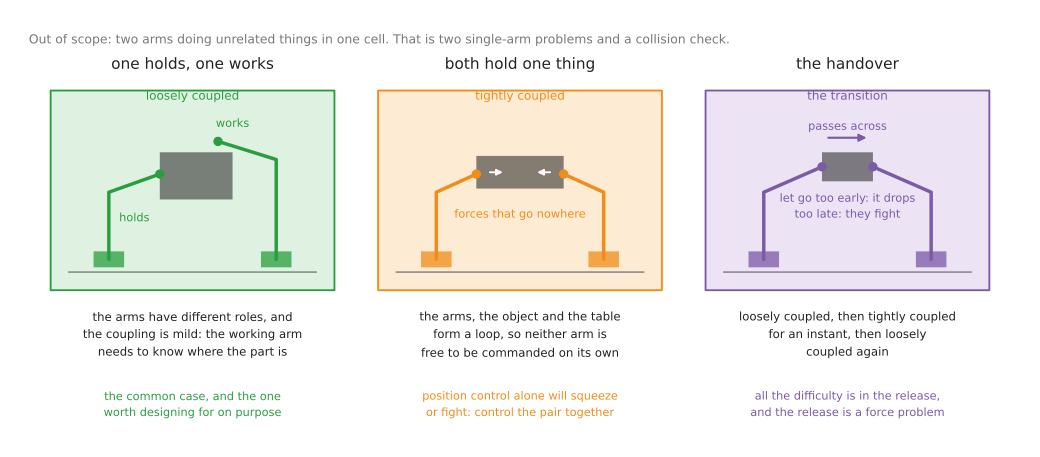
One arm grips the workpiece and holds it steady, or presents it at a convenient angle; the other does the fine work on it. The two arms have different roles, and the roles are not interchangeable — the holding arm needs to be stiff and stay put, the working arm needs to be precise and compliant.
This is the most common useful pattern, it covers most of the tasks in the task catalogue, and it mirrors what people do without thinking: your off hand holds the jar while your other hand turns the lid.
The coupling is real but mild. The working arm needs to know where the holding arm put things, and the holding arm must not give way when pushed — but the two can still be controlled largely separately, which is why almost everything that works today is built this way.
That separation is worth designing for deliberately rather than stumbling into. One research system built exactly on this idea — one arm stabilises the object, a learned component decides when it needs re-stabilising, and the other arm acts — reached 77% across four tasks from twenty demonstrations, well above an unstructured policy given the same data. Telling the system which arm holds is information you have for free, and it is worth roughly as much as a lot of extra data.
Tightly coupled: both hold one thing#
Both grippers grip the same rigid object, and now the arms, the object and the table form a closed loop. This is the case that breaks ordinary software, and it is worth being precise about why, because the reason is not a bug anywhere.
If you command each arm to a position independently and the two commands disagree by even a millimetre, the arms do not split the difference. They fight, squeezing or stretching the object between them with forces that can be enormous and that no camera will show you. The object's position is over-specified, and something has to give — the object, the grippers, or the arms.
The arithmetic makes it unavoidable. Two six-joint arms have twelve degrees of freedom between them; the object they hold has six. The other six dimensions do not disappear — they become force. That is the internal or squeeze force: the part of what the arms exert that produces no motion at all, only compression or tension in the object between them. You cannot choose not to have it. You can only choose whether you command it deliberately or discover it when something is crushed.
Handling this properly means controlling the pair as one system, usually by commanding the object's motion and the squeeze separately. The feedback control section works through how.
The practical advice#
Keep the coupling as loose as the task permits. Use hold-and-work wherever the arms can cooperate that way, and accept the closed chain only where the object genuinely has to be carried or stretched by both — because everything from motion planning to policy learning gets harder in that order. A surprising number of tasks that look like they need a closed chain do not, once you are willing to let one arm be a fixture.
2. The handover, which is both#
A handover — an object passing from one gripper to the other — deserves its own treatment, because it is the transition between the two cases and the one place every two-arm system eventually goes wrong.
For most of the motion it is loosely coupled: one arm carries, the other approaches. Then for a moment both arms hold the object, and you are briefly in the closed-chain case with all of its problems. Then one lets go.
The difficulty is concentrated entirely in that instant of release. Let go too early and the object drops; too late and the arms fight, dragging the object out of the receiving gripper or deforming it. Doing it by position is guesswork — the two grippers' positions are known to about a millimetre and the timing to about a control cycle, and neither is good enough. Doing it by watching the force fall as the other arm takes the weight is measurable, which is why the release is a force problem rather than a planning problem.
It is also the single most useful thing to build first if you are learning this. It is short, it fails visibly, the failure is instructive, and every open two-arm benchmark includes one.
3. The same ideas in the words the literature uses#
The plain names above are the ones this folder uses, but you will meet the formal versions and they are worth recognising — with one caveat that comes at the end.
The 2012 dual-arm survey that most papers cite splits the field into non-coordinated manipulation, where the arms do two different tasks — the case this folder excludes — and coordinated manipulation, where they work on the same one. It then divides coordinated work into goal-coordinated, where the arms contribute to the same goal without touching each other or the same object, and bimanual, reserved for arms physically interacting with the same object. So "bimanual" in that vocabulary is narrower than "two arms": it means the closed chain. (That survey popularised the taxonomy but did not invent it; it credits a 2010 paper by Surdilović and colleagues.)
The modern reference is Krebs and Asfour's bimanual manipulation taxonomy from 2022, which is the one to read if you read one. It separates loosely coupled actions, connected only by shared waypoints in space or moments in time, from tightly coupled ones, where contact creates forces that constrain both arms together — exactly the distinction in section 1, and the source of the names used there.
It also gives the hold-and-work pattern its proper name, role-differentiated bimanual manipulation, borrowed from a model of human handedness in which the non-dominant hand stabilises the object and sets the frame of reference that the dominant hand then works in. It is reassuring that the ergonomics literature arrived at the same arrangement first.
One nuance from that work is worth keeping against section 4: in human manipulation the roles are not statically assigned to a particular hand, but swap to suit each step. Robot systems today almost always fix them, which is a simplification rather than a principle.
A separate and often-confused distinction is symmetric against asymmetric coordination — whether the two arms are doing the same thing to the same object, or different things. It comes from a 2004 paper by Zöllner, Asfour and Dillmann, which is also where the closed kinematic chain first enters the taxonomy, and it is a different axis from how tightly the arms are coupled. Conflating the two is a common error: two arms can be symmetric and loosely coupled, or asymmetric and tightly coupled.
One honest caveat about all of this: there is no standard here. No ISO or IEEE document defines a dual-arm coordination taxonomy — the international vocabulary for robots offers only "simultaneous motion" and "robot cooperation", and reserves "collaborative" for humans working with robots, so do not borrow that word for two arms working together. Recent papers do not agree either: some reuse the 2012 terms, some independently reinvent "loosely and tightly coupled" without citing anyone, some use "master–slave versus symmetric", and at least one survey explicitly declines to propose a taxonomy at all. Treat the vocabulary above as a good map rather than an agreed standard, and expect any paper you read to have picked its own words.
One practical vocabulary is worth knowing because it appears in working code: the data-generation tool DexMimicGen splits two-arm subtasks into parallel (each arm runs independently), coordination (both arms' timing is synchronised so their relative pose is maintained) and sequential (one arm waits for the other to finish, as in a handover). Those are the same ideas again, expressed as scheduling rules.
4. The layer a second arm adds#
A single arm doing a real job answers four questions over and over, set out in the one-arm overview: what to do next, which skill and where, how to move, and how to touch. Coordinated two-arm work adds a fifth, and it sits near the top.
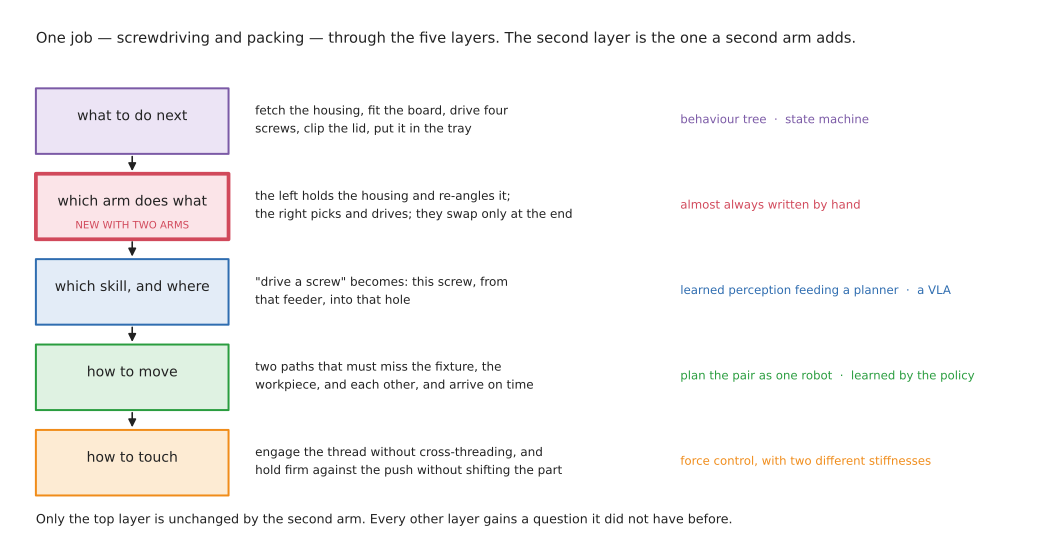
Which arm does what — who holds, who works, and when they swap. Take a screwdriving-and-packing job. The sequence is: fetch the housing, fit the board, drive four screws, clip the lid, put it in the tray. The new question is that the left arm holds the housing throughout and re-angles it between screws, the right arm does all the picking and driving, and they swap only when the finished unit is lifted into its box.
Role assignment is almost always written by hand, and in a well-designed system it is written once and never changes: this arm holds, that arm works. Fixing the roles in advance costs you some flexibility and buys an enormous simplification, because each arm can then be given a single job that a single-arm method already solves. A system that decides dynamically which arm should do the next step is more capable and much harder to build, and outside research it is rare.
The other four layers all change too, and each method document says how. In short: how to move becomes two paths that must miss each other and arrive at agreed times; how to touch gains the internal force problem; which skill and where gains the question of which arm can reach it. Only what to do next is largely unchanged.
5. Which method for which coordinated task#
Read a row to plan a system; read a column to see where a method earns its keep.
The columns are the same nine as in the one-arm grid, and that document explains what each one is and what you would install. This section says something different and more useful here: what actually changes for each when the arms must cooperate, and which of those tools support two arms at all. The short answer is that about half of them do not, and knowing which half in advance will save you weeks.
The nine columns, for two coordinated arms#
Teach / offline programming. Still how coordinated two-arm robots are programmed in industry, and there is no open-source equivalent whatsoever. The capability lives in vendor controllers — ABB's MultiMove is the one to study, with its independent, semi-coordinated and coordinated-synchronised modes and its rule that the number of motion instructions between synchronisation on and off must be identical in both arms' programmes. Offline programming handles the loose case through synchronisation points ("arm one waits here until arm two reaches there"), which commercial tools have supported for decades and which is enough for most hold-and-work tasks. The open industrial stack — Tesseract, Noether — has no two-arm coordination concept at all. Read the programmed methods document for why that lockstep rule tells you everything about the difficulty.
Motion planning. The method that changes most, and the one where the tooling gap is sharpest. MoveIt 2's maintained dual-arm Panda configuration is the reference to copy, but it defines two planning groups and plans one at a time — no shipped configuration plans them as one twelve-joint robot, the default inverse-kinematics solvers are chain solvers so a closed loop cannot be solved at all, and there is no constraint type relating two grippers to each other. cuRobo genuinely plans for two arms at once and ships a dual-arm configuration — it is the best open answer here — though it too cannot express a constraint between the grippers, and it needs an NVIDIA card. For a real closed chain, Drake and Pinocchio are the two libraries with genuine closed-kinematic-chain support and are worth switching to. There is no maintained ROS 2 dual-arm coordination package at all.
Force control. The column that is never empty in the grid below, because loads pass between the arms whatever else you use. ros2_control and cartesian_controllers give you per-arm admittance and Cartesian impedance, which is enough for the loosely coupled case — and note it needs two different stiffness settings at once, stiff for the holding arm and soft for the working arm, which is easy to get backwards. For the closed chain you need a controller that commands the object's motion and the squeeze separately, and no open implementation of a cooperative two-arm controller exists. You write it from the papers — search for the symmetric formulation, cooperative task space, virtual linkage, augmented object and object impedance control — using Drake or Pinocchio for the model. This is the single biggest piece of work in coordinated two-arm robotics, and it is why serious work still runs on vendor software.
Learned perception. The networks are unchanged — Segment Anything, FoundationPose and grasp proposers neither know nor care how many arms will use their output. What the second arm adds is the choice made with that output: which arm takes which grasp, whether both are reachable, whether taking this one with the left arm leaves the right able to reach the next, and whether the resulting pair of motions collide. That selection is ordinary code between the network and the planner, and it is where most of the two-arm engineering in such a system lives. It is also a good first two-arm project precisely because the hard part is code you write rather than a model you train.
Imitation. The column where coordinated two-arm work actually happens, and the
best-supported one. LeRobot supports pairs
directly through its bi_so_follower robot and bi_so_leader teleoperator, which
compose two single arms with observations prefixed left_ and right_. The
standard design is one network emitting both arms' commands — fourteen numbers per
step — though the evidence for that being better is a tie.
What is measured: the grippers' pose relative to each other must be in the input.
To practise: gym-aloha has exactly two
environments and both are coordinated;
RoboTwin 2.0 is the most complete
open two-arm stack, with 50 dual-arm tasks and over 100,000 pre-generated
trajectories. Watch the licences:
DexMimicGen is research-only, and
PerAct2 inherits RLBench's
academic-use restriction and has been dormant since early 2025.
Reinforcement learning in simulation. Harder for two arms in a specific and instructive way: the space to explore is the product of both arms' possibilities rather than the sum, and the useful behaviours only pay off when both arms do the right thing at the same moment — a handover earns nothing unless one arm has arrived and the other releases on time. Random exploration essentially never stumbles on that, so the reward is not merely sparse but sparse in two dimensions at once. robosuite has four two-arm tasks — lift, peg-in-hole, handover, transport — and one property nothing else offers: you can run the same task with one two-armed robot or with two independent single arms, which is as close to a controlled experiment on "what does coordination change" as exists. Use this column as a second stage after demonstrations, not a first.
Real-robot reinforcement learning. HIL-SERL, inside LeRobot, is the method — but be clear that its published results are single-arm. The correction rig for two arms is the same leader-arm pair you collected with, so a person can grab whichever arm went wrong, and the failures worth correcting are coordination failures rather than single-arm ones: the holding arm drifted, the handover released early, the arms pulled the cloth out of each other's grip. Treat the two-arm case as the same method with less evidence behind it rather than as a proven recipe.
Vision-language-action models. Check what is downloadable rather than what is supported, because for two arms they differ. openpi has a configuration for the two-armed ALOHA platform with no published checkpoint behind it; GR00T carries embodiment definitions for two-armed platforms with separate left and right entries, but every released fine-tuned checkpoint is single-arm. The exception is RDT and its successor H-RDT, which were designed bimanual first — RDT splits its state vector into left and right halves and tells you to write a single arm's values into the right-arm portion, the opposite of everyone else. The base models are genuinely usable for two arms; you will be fine-tuning one yourself.
Language planner. The interesting two-arm possibility is that the model assigns the roles — deciding the left arm holds the bag while the right fills it — rather than a person writing that down. Of the three shapes, the code-writing one fits two arms best, because a short program can state plainly which arm does what and in which order, and you can read it before running it. As with one arm there is no framework: you build it from a language-model API plus BehaviorTree.CPP. Treat this as a promising direction rather than how systems are built — role assignment in working two-arm systems is written by hand.
The grid#
★ the usual choice today · ✓ used, and works · ~ emerging, or used in part · – not used
The second column is the coupling from section 1 — hold for loosely coupled, chain for tightly coupled — because it predicts the rest of the row better than anything else does.
| Task | Coupling | Teach / offline | Motion planning | Force control | Learned perception | Imitation | RL in sim | Real-robot RL | VLA | Language planner |
|---|---|---|---|---|---|---|---|---|---|---|
| A. Screwdriving and packing | hold | ★ | ✓ | ★ | ✓ | ~ | ~ | ~ | – | – |
| A. Connector / harness insertion | hold | ✓ | ✓ | ★ | ✓ | ✓ | ★ | ★ | ~ | – |
| A. Kitting and packing | hold | ✓ | ★ | ~ | ★ | ~ | – | – | ~ | ~ |
| B. Bin picking with a re-grip | chain | – | ★ | ✓ | ★ | ~ | ~ | – | ~ | – |
| B. Unloading a dishwasher or crate | hold | – | ✓ | ✓ | ✓ | ★ | – | – | ★ | ✓ |
| B. Mating two held parts | chain | ~ | ✓ | ★ | ✓ | ✓ | ★ | ★ | ~ | – |
| C. Laundry folding | chain | – | ~ | ✓ | ✓ | ★ | ~ | ~ | ★ | ~ |
| C. Cable and harness routing | hold | ~ | ✓ | ★ | ✓ | ★ | ~ | ~ | ~ | – |
| C. Bag and container handling | hold | – | ✓ | ✓ | ★ | ★ | – | – | ✓ | ~ |
| D. Stacking irregular stones | hold | – | ★ | ★ | ✓ | ~ | ~ | ~ | – | ~ |
| D. Building from rubble | hold | – | ★ | ✓ | ✓ | ~ | ~ | – | – | ~ |
Four things fall out of the grid.
Force control is the one column that is never empty. Whatever else you use, two arms working on one object means loads passing between them, and something has to manage that. If you take one thing from this folder, take that.
Group A is where the two families meet. Force control does the work today, learned methods are arriving specifically for the precise phase, and the 2026 approach — demonstrations to get the shape of the task, then a short burst of reinforcement learning to make it reliable — was demonstrated on exactly these jobs. This is the group to watch if you care about manufacturing.
Groups C and D cannot be done any other way. There is no CAD model of a shirt, and no published system folds laundry by planning. Where the object's shape is decided by where the two arms hold it, learning is not an improvement but the only option.
The "chain" rows are the hard ones, and the pattern is visible. Where both arms hold the same object, teaching and offline programming drop out entirely, force control becomes essential, and the learned methods take over. That is the whole argument of this folder in one column.
6. What coordination costs you, method by method#
This is the table this folder exists for: what the second arm adds to each method's bill, over and above what the single-arm version already demanded.
The eight families are the same as in that document, which explains what each one is and what you would install. Before the table, here is the question that actually decides your project plan: does the open tooling support two arms, or will you be writing it?
Does the open tooling support two arms?#
| Family | Two-arm support in open tools | What you write yourself |
|---|---|---|
| Teach & replay | none — this lives entirely in vendor controllers (ABB MultiMove and its equivalents) | everything, or you buy the controller |
| Offline prog. + planner | none in the open industrial stack; synchronisation points are a commercial-tool feature | the waits and the arm-to-arm calibration |
| TAMP | PDDLStream can express which arm does what in principle | the domain model, and in practice you assign roles by hand anyway |
| Classical control | per-arm admittance and impedance from ros2_control and cartesian_controllers; no cooperative two-arm controller exists | the closed-chain controller, from the papers, on Drake or Pinocchio |
| Imitation | good — LeRobot bi_so_follower / bi_so_leader, gym-aloha, RoboTwin 2.0 | nothing; the algorithm is unchanged, the data collection is the work |
| RL (sim → real) | robosuite has four two-arm tasks and a one-robot-or-two-arms switch | a reward that two arms can actually stumble into |
| VLA fine-tune | configurations exist, checkpoints mostly do not; RDT / H-RDT are bimanual-first | the fine-tune, on your own two-arm data |
| Learned pieces in a classical stack | the networks are arm-count agnostic, so full support | the grasp-assignment logic — which arm takes which grasp |
Read that table down the middle column and the plan writes itself: start in the imitation row, because it is the only one where the open tooling genuinely supports two arms out of the box, and treat the classical-control row as the serious engineering project it is.
Planning motion for the pair#
Motion planning is split across two rows above because it sits under several families, so it is worth stating separately. The reference to copy is MoveIt's dual-arm Panda configuration, which plans the arms one at a time; cuRobo is the one open planner that genuinely plans both at once. Neither can express a constraint between the two grippers, and there is no maintained ROS 2 dual-arm coordination package. Budget for that rather than assuming you have misconfigured something.
| Teach & replay | Offline prog. + planner | TAMP | Classical control | Imitation | RL (sim → real) | VLA fine-tune | Learned pieces in a classical stack | |
|---|---|---|---|---|---|---|---|---|
| 1. Extra work for the second arm | teach both, then insert the waits | model both arms, check arm against arm | the search grows sharply | a coordinated controller, written once | collect two-arm demonstrations; the algorithm is unchanged | exploration gets much harder | none worth naming | choose which arm takes which grasp |
| 2. Demonstrations needed | one per arm, by hand | none | none | none | 50–1000+, and harder to record | none | 10–500, and harder to record | none |
| 3. Handles one holds, one works | yes, with waits | yes | yes | yes, and needs two different stiffnesses | yes, naturally | yes | yes | yes |
| 4. Handles both hold one object | no | no | rarely | yes — this is its job | yes, learned implicitly from demos | yes, in simulation | yes | not applicable |
| 5. Handles a handover | no | no | in principle | yes, by force | yes, and it is the standard demo | hard: the reward is sparse | yes | not applicable |
| 6. How the arms stay in step | explicit waits you write | synchronisation points in the programme | the planner schedules both | one controller commanding the pair | one policy predicts both arms at once | a shared reward | one policy predicts both arms | your own code decides |
| 7. Typical two-arm failure | the arms collide, or a wait is in the wrong place | the model differed from reality, now twice over | no plan found, or too slow | the pair fight and crush what they hold | the arms drift out of step and drop it | never discovers the coordinated behaviour at all | confidently wrong with both arms at once | the wrong arm was given the grasp |
Read row 4 across and the shape of the field appears: the closed-chain case is handled by exactly two things — a coordinated controller written by an engineer, or a policy that learned it from demonstrations. Everything in between is silent on it. That is why this folder has two method documents and not five.
7. What real coordinated systems actually do#
A few worth understanding properly — and note the pattern, because it is the honest summary of this whole folder: the deployed systems are single-arm, and the coordinated two-arm systems are the learned ones. Nobody has put a two-armed robot into production doing coordinated work by programming it, and nobody has needed to, because the tasks that justify two arms are exactly the tasks that resist being written down.
ALOHA with ACT is the two-arm reference point. Two arms, a pair of leader arms for a person to drive them with, fifty demonstrations, one policy that outputs both arms' commands, and no model of anything. It is the counter-example to most of this folder: sometimes copying really is enough, and the fact that it works at all on two arms is why the field went in this direction.
DexMimicGen uses programming to manufacture the data that training needs: a classical routine turns a handful of two-arm demonstrations into thousands by re-composing them around the objects' positions, splitting subtasks into parallel, coordinated and sequential kinds so that the relative timing survives the re-composition.
Figure's Helix splits by speed: a vision-language model at 7–9 Hz to understand the scene, and a separate visuomotor policy at 200 Hz to move. Thinking and reacting have different timescales, so they are different models.
SpeedFolding is the counterweight everyone forgets. A two-armed system built the classical way — learned perception feeding planned motions — it reported 93% success on a known t-shirt and 80–87% on unseen garments, at thirty to forty folds an hour from a crumpled start, and won a best-paper award in 2022, three years before the current wave. Nobody has run the classical and learned approaches against each other on the same garments, so "learning won here" is the direction of travel rather than a measured result.
| System | Programmed part | Learned part | Why the split falls there |
|---|---|---|---|
| MimicGen / DexMimicGen | the routine that multiplies demonstrations | the final policy, by imitation | programming manufactures the data training needs |
| RoboTwin 2.0 | expert data generation, randomisation, evaluation | the policies under test | the benchmark is programmed, the subject is learned |
| Figure's Helix | the low-level stack | a VLM at 7–9 Hz, a visuomotor policy at 200 Hz | thinking and reacting run at different rates |
| TRI's Large Behavior Models | data collection and evaluation | one diffusion model pretrained on ~1,700 hours, fine-tuned per task | pretraining reportedly cuts the data a new task needs several-fold |
| ALOHA / ACT | almost nothing above the controller | the entire task, from 50 demonstrations per task | the counter-example: sometimes copying is enough — 84–93% on four tasks, but 20% on the hardest |
| ALOHA Unleashed | nothing | the entire task, from 26,241 demonstrations across five tasks | 100× the data for success rates no higher; nothing released |
| SpeedFolding | the folding plan and both arms' motions | where to grasp the garment | the classical two-arm system that folds laundry, and predates the learned ones |
8. What you can realistically build in the next year#
The economics that make dual-arm industrial robots a poor buy do not apply to a pair of cheap arms on a desk, and that is the single reason this folder is worth your time. Here is what is actually achievable.
Start in simulation, because coordinated two-arm tasks simulate unusually well. The two things that make simulation misleading — contact physics and deformable objects — are exactly what a handover does not involve. You need no hardware to build and evaluate a handover policy. gym-aloha has precisely two environments and both are coordinated: transferring a cube between the arms, and a two-arm insertion. That is the right first project, and it is free.
Then run the one controlled experiment this field offers. robosuite lets you run the same task with one genuinely two-armed robot or with two independent single arms. Almost nothing else in robotics gives you a clean A/B on "what does coordination actually change". If you want to understand this folder rather than have read it, that is the afternoon to spend.
If you want real hardware, two cheap arms is now a few-hundred-dollar
proposition. LeRobot supports bimanual
setups directly — its bi_so_follower robot and bi_so_leader teleoperator compose
two single arms into a pair, with observations prefixed left_ and right_. In
India the
so101-india-guide documents
sourcing a leader-and-follower pair domestically for roughly ₹25,000–27,000
excluding tax with no customs; a bimanual rig is two of those, so budget around
₹50,000 plus a frame. Check the prices, which were last verified in April 2026.
Do not buy into the ALOHA hardware lineage. This is the most expensive mistake available here. The Trossen arms that essentially every 2023–2025 bimanual tutorial targets — WidowX 250 S, ViperX 300 S, ALOHA Stationary — are discontinued, and the Interbotix ROS packages underneath them have had no meaningful commit in over a year, with no deprecation notice anywhere saying so. The replacement products exist and are good, but they are a different software stack: a Trossen Workbench, the bimanual station that replaces ALOHA Stationary, runs $12,490 to $30,495 depending on arms and cameras. Following an ALOHA tutorial in 2026 means buying hardware you cannot buy and running code nobody maintains.
What is realistic as a project. Build the handover first, in simulation, then on cheap hardware — it is short, it fails visibly, the failure is instructive, and every open two-arm benchmark includes one. Then attempt something loosely coupled where one arm holds and the other works, because that is the pattern almost all useful systems use and it decomposes into two single-arm problems you already know how to solve. Leave the closed chain until you have felt the other two, and when you do reach it, expect to write the cooperative controller yourself, because no open implementation exists.
What is not realistic. Cloth. Folding laundry is the flagship two-arm task and the reason the field exists, and a frontier model evaluated properly at 300 trials per task scored 6.7% at folding a towel in half. Attempting it will teach you how hard it is and not much else. Similarly: do not attempt to pretrain a policy, and do not expect a downloadable two-arm checkpoint to exist for your hardware — the base models support two arms, but you will be fine-tuning one yourself.
One honest expectation to set. Coordinated two-arm work is, right now, a research skill rather than a billable one — the hiring evidence in the one-arm overview finds vision-language-action and related terms at essentially zero across thousands of job postings, including in the corpora most biased towards this kind of work. Learn this because the unsolved problems live here and because every humanoid is bimanual, not because someone is about to pay you for it. The thing that pays is in the other folder.
Next: programmed methods for what changes in the classical stack, or learned methods for where the two-arm results actually are. If you have not yet decided whether your task needs two arms, go back to when two arms are really useful.