A second arm is not free. It doubles the hardware, doubles the number of joints some piece of software has to reason about, adds a collision problem that did not exist before, and makes almost every method in this folder harder. It has to earn that, and quite often it does not.
This document is the honest answer to whether your task needs one. It is deliberately the first thing in this folder, because the most useful thing these documents can do for most readers is talk them out of a second arm and back to one arm and a fixture. The rest of the folder is for the cases where that answer is no.
What this folder covers, and what it does not. Everything here is about coordinated two-arm work — two arms cooperating on one job, where what each arm does depends on what the other is doing. Two arms that happen to share a cell while doing unrelated things are not covered, and deliberately so: that is not a two-arm problem at all. It is two single-arm problems plus a collision check, it is solved by running the one-arm methods twice, and the standard survey of the field says as much, noting that uncoordinated two-arm work has "no intrinsic difference to single-arm systems". If your two arms never need to agree with each other about anything, you are in the wrong folder, and that is good news.
It ends with the question that matters for anyone reading this to learn rather than to build: if two-arm robots are genuinely rare, why is two-arm work worth studying at all? There is a good answer, and it is not the obvious one.
Contents#
- The cheap alternative is a fixture
- How rare two-arm robots actually are
- The four things a fixture cannot do
- The counter-arguments, which are real
- The tasks two arms are asked to do
- A checklist: do you need a second arm?
- So why learn this at all?
1. The cheap alternative is a fixture#
Start here, because it is the comparison every two-arm proposal has to survive.
A jig, a vice or a clamp is a second hand that costs a fraction of an arm, never drifts, needs no software, cannot collide with anything, and does not have to be programmed. It also holds far more. The two best-known dual-arm industrial robots carry half a kilogram and two kilograms per arm respectively — less than a full mug of tea. A twenty-pound machinist's vice holds a hundred times that, forever, without a control cabinet.
So whenever the object is rigid, always the same shape, and the job repeats often enough to justify making the jig, the sensible engineering is a fixture and one arm. That is not a grudging admission, it is the default, and departing from it needs a reason.
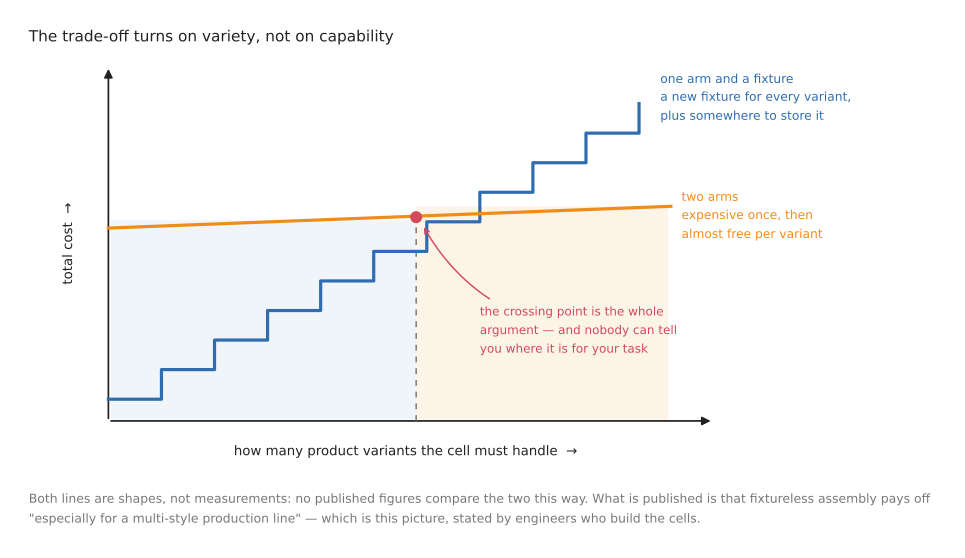
What the trade-off actually turns on is variety, not capability. The research area even has a name — fixtureless assembly, or jigless in aerospace — and engineers at a large car maker put the economics plainly: holding parts with robots instead of fixtures pays off "especially for a multi-style production line or when new styles are frequently introduced". A fixture is cheaper for one product and a liability for twenty, because each new variant needs a new fixture, a place to store it, and a changeover.
The vendors' own marketing agrees, and is revealing about what they are really selling. The stated arguments for dual-arm robots are that they fit in the space of one human workstation, need no safety fence, and can be dropped into a line built for people without redesigning it. Those are arguments about space and flexibility, not about doing something a fixture cannot do.
2. How rare two-arm robots actually are#
This is worth stating properly, because the evidence is unusually clean and it sets realistic expectations for everything that follows.
The body that counts the world's industrial robots does not have a category for them. Its published methodology classifies every one of the roughly 542,000 robots installed in 2024 by mechanical structure — articulated, cartesian, cylindrical, parallel, SCARA, or "others" — and "dual-arm" appears nowhere in that methodology, nor as a field on the forms manufacturers fill in. The data does not exist at source, which means nobody can honestly quote you a dual-arm market share, and anyone who does is making it up.
This is not an oversight of a fast-moving area, either. The same body added a separate category for humanoids once those became numerous enough to warrant one. The nearest niche it does publish is collaborative robots, at about a tenth of installations.
The vendor catalogues say the same thing. Of the major industrial robot makers — FANUC, KUKA, Yaskawa, Universal Robots, Doosan, Techman, Comau, ABB — exactly one still lists a purpose-built dual-arm robot as a current global product, ABB's YuMi. Kawasaki's duAro is still sold in Japan but its robot pages disappeared from the Americas site in 2026. Yaskawa's dual-arm series is gone from the US catalogue and the controller it runs on is officially phased out. And the most telling detail of all: when ABB wanted to grow the YuMi line after launching it, it added a single-arm version.
The cautionary tale is worth knowing in full, because it is usually told wrongly. The most famous two-armed robot ever built was Baxter, from a company that raised around $150 million and shipped a couple of thousand machines before closing in 2018. The brand was bought, relaunched in 2024, and shut down again in September 2025; the website is now a parked domain. But "two arms" was not what went wrong. Baxter's joints were deliberately springy so that it would be safe near people, and that cost it the precision to do useful work — one robotics professor's summary was that the design compromised accuracy in favour of safety, and that the company then spent too long trying to fix hardware problems in software. Meanwhile a competitor selling a conventional single arm outsold them roughly twenty-five to one over the same period. The lesson is that the second arm doubled the cost without doubling the set of jobs it could pay for.
So the honest framing is this: two-arm manipulation is a fast-growing research field and a shrinking industrial product category at the same time. That is not a contradiction. It means the tasks two arms are good at are mostly tasks nobody has yet automated profitably — which is a statement about opportunity as much as about failure, and section 7 takes it seriously.
3. The four things a fixture cannot do#
Here is where a second arm genuinely earns its keep. If your task does none of these four things, it does not need two arms.
The hold itself has to change during the task. A fixture grips one way, once. If the part must be turned over, re-seated, lifted to a new angle or held differently at each stage, a fixture becomes a sequence of fixtures, which is a machine nobody wants to build. A second arm is a grip that can move.
The object has no fixed shape. You cannot build a jig for a shirt. A garment, a cable, a bag or a sheet takes whatever shape the places you hold it imply, so holding it in two places is not a convenience — it is the only way to control what shape it is in. This is the strongest single argument for two arms, and it is why cloth is the flagship two-arm task.
The grip has to change mid-task. Picking something up in the orientation it happens to be lying in, and then needing a different grip to use it, is extremely common. With two arms you hand it over in mid-air. With one arm you put it down, let go, and pick it up again — slower, and sometimes impossible, because the object may not sit stably in any orientation you can then pick up from.
Two things must be true at the same moment. Keeping a cable in tension while routing it into a clip; holding a lid down while driving the screw that fixes it; supporting a stone while releasing it at exactly the right instant. No sequence of one-arm motions is equivalent to two constraints holding simultaneously, and this is the one that cannot be worked around by being clever.
4. The counter-arguments, which are real#
This document would be dishonest to skip these, and each of them is a published result rather than a hypothetical.
Two arms are not reliably better at re-grasping. One careful study compared re-grasping with two arms against re-grasping with one arm that puts the object down and picks it up again — using the table as the fixture — and concluded that two arms are not reliably better. When the two grasps have room, the second arm wins; when they overlap, it is worse.
Jigless assembly has been done with one arm. Another group showed that "completely jigless" assembly is achievable with one ordinary position-controlled arm, if the gripper is designed so that the act of grasping self-aligns the part. That is a mechanical solution to a problem people reach for a second arm to solve, and mechanical solutions are usually cheaper.
Even the flagship task has a single-arm solution. Garment folding, the task this whole field points at, has a published single-arm result.
The one direct speed comparison is weaker than it sounds. A study found a dual-arm cell about 20% faster than a single-arm one and less energy-efficient, paying for itself in eight months — but it was a simulation study, and the single-arm alternative was not given an optimised fixture.
None of this makes two arms useless. It makes the burden of proof sit on the second arm, which is where it belongs.
5. The tasks two arms are asked to do#
Here is the spread of real jobs where two arms are the right answer, in four groups ordered by how much is known in advance — the same lettering used throughout this folder and in the one-arm documents. Every row says what the second arm is actually for, because if you cannot answer that for your own task, the honest conclusion is that you do not need it.
Where one arm is enough, and two would be waste#
Before the four groups, the exclusion. Spot and arc welding, machine tending, palletising, painting and dispensing, polishing a fixtured part, moving tubes between laboratory instruments: in all of these the work is held by a jig, the geometry is known from a drawing, and the job is to be accurate and fast a million times over. There is nothing for a second arm to hold that a fixture is not already holding better. These tasks are the bulk of installed industrial robots and they are solved. Where two such arms do appear near each other, they are usually two independent robots sharing a cell rather than two arms cooperating on one part.
Group A: the parts are known, but the fit decides everything#
You have the drawings and the parts arrive in feeders, yet the job still fails, because success is settled in the last millimetre by contact rather than by position. This is where most industrial difficulty lives, and where a second arm replaces a fixture that would have to keep changing its grip.
| Task | What the two arms do | What makes it hard |
|---|---|---|
| Screwdriving and packing an assembly | one arm holds the housing and re-angles it for each fastener; the other picks screws and drives them, then both place the finished unit in its packaging | the tolerance is tighter than the arm's repeatability; twenty steps must all succeed; and the holding arm must not give way when the driving arm pushes |
| Connector and harness insertion | one arm holds the cable or connector, the other presents the socket or supports the board | clearances under a millimetre, the contact hidden from view, and now both ends of the mating pair can move |
| Kitting and packing | one holds the carton open or steadies the tray, the other places items into it | many small motions, items starting in different places, and a container that will not stay open by itself |
Group B: the objects are known, but their arrangement is not#
The catalogue is fixed, or nearly so, but nothing is where you left it. This is the class that learned perception unlocked, and where machine learning is genuinely in production today — though usually with one arm doing the picking.
| Task | What the two arms do | What makes it hard |
|---|---|---|
| Bin picking that needs a re-grip | one arm extracts the part however it can be reached, then hands it to the other, which takes the grip the next step actually needs | clutter and occlusion, plus a handover in mid-air between two moving grippers |
| Unloading a dishwasher or a crate | one holds the rack, door or crate steady, the other lifts items out | clutter, fragility, many steps, and a container that moves if you pull against it |
| Assembling two parts brought together | each arm holds one part and they are mated in mid-air, with no fixture at all | the accuracy of two arms relative to each other, which is worse than either arm's own repeatability |
Group C: the object itself has no fixed shape#
The object's shape is decided by where you hold it. This group is the reason two-arm manipulation is a research field rather than a footnote.
| Task | What the two arms do | What makes it hard |
|---|---|---|
| Laundry folding | both arms grip the garment; lifting, shaking, flattening and folding are all done by moving the two grip points relative to each other | a cloth has effectively infinite configurations, it changes shape as you grip it, and most of it is hidden under itself |
| Cable and harness routing | one arm keeps the cable in tension and feeds it, the other seats it into each clip along the route | the cable moves while you work, tension is invisible, and the task is long, so failures compound |
| Bag and container handling | one holds the bag open, the other puts things in | a bag has no shape of its own and closes the moment you let go |
Group D: the geometry is unknown and physics decides the outcome#
The hardest class, and the one this repo's worked example lives in.
| Task | What the two arms do | What makes it hard |
|---|---|---|
| Stacking irregular stones | one arm steadies the tower or holds the stone level while the other adjusts and lets go | no model of the object, and success is only known a second after both grippers release |
| Building from rubble or scrap | one supports a piece while the other wedges the next in against it | every piece differs, errors accumulate upwards, and support must be released gradually |
6. A checklist: do you need a second arm?#
Run your task through these in order. The first "yes" is your reason; if you reach the end with no yes, use one arm.
- Does the object change shape depending on where you hold it? Cloth, cable, bag, sheet, food. If yes, you need two arms, and no amount of cleverness with one will fix it. This is the strongest case there is.
- Must two constraints hold at the same instant? Tension while clipping, hold while releasing, support while fastening. If yes, you need two arms, because no sequence of single-arm motions is equivalent.
- Must the grip change mid-task, and can the object not be safely set down and re-picked? If it cannot sit stably in any pose you can then pick from, you need a handover, which needs two arms. If it can be set down, check the re-grasping evidence in section 4 first — the table may be a better second hand than an arm.
- Does the hold have to change at every stage, across many product variants? If yes, you are in fixtureless-assembly territory and the economics may work. Count how many fixtures you would otherwise build; that is the number the second arm has to beat.
- Is the argument really about floor space or fencing? If the honest reason is that a two-armed robot fits a human workstation, say so. That is a legitimate reason, and it is a facilities argument, not a manipulation one.
- Otherwise: one arm and a fixture. Read the one-arm documents and spend the saved money on better perception.
7. So why learn this at all?#
If two-arm industrial robots are this rare, an obvious question follows: why does this folder exist, and why should anyone spend time on it? Four honest reasons, which matter more if you are learning the field than if you are buying a robot next week.
Because every humanoid is bimanual. The form factor that the current wave of money is going into has two arms by construction, and the manipulation problems it faces are exactly the ones in this folder: coordination, handovers, closed chains, deformable objects. Two-arm manipulation being a small industrial product category and a central research topic at the same time is explained entirely by this.
Because the unsolved tasks are the two-arm ones. Section 5's Groups C and D are where automation has not reached, and they are not there because nobody wants them automated. Laundry, cables, food, harvesting, unstructured assembly — the reason these are still done by hand is that they need the thing a fixture cannot provide. If you want to work on something that is not already solved, this is where it is.
Because two arms are where the interesting failure modes are. The closed chain, the internal force that no camera shows you, the arms drifting out of step, the handover that releases too early — these are genuinely instructive, and they teach you what the control layer underneath a policy is actually doing. Someone who understands why two position-controlled arms holding one object will crush it understands force control better than someone who has only read about it.
Because the cheap hardware arrived. The economics that make dual-arm industrial robots a poor buy do not apply to a pair of few-hundred-dollar open-source arms on a desk. The practical barrier to learning this has fallen by about two orders of magnitude in three years, which is why the research output has not.
What none of that means is that you should propose two arms for a customer's problem. Keep the two questions separate: what should this task use, answered by the checklist above, and what is worth learning, answered here. They have different answers, and being clear about which one you are answering is most of what distinguishes good advice in this field from bad.
Next: the two-arm overview for what actually changes, or the one-arm documents if the checklist sent you back there.