This document assumes you know the single-arm versions of these methods. It does not repeat them. It says what changes when two arms have to cooperate — and the honest summary is that one of these five methods handles the hard case and the other four work around it.
That is not a criticism of the other four. Teaching, offline programming, behaviour trees and motion planning all extend to two arms perfectly well as long as the arms take turns, or stay out of each other's way, or one simply holds still while the other works. What none of them can express is two arms holding the same object at the same time. That belongs to feedback control, which is section 5 and the reason to read this.
Remember the scope: this is about coordinated work. Two arms doing unrelated things in one cell need nothing from this document — plan each with the single-arm methods and check they do not collide.
Contents#
- Teaching two arms
- Offline programming and synchronisation points
- Behaviour trees, where role assignment lives
- Motion planning for a pair
- Feedback control and the closed chain
- What to take from all five
The task group letters — A to D — are from the task catalogue.
1. Teaching two arms#
Teaching and replaying is still perfectly workable with two arms, and it is how dual-arm industrial robots are actually programmed. You teach the holding arm its one pose, you teach the working arm its sequence, and you insert waits so that neither moves while the other is in its space. For a loosely coupled hold-and-work task where the holding arm never moves during the work, this is genuinely all you need.
What it leaves out is continuously coordinated motion, and industrial controllers have a specific answer for it that is worth studying, because it shows exactly what coordination demands.
ABB's dual-arm facility offers three modes. The first is independent — out of scope here. The second is semi-coordinated, where one arm moves relative to a coordinate frame that the other arm is holding, but only one moves at a time. The third is coordinated-synchronised, where both move together as one motion.
Turning on the synchronised mode imposes a rule that tells you everything about the difficulty. The number of motion instructions between switching synchronisation on and off must be identical in both arms' programmes, and matching instructions are paired by an identifier so that the controller can step them together. Two arms moving as one is not two programmes running side by side. It is one programme written twice, in lockstep, and the controller enforces the lockstep because nothing else can.
The same manual is candid about the consequences, and they are worth knowing before you design around this. If one arm faults during synchronised motion, the other stops too — it cannot meaningfully continue, because its motion was defined relative to the other's. And when a collision is detected, the default is to stop every robot in the cell, on the sensible grounds that the most likely thing a robot in a two-robot cell has collided with is the other robot.
Good for: the free-space parts of Group A, and any coordinated task where one arm holds a known part in a known place while the other works. Useless for: Groups B, C and D, because there is nothing stable to record against — and useless for anything where the arms must adapt to each other, because a recording cannot adapt. Status in 2026: standard, and the only way coordinated two-arm motion is programmed in industry today. Worth learning now? Read the MultiMove documentation even if you will never touch an ABB controller. It is the clearest existing statement of what two arms moving as one actually requires, and it is free. Code to look at: none — this lives in vendor software, and the concepts do not transfer to open tooling because the open tooling does not have them.
2. Offline programming and synchronisation points#
This is the natural home for the problem teaching cannot handle, because the simulation contains both arms and can therefore check the one thing that matters most in a coordinated cell: that the arms never occupy the same space at the same time.
Multi-robot cells have been modelled this way for decades, and the standard tools handle synchronisation points — markers saying "arm one waits here until arm two reaches there". That is exactly the loose coupling the hold-and-work pattern needs, and it is expressive enough for a surprising amount of real work.
It remains a poor fit for continuously coordinated motion, and it inherits all of its single-arm brittleness twice over: now two sets of waypoints are wrong if the fixture moves, and the errors interact, because an arm that is three millimetres off relative to the world may be six millimetres off relative to the other arm.
That last point deserves emphasis, because it is the quiet killer of two-arm precision. What matters in coordinated work is not each arm's accuracy relative to the world, it is their accuracy relative to each other, and that is the sum of two calibration errors rather than one. An arm that repeats to a tenth of a millimetre in its own frame may be a millimetre out relative to its partner. Any task that mates two parts held by different arms — Group B's "assembling two parts brought together" — is limited by this number, not by the arms' specifications. Calibrating the two arms to each other is a real and separate job.
Good for: the planned motions of Group A, and any coordinated cell where the layout is fixed and the sequence is known in advance. Status in 2026: standard. Worth learning now? The arm-to-arm calibration problem is the transferable part and is worth understanding properly. The rest is the same skill as the single-arm case.
3. Behaviour trees, where role assignment lives#
This is where the layer a second arm adds actually gets written, and it is the most important thing in this section.
The tree is what says "left arm holds, right arm works". It sequences the two, and it expresses the waiting — do not start driving the screw until the holding arm reports it has the part. Each arm's behaviour can be its own subtree, with a small amount of shared state between them, so you can read off which arm is doing what and when.
Two arms also make the recovery logic sharply more valuable, because there are more ways to fail and the failures are less obvious. A handover can drop the object. The holding arm can lose its grip while the other pushes. Either arm can be the one that got stuck, and the tree has to know which. A single-arm system has one thing that can be wrong; a coordinated pair has the two arms and the relationship between them.
The practical advice is to make the role assignment explicit in the tree even when it is obvious and fixed, rather than leaving it implicit in which arm each subtree happens to command. When you later want to swap the roles — and you will, because the reachability will be wrong somewhere — you want that to be one change rather than a rewrite.
Good for: the sequencing and role-assignment layers of every coordinated task in every group, and especially the twenty-step jobs in Group A. Status in 2026: standard, and the default answer for the top two layers. Worth learning now? Yes. This is the cheapest thing in this folder to learn and the one you will use in every coordinated system you build. Code to look at: BehaviorTree.CPP and py_trees, as for one arm. There is nothing two-arm-specific to install, which is itself the finding: the coordination is something you express, not something a library gives you.
4. Motion planning for a pair#
Motion planning is the method that changes most, in three ways — and then there is a fourth case it cannot express at all.
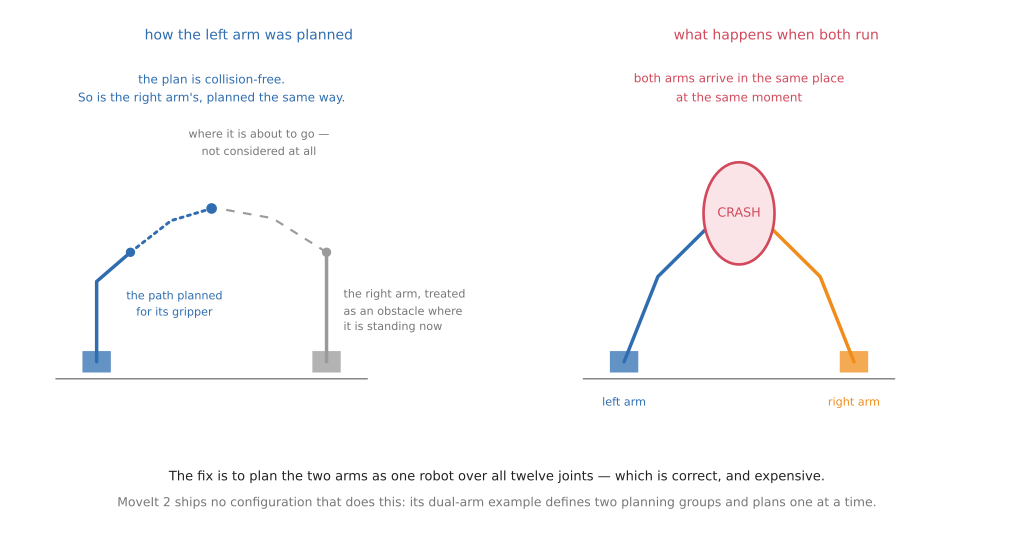
The space to search doubles. Two six-joint arms make a twelve-dimensional configuration space, and the volume to be searched grows exponentially with dimension, so a planner that solved one arm comfortably can become slow or fail to find a path at all. The standard answer is to plan the two arms as one robot — a combined group over all twelve joints — which is correct but expensive.
Each arm is the other's moving obstacle. Self-collision checking now includes arm against arm, and unlike a table or a fixture, that obstacle moves during the plan. This produces the classic two-arm bug, and it is worth stating exactly: when the left arm is planned, the right arm is treated as an obstacle at the position it is in right now, not along the path it is about to follow. Each plan is collision-free on its own. Together they collide. The diagram above shows why — the two paths never intersect in space at the same planning time, but they do in execution time.
Timing becomes part of the answer. For one arm, a path is a sequence of configurations and the speed is a separate matter settled afterwards. For two arms that must meet — a handover, or a joint carry — when each arm is where is part of the specification, so the planner has to produce two time-synchronised trajectories rather than two paths.
And the case a planner cannot express at all is the closed chain. When both arms grip one object, their positions are no longer free to choose independently — the object's rigidity ties them — and an ordinary planner has no way to represent that constraint. This is not a gap in any particular planner; it is a gap in the representation.
Exactly where the standard tools stop#
This is not theoretical, and knowing the boundary will save you weeks.
In MoveIt 2, the maintained dual-arm example defines the two arms as two separate planning groups and plans for one at a time; no shipped configuration plans them as one. The inverse-kinematics solvers are chain solvers, and the documentation says so outright — the default one "only works with serial chains" — so a loop through both arms and the object cannot be solved at all. There is no constraint type for "keep these two grippers a fixed distance apart", because every constraint relates one link to a frame rather than two links to each other. A maintainer's own summary of the situation is the sentence to remember: nobody seems to have made tools that specifically go this far to assist you in formulating these problems.
One more trap in the same tooling, which produces the other classic two-arm bug: the arms do not start at the same moment. The layer that executes a two-arm trajectory splits it by joint name and dispatches each arm's half in sequence, without stamping a common start time, so each arm begins when its own command arrives. For a loosely coupled motion this does not matter. For a coordinated carry it is the difference between working and dropping the object. The fix is to give both halves the same future start time yourself.
Good for: Groups A, B and C, and the "how to move" layer of D. Status in 2026: standard and healthy for one arm, and genuinely under-tooled for two. The live development is speed — GPU planners replan continuously rather than planning once, which matters disproportionately for two arms, because continuous replanning is what lets one arm get out of the other's way rather than waiting for it. Worth learning now? Yes, and expect to hit the limits above quickly. Budget time for them rather than assuming you have configured something wrongly.
Code to look at. Start from MoveIt's maintained dual-arm Panda configuration and copy its structure — it is simulated only, but it is the reference that works. cuRobo genuinely supports planning for two arms at once and ships a dual-arm configuration, though it too has no way to express a constraint between the two grippers. If your task involves a real closed loop, Drake and Pinocchio are the two libraries with genuine support for closed kinematic chains, and are worth the switch.
Be warned that open two-arm hardware support is thin: there is no maintained ROS 2 dual-arm coordination package at all, and ABB's YuMi — the one dual-arm robot still in general production — has no ROS 2 driver, only two archived ROS 1 attempts.
A note on task and motion planning#
With two arms the appeal of TAMP grows, because "which arm should do this step" is exactly the kind of decision a symbolic planner could make instead of a person — and re-grasping, the thing two arms are best at, is naturally expressed as a symbolic action with geometric preconditions.
That is the theory. In practice the search gets harder for the same reason motion planning does, and the honest position is that role assignment in working systems is written by hand. Know that this is the principled answer; do not expect to use it.
5. Feedback control and the closed chain#
This is the section that matters. Everything above works around the closed chain; this is the thing that actually solves it.
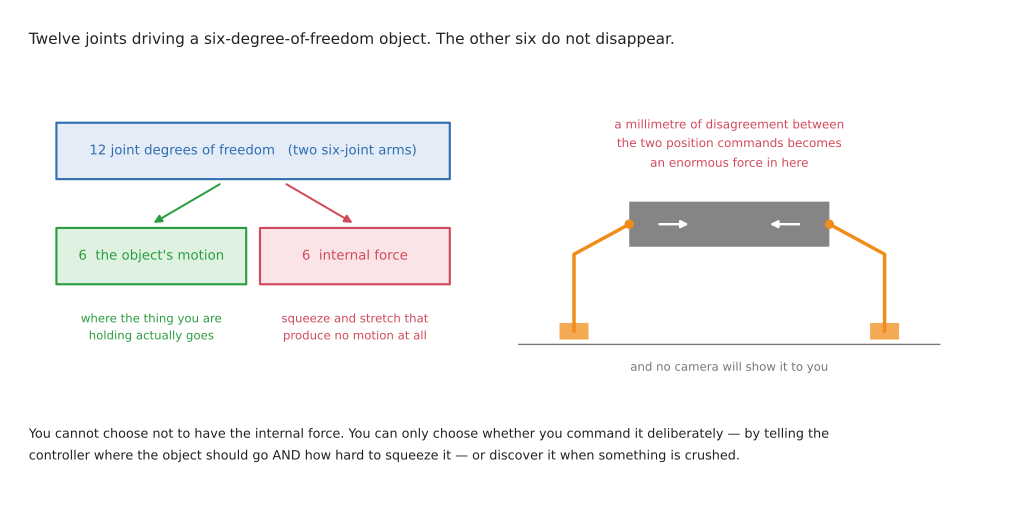
The closed chain has to be controlled, not planned. When both grippers hold one object, commanding both arms by position guarantees a fight, because no two position commands agree to the precision that the object's rigidity demands. The control literature is blunt about this: with independent joint control, the tracking errors that violate the closed-chain constraint "lead to building of large internal forces". A classic textbook puts the same thing more vividly — the two chains "fight against each other and apply forces which cause no net wrench".
The arithmetic in the diagram above makes it clear why this is unavoidable rather than a tuning failure. Two six-joint arms have twelve degrees of freedom between them, and the object they are holding has only six. The other six dimensions do not disappear: they become force. That is the internal or squeeze force — the part of what the arms exert that produces no motion at all, only compression or tension in the object between them. You cannot choose not to have it; you can only choose whether you command it deliberately or discover it when something is crushed.
So the standard fix is to stop thinking about two arms and think about one object. Command where the object should go and how hard the arms should squeeze it, and let the controller work out what each arm does. Those are two separate commands over two separate sets of coordinates, and separating them is the whole idea.
If you go looking for this in the literature, the names to search for are the symmetric formulation, which treats the pair even-handedly and is what the reference handbook chapter on cooperative manipulation adopts; cooperative task space, the same idea in a different parameterisation; the virtual linkage and augmented object models; and object impedance control, which makes the held object behave like a spring. The older alternative is master–slave, where one arm leads and the other follows — simple, and largely superseded by the symmetric approaches.
The holding arm needs the opposite setting to the working arm. An arm that steadies a part while the other pushes into it should be stiff, so the part does not move. An arm that pushes a connector home should be soft, so a small misalignment is absorbed rather than jamming. That means two different control configurations running at once, which is ordinary to set up and very easy to get backwards. If your hold-and-work task is failing in a way that looks like the part "wandering", check this first.
Release timing is a force problem. A handover, or setting a stone down and letting go, comes down to transferring load from one arm to the other or to the world. Doing it by position is guesswork; doing it by watching the force fall as the other support takes the weight is measurable. This is the single most reusable idea in two-arm control.
An open gap worth knowing about#
Control theory has had a proper mathematical treatment of two cooperating arms for decades — formulations that describe the pair as a single system, with one set of coordinates for the object's motion and another for the internal squeeze, so that the two can be commanded separately.
Learned policies do not use any of it. A search for work combining a trained policy with an explicit cooperative formulation turns up essentially nothing. The learned side reinvents the idea informally, by putting each gripper's position relative to the other into the network's input and hoping the constraint is picked up from the data. Whether the formal structure would help a learned policy is, as far as this document could establish, an unanswered question rather than a settled one — which makes it an unusually accessible thing to be curious about.
Good for: Group A is force control's home — insertion, screwdriving, anything
where a part is held while another is fitted — and it underlies the release in
Group D. It is also the bottom layer under every learned method in this folder.
Status in 2026: standard, essential, and still the answer to contact-rich
coordinated work.
Worth learning now? Yes, and more than anything else here. The closed chain is
the one genuinely distinctive technical problem in two-arm manipulation, and
understanding it is what separates someone who has thought about two arms from
someone who has read about them.
Code to look at: ros2_control including its
ready-made admittance controller, and Drake or
Pinocchio for the model-based side
with genuine closed-chain support. Be aware of where the open stack stops:
ros2_control gives you admittance control and a force-torque broadcaster, and
there is no open implementation of a cooperative two-arm controller to pick up
and use. You write it from the papers or you buy it from the robot vendor. That gap
is real, and it is the main reason serious coordinated work still runs on vendor
software.
6. What to take from all five#
Four of the five methods handle coordination by avoiding it. Waits, synchronisation points, taking turns, one arm holding still. That is not a criticism — it is good engineering, and most tasks that look like they need simultaneous motion do not. Reach for the avoidance first.
The tooling gap is real and specific. There is no maintained ROS 2 dual-arm coordination package, no constraint type relating two grippers, no chain-capable default IK solver, no common start time on a two-arm trajectory, and no open cooperative controller. Every one of those is a thing you will have to work around, and knowing the list in advance is most of the value of this document.
Relative accuracy is the number that limits you, not each arm's own repeatability, and it is the sum of two calibration errors.
Force is how the arms talk to each other. Position tells each arm where to go; force is the only channel that tells it what the other arm is doing to the object they share. Every hard problem in this document — the closed chain, the release, the stiff-versus-soft pairing — is solved by paying attention to force rather than position.
Next: learned methods, or back to the overview.