Every other page in this chapter assumes that teaching a robot a new task means changing a model. You collect examples, you run training, and you end up with a new model file that knows the task. This page is about a different answer, in which the model file never changes at all: you show the robot one recording of the task, the recording goes in alongside the camera picture, and the robot does the task.
This page is for a reader who has read fine-tuning, because the method here is best understood as the alternative to it. By the end you will know what "in context" means, why a video says more than a sentence, what this way of teaching costs, and how to decide which of the two routes a job needs. You will also know what the evidence for it is today, which is thinner than the attention it receives.
One thing is worth saying before the explanation starts. The method is real and it is in commercial use, but the only well-documented model that does it cannot be downloaded, has no published architecture and has not been evaluated by anybody outside the company that built it. So this page teaches the idea, which is durable, and treats the reported numbers as claims rather than as measurements.
Contents#
- The idea in one sentence
- What "in context" means
- Where the idea comes from
- Why a video rather than a sentence
- The two routes, side by side
- What each route costs as the work grows
- A miniature that shows the mechanism
- The evidence so far, and what is missing from it
- How to choose between the two routes
- Where it works and where it does not
- Where to read next
- Using it in Python
1. The idea in one sentence#
You teach the robot by giving it an example at the moment you ask, instead of by training the example into the model beforehand.
The example is an input to the model, in the same way that the camera picture is an input. It arrives, it is used, and when the next request comes with a different example the model does a different task. Nothing about the model is different before and after. This is called in-context learning, because the learning happens inside the context the model is given rather than inside its weights.
2. What "in context" means#
To see why that is surprising, recall what a weight is. Inside a neural network explained that a model is a large set of numbers called weights, and that training is the process of changing those numbers so that the model's outputs match the examples it was given. Under that description, a model that has learned something must be a model whose numbers have changed, and so teaching must mean training.
In-context learning breaks that link. The weights stay exactly as they were, and the new information is supplied as part of the input. The model was trained, once and expensively, to be good at reading an example and applying it. After that, each new task costs one example and no training at all.
Two consequences follow from this, and they matter more than the mechanism.
The first is that nothing is remembered. A fine-tuned model carries its task in its file, so the task survives a restart. A prompted model carries nothing: if you want the task done again tomorrow, you supply the example again tomorrow. The example is data you keep, not a model you keep.
The second is that one model does every task. Fine-tuning gives you one file for each task, and a robot that does twelve jobs holds twelve files and must know which to load. Prompting gives you one file and twelve recordings, and switching jobs means handing over a different recording.
3. Where the idea comes from#
This is not a new idea, and it is easier to understand if you have seen it in its first setting, which is language.
A large language model is trained on text and then asked questions. Early on, people found that if you put two or three worked examples into the question itself, the model answered the rest far better than if you had simply asked. Writing out examples inside the request is called few-shot prompting, and the page on language models as planners describes how it is used to make a planner produce steps in the shape you want.
What made that so useful was the cost. Fine-tuning a language model for each new job needs data, a graphics card and a training run, while writing three examples into a prompt needs a minute. Few-shot prompting is the reason a language model can be put to a new use in an afternoon, and it is the reason the same idea was worth trying for robots.
The question for robotics was always whether a model could read an example of a physical task and apply it, since a physical task is not a sentence. Answering that took much longer than it did for language, and the answer is still only partly in.
4. Why a video rather than a sentence#
Every vision-language-action model described in the page on them is told what to do in words. The instruction "put the cup on the saucer" goes in beside the camera picture, and the model produces movements.
Words are a narrow channel, and the narrowness is the problem. "Fold the towel" does not say which fold, in which order, or to what standard. "Tidy the bench" does not say what counts as tidy. The model has to guess the missing detail from whatever it saw during training, and when your idea of the task differs from the average of its training data, it does the average thing instead of your thing.
A video does not have that problem, because a recording of somebody doing the task contains the order, the standard and the detail by construction. You do not have to describe the fold. You show it.
This is the change that the method rests on, and it is worth stating plainly: the task is specified by an example of the task, rather than by a description of it.
5. The two routes, side by side#
The picture below puts the two ways of teaching next to each other. Both begin with a model somebody else trained, and both end with a robot doing your task. What differs is what changes along the way.
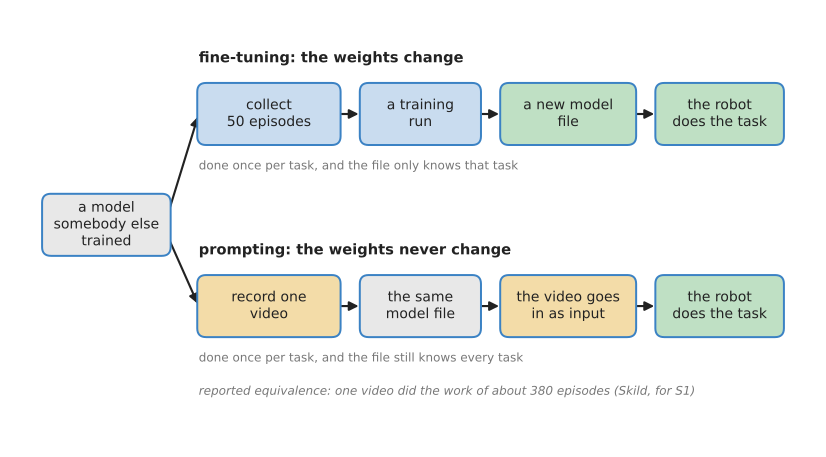
In the upper route the collected episodes are consumed by a training run, and the thing that comes out is a different file. In the lower route nothing is consumed and nothing is produced: the recording is held, and it is supplied again every time the task is asked for.
The figure of one video being worth about 380 episodes is drawn from the launch post for Skild AI's S1 model, and section 8 says what that number does and does not establish. It is quoted here because it is the only published figure of its kind, not because it has been checked.
6. What each route costs as the work grows#
The difference between the two routes is almost invisible when a robot does one job, and it becomes the whole story when a robot does many. The chart below counts the recording a person has to do, measured in episodes, as the number of jobs grows.
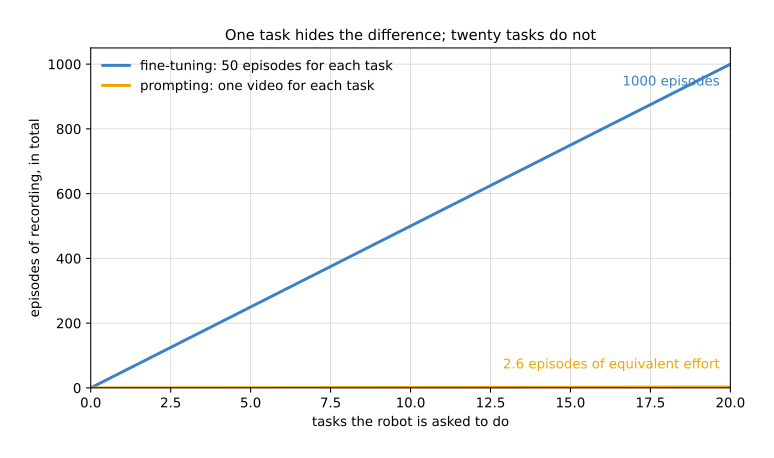
At one task the two are close enough that the choice hardly matters. At twenty tasks the fine-tuning route has cost a thousand recorded episodes and twenty separate training runs, and the prompting route has cost twenty recordings and no training run at all.
The lesson is not that one route is better. It is that the question is how many tasks, not how hard the task is. A cell that does one job for a year should be fine-tuned, because the cost is paid once and the result is more accurate, for the reason section 7 shows. A cell whose job changes weekly is where the other route pays.
7. A miniature that shows the mechanism#
The mechanism is easier to believe once you have watched it work on something small enough to check by hand, so this section describes a tiny example and section 12 gives the code for it.
The task is to say where to put the gripper, given where the object is. Three different tasks share that shape: pick the object up, put it ten centimetres to the left, and put it twelve centimetres behind. The robot is never told which task it is doing.
Two methods are compared. The first stands for fine-tuning: it is fitted to fifty examples of the first task and then frozen. The second stands for prompting: it is given one example at the moment it is asked, and its answer depends on that example. Every recorded example carries five millimetres of error, because a person's hand is never exactly on the mark, and that detail is what makes the comparison honest.
The average error, in centimetres, is this:
| task | the fitted method | the prompted method |
|---|---|---|
| the task it was fitted on | 0.08 cm | 0.84 cm |
| put it to the left | 9.93 cm | 0.76 cm |
| put it behind | 12.08 cm | 0.82 cm |
Read the table one row at a time, because each row makes a different point.
The first row is the case for fine-tuning. On the one task it was fitted for, the fitted method is about ten times more accurate, and the reason is that it averaged fifty noisy examples while the prompted method had one. Averaging is how error is removed, and a single example cannot average anything.
The next two rows are the case against it. On tasks it was not fitted for, the fitted method is wrong by the whole difference between the tasks, roughly ten and twelve centimetres, which is simply the offset it never learned. The prompted method stays at about eight millimetres on every task, including the two nobody prepared it for.
So the trade is accuracy against reach. Fine-tuning is more accurate on the task it knows and useless on the others. Prompting is slightly worse everywhere and about equally good everywhere, which on a new task is the difference between working and not working.
The example is a miniature and it is honest about being one. The relation between the example and the answer is a simple offset, and a real model has to read that relation out of a video of a person doing a ten-minute job. What the miniature shows faithfully is the shape of the method: the answer depends on an input supplied at run time, and no number inside the method was changed.
8. The evidence so far, and what is missing from it#
One model is the reason this page exists, and it is worth separating what has been reported from what has been established.
Skild AI's S1, published on 18 August 2026, is a model that takes a video of a task instead of a sentence, and performs the task with no fine-tuning. The company reports 66 per cent success on tasks it had never seen, lasting between four and ten minutes, against 9 per cent for models prompted with language and trained on the same 100,000 hours. It also reports 96 per cent on tasks it had seen, and that one video demonstration did the work of about 380 episodes of post-training.
The company says little about how, beyond that the model was built from the start as an in-context learner, meaning the demonstration is supplied as input at run time rather than folded into the weights by training.
Four things are missing, and a reader should hold all four.
The headline comparison is not what it first appears. The 66 per cent against 9 per cent is an average of per-step success, not of whole tasks finished, and a long task has many steps. The frontier overview explains why an average of per-step scores flatters a long task, and that page is the one to read before quoting the number anywhere.
Nobody outside the company has measured it. There is no independent evaluation, no parameter count, no architecture and no named robot hardware in the post.
The post states no limitations at all, which is a gap rather than evidence that there are none. Every other model in this book has a section on what it cannot do.
And you cannot have it. S1 is available to commercial partners and through an early-access list, so nothing on this page can be run on your own arm today. The frontier chapter's open shelf lists what can actually be downloaded, and no model on that list learns in context.
9. How to choose between the two routes#
The table compares the two routes on the things that decide a real job. Read each row as a question you should be able to answer about your own cell before choosing.
| question | fine-tuning | prompting with a demonstration |
|---|---|---|
| what you collect for a new task | tens to hundreds of episodes | one recording |
| what you run afterwards | a training run on a graphics card | nothing |
| what you end up with | a new model file per task | the same model file, plus recordings |
| time from "new task" to "robot does it" | hours to days | minutes |
| accuracy on the one task | higher, because many examples are averaged | lower, because one example is not |
| behaviour on a task nobody prepared for | it does the task it was trained for | it does the task in the recording |
| what happens when the task changes slightly | collect and train again | record again |
| can you run it today | yes, on downloadable models | no, not on anything you can obtain |
The last row is the one that settles most decisions in 2026. Whatever the method's merits, the only way to put it on your own arm today is to become a commercial partner of the one company that has it.
10. Where it works and where it does not#
It works when the number of tasks is large and each one is seen a few times, because that is exactly the case where the fine-tuning route spends most of its effort on collection and training that is thrown away when the job changes.
It works when the task is easier to show than to describe. Any job whose standard lives in a person's hands rather than in a sentence is in this category, and folding, wiping and arranging are the usual examples.
It does not work when you need the last millimetre. A single example cannot average away the error in itself, as section 7 measured, so a job whose tolerance is tighter than the wobble in one human demonstration still wants many demonstrations and a training run.
It does not work when the task cannot be shown in a recording. A task defined by a measurement, a force or a rule, rather than by how it looks, gives the model nothing to read.
And it does not work when you cannot get a model that does it, which today is almost everybody. That is a statement about August 2026 rather than about the method, and it is the part of this page most likely to be out of date first.
11. Where to read next#
- Fine-tuning is the route this page is the alternative to, and the one you can actually run. Read it first if you have not.
- Vision-language-action models explains the kind of model this method is built on, including which ones can be downloaded.
- Language models as planners shows few-shot prompting in its original setting, which is where the idea came from.
- Learning from human video covers the other half of the same shift, which is using recordings of people instead of recordings of robots.
- Where the data comes from explains pretraining and foundation models, which is what makes a model able to read an example at all.
- Fine-tuning and adapters in Book 5 puts this on a ladder of five rungs, from a prompt to a full retrain, and gives the trainable-weight count for each one.
- Vision-language-action models in Book 5 explains why a transformer can take the task as input at all, which is the part of the mechanism this page assumes.
- The frontier chapter on foundation models has the news, the dates and the claims, and is the page to re-read when this one looks stale.
12. Using it in Python#
No library implements this, because no model you can download does it. What this section gives you instead is the miniature from section 7, which is short enough to read in one sitting and shows the one thing that matters: the prompted method takes the example as an argument, and the fitted method does not. After reading it you will be able to tell the two shapes apart in any code you meet.
import numpy as np

rng = np.random.default_rng(0)

# A "task" says where to put the gripper, given where the object is. Each task is a
# fixed offset in metres, and the robot is never told what the offset is.
PICK_IT_UP    = np.array([0.00, 0.00])
PUT_IT_LEFT   = np.array([-0.10, 0.00])
PUT_IT_BEHIND = np.array([0.00, 0.12])

# A person's hand is never exactly on the mark, so every recorded example carries a
# little error. This is what makes the comparison honest: fine-tuning averages that
# error away over fifty examples, and a single prompt cannot.
WOBBLE = 0.005        # 5 mm, one standard deviation

def examples(task, n):
    seen = rng.uniform([0.30, -0.20], [0.60, 0.20], size=(n, 2))
    return seen, seen + task + rng.normal(0, WOBBLE, size=(n, 2))

# Route 1: fine-tuning. Fit the offset from fifty episodes of one task, then freeze it.
# Note what the finished function takes: only the observation.
seen, done = examples(PICK_IT_UP, 50)
fitted = (done - seen).mean(axis=0)

def fine_tuned(where_it_is):
    return where_it_is + fitted

# Route 2: prompting. Nothing here was fitted to anything. The example arrives as an
# argument, so the same function does a different task when given a different example.
def prompted(where_it_is, example_seen, example_done):
    return where_it_is + (example_done - example_seen)

def error(fn, task, trials=200):
    seen = rng.uniform([0.30, -0.20], [0.60, 0.20], size=(trials, 2))
    want = seen + task
    got = np.array([fn(s) for s in seen])
    return np.abs(got - want).sum(axis=1).mean() * 100          # centimetres

for name, task in (('the task it was fitted on', PICK_IT_UP),
                   ('put it to the left', PUT_IT_LEFT),
                   ('put it behind', PUT_IT_BEHIND)):
    # One prompt is a lottery, so the prompted route is measured over many prompts.
    pr = np.mean([error(lambda w, s=examples(task, 1): prompted(w, s[0][0], s[1][0]), task)
                  for _ in range(200)])
    ft = error(fine_tuned, task)
    print(f'{name:28}  fine-tuned {ft:6.2f} cm   prompted {pr:6.2f} cm')
It prints the table of section 7:
the task it was fitted on     fine-tuned   0.08 cm   prompted   0.84 cm
put it to the left            fine-tuned   9.93 cm   prompted   0.76 cm
put it behind                 fine-tuned  12.08 cm   prompted   0.82 cm
The line worth looking at twice is the signature of each function. fine_tuned takes
the observation alone, because everything it knows is already inside fitted.
prompted takes the observation and the example, because what it knows arrives with
the question. Every real implementation of this idea has that difference somewhere in
it, however large the model.