This page follows this solution through one table of glasses. It also covers the case this book keeps coming back to: a glass that cannot be pushed safely. An example that shows only the easy case would teach the wrong lesson.
Contents#
1. When a glass cannot be pushed safely#
The unsafe glass comes first, because the rule for it is the same in both halves of the pair. Pushing without toppling sets that rule out once. It explains which glasses are refused and why the check sits outside every policy. This section adds only what belongs to this solution.
Here this solution and solution 5 are sure to behave the same. The same code decides, from the same readings, with the same arithmetic. So any difference in their refusal counts comes from where their pushes left the glasses. Neither one is better at refusing.
Training adds one new fact. The training set holds no refusals, because the teacher refused those glasses and so never pushed them. The policy has never been shown a glass it must not push.
The check needs the friction, and nobody has it. So the limit is only as good as the guess. The early abort that would catch a bad guess is a design, not code. So in both halves of the pair, the only protection is the limit worked out before the jaw moves.
With the rule for unsafe glasses set, the next section follows one whole table.
2. A worked example#
The rule above applies to both halves of the pair. Now follow one table through both, because the difference is easier to see on a single table.
The table. Five tapered glasses stand in the glass zone. They have different heights. Two of them stand as close as the examiner allows. So neither has its 76 mm of clear room to the other's edge. The test is to the edge, not to the middle, so the narrower glass is crowded while the wider one may not be. A third glass stands alone. Its foot is so narrow that its tipping limit is below the jaw's top edge. The examiner renders the view from the top and hands over the readings, each with its usual error.
What solution 5 does. Its model has never seen a picture like this one. It returns a smooth chunk of waypoints. But the chunk stays far above the glasses and runs across the whole table, so it nearly always touches nothing. Solution 5 gives the measured figures.
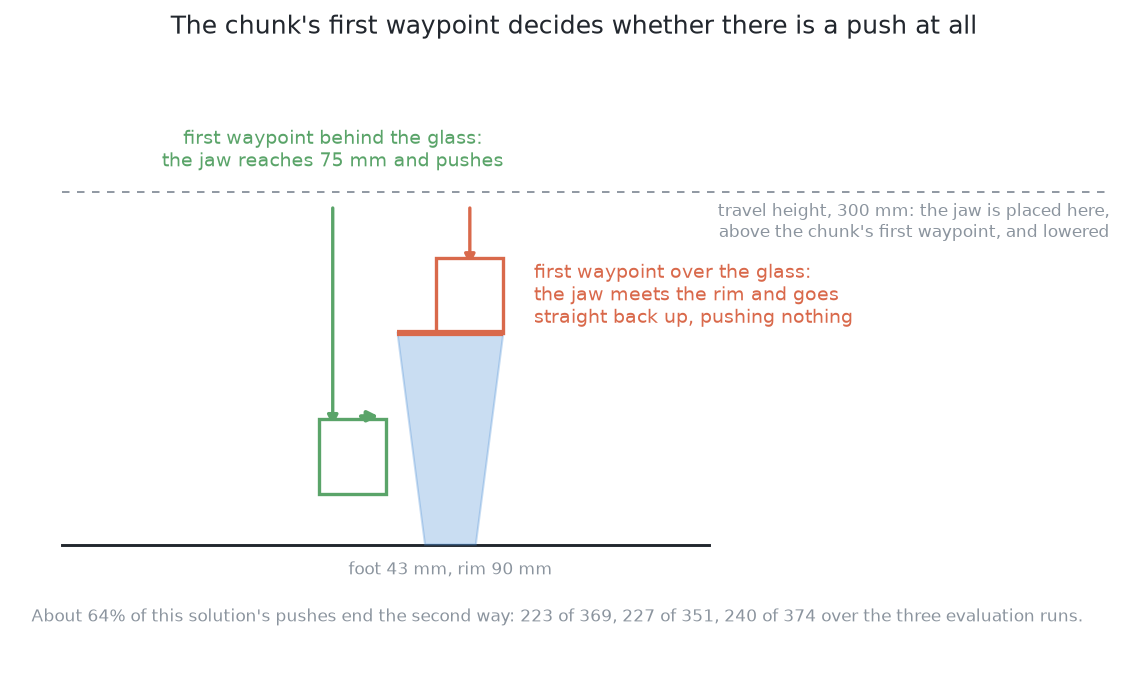
What this solution does. Its model has seen many pictures like this one in training. It returns a chunk in this cell's own units. It brings the jaw down to 75 mm, the height the gripper pushes at. Solution 5 never does that. Then the chunk's first waypoint decides everything.
The examiner carries out a chunk in two steps. First it places the jaw high
above where the chunk starts. Then it lowers the jaw to the first waypoint.
Suppose the first waypoint is behind the crowded glass, on the side away from
its neighbour. Then the jaw reaches push height in open table, and the rest of
the chunk is a push. Now suppose the first waypoint is over a glass. Then the
jaw meets the glass on the way down, and follow() reports the chunk
blocked on the way down. Either the jaw goes straight back up without
pushing, or the glass falls over. The model learned the height but not the
place. How it
compares shows how
often this happens.
Which glass to move comes from the teacher. Solution 2's ranker chooses which of the crowded pair to move. On a pair like this, the choice is close to random, because moving either one frees both. The policy copies what the ranker tended to do. It cannot improve on that choice, because nothing scored the choice.
The look-again loop works in both. A pushed glass does not stop exactly where it was aimed. The friction guess was wrong, and a glass turns as well as slides. So the arm looks again. Here the two halves differ. The trained policy saw recordings from every point in the teacher's loop, including after a glass stopped short. So it has seen this situation. Solution 5's model has not. Neither model learns during the run.
Neither model can answer the last case. The third glass, with the narrow foot, cannot be pushed safely. The shared check works out its limit and finds it below 107 mm. It refuses that glass, with that reason, before either model is asked anything. The glass is left standing, and the table is marked correct but incomplete. The refusal belongs entirely to the shared geometry.
But the refused glass is still in the picture. Neither model can be told to leave it alone. So a chunk whose path runs into a refused glass is not carried out, and the loop asks again. The check needs the path, so it can only run after the model has answered. A rejected chunk is a wasted answer. It is not counted against the push budget, because it never touches the table. A separate cap allows three times the push budget in answers per table. Each solution's record of its answers counts how often that cap was reached. It ended 5 tables in this solution's 1,515 answers over three runs. It ended none in solution 5's 1,855.
So the training changes the first half of the example and not the second. The chunk now comes down at push height, in units this cell can carry out. But it still often comes down on a glass instead of behind one. The refusal, the topple limit, the destinations and the loop stay where they were. They were never the model's job.
← How it works · What it needs →