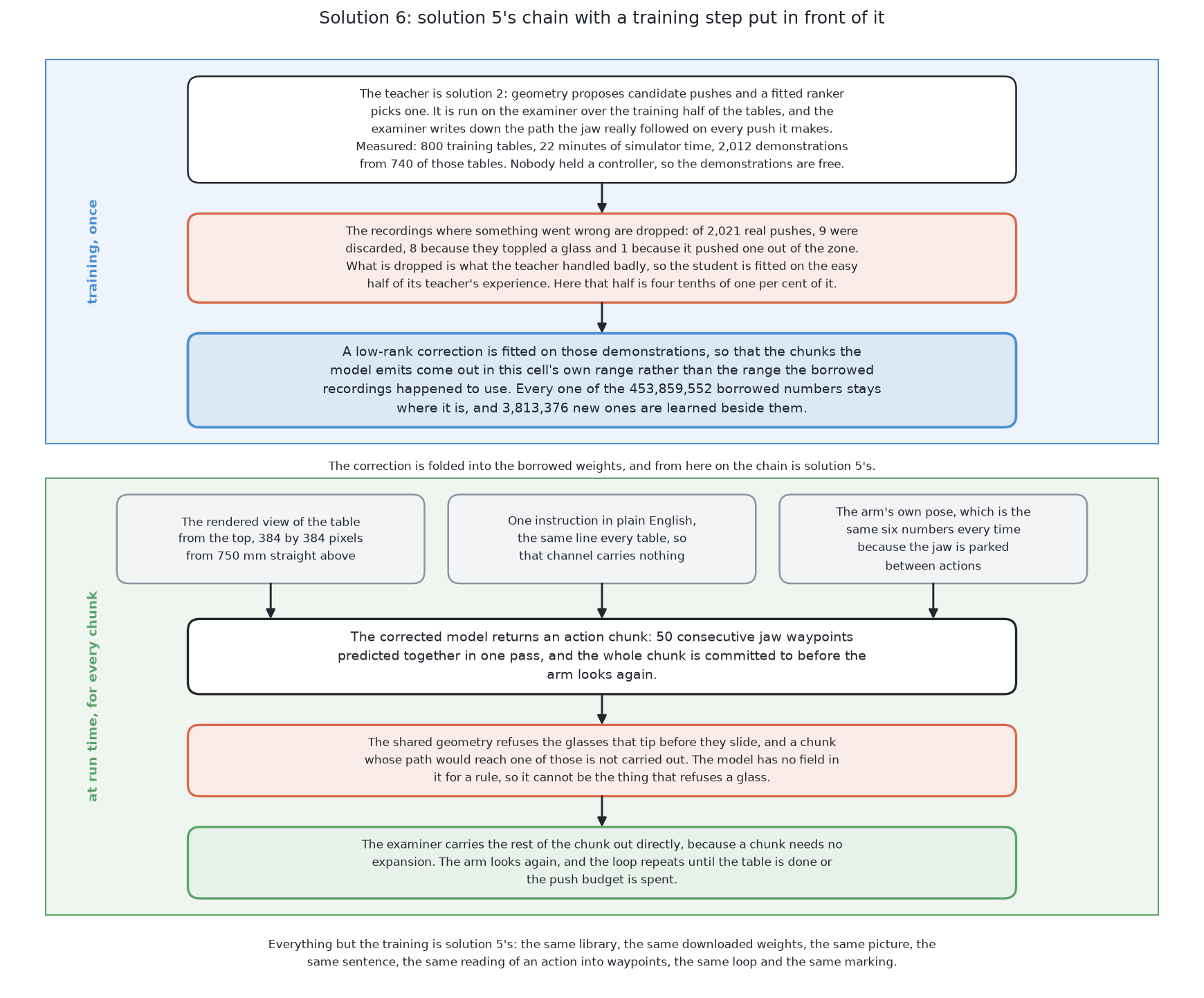
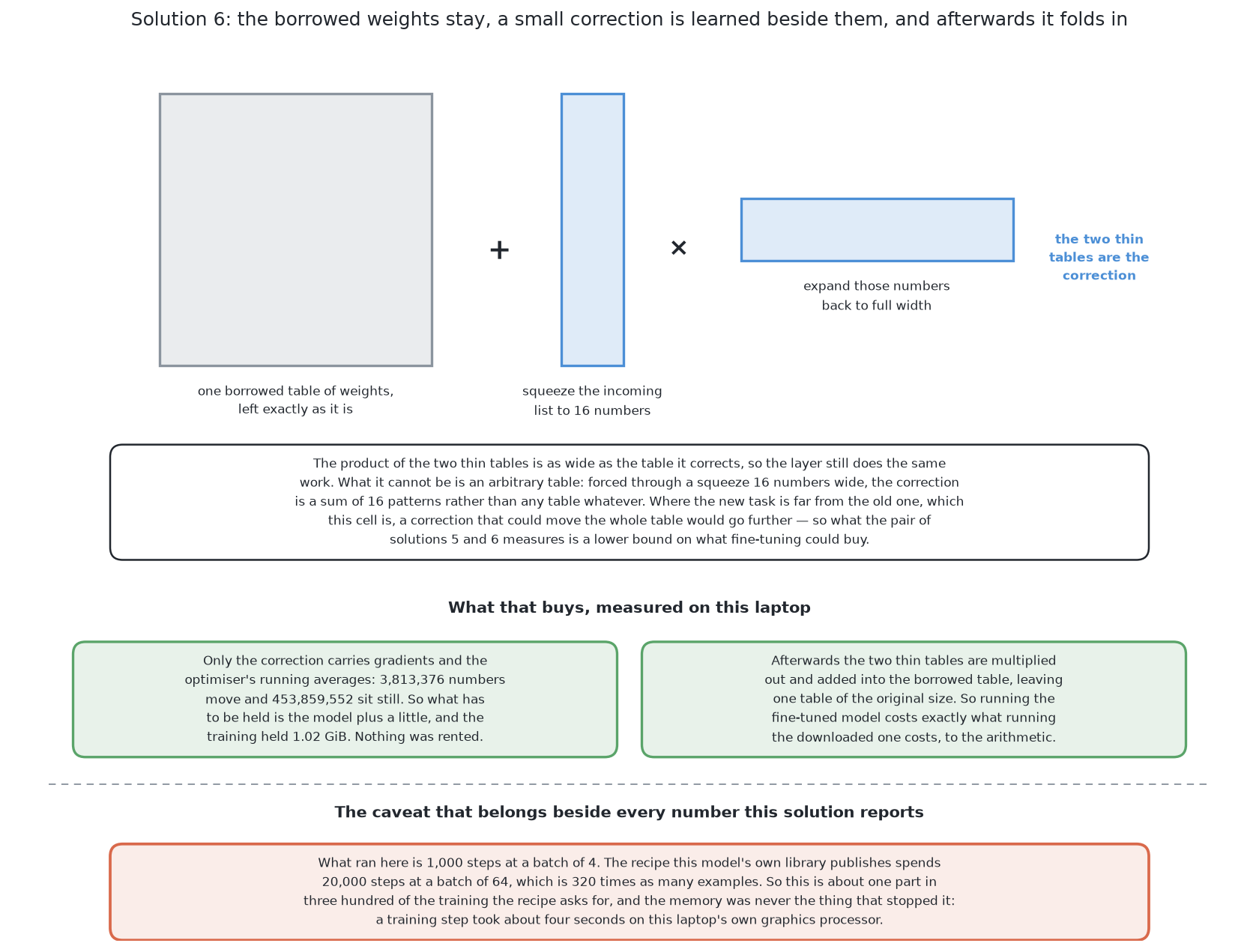
What it uses — LeRobot, with PyTorch underneath. The training ran on this Mac's own Metal GPU. The model is SmolVLA, with the same library, the same model and the same downloaded weights as solution 5. Here its training is continued by low-rank adaptation, on pushes made on the examiner's tables. What it does — it keeps the borrowed model's numbers and learns a small correction to them. The correction comes from pushes made on this examiner. So the model stops being a general copier of robot motion and becomes a pusher of glasses on this table. How the output is produced — a view of the table from the top goes in, with one instruction in plain English and the arm's own pose. The pose is the same every time, because the jaw is parked between actions. The model returns an action chunk, which is a short run of jaw waypoints predicted together in one pass. The shared geometry refuses the glasses that tip before they slide. A chunk whose path would reach one of those is not carried out. The examiner carries the waypoints out directly. Then the arm looks again, and the loop repeats until the table is done or the push budget is spent. What it costs — the demonstrations are free, because solution 2 makes them and no person holds a controller. The training fits in 1.02 GiB on a laptop, so nothing was rented. Running it costs the same as running solution 5. The licence is not the obstacle it was for the pair that tells the glasses apart. But a fine-tuned file keeps the terms of the file it came from, so read those terms before anything leaves this project.
The cell is described once, in the cell — the layout, the two places the camera works from, from the top and from the side, all four sensors, and the words this project uses them with. What follows is only what is specific to this solution.
Contents#
1. Introduction#
This page explains how this solution answers the problem this book sets. It takes a robot foundation model that was trained somewhere else. Then it continues that training on pushes made in this cell. This is called fine-tuning. It is the ordinary way to put a borrowed model to work on one job.
This solution is one half of a matched pair. Solution 5 is the same model with no training in this cell. This solution is the same model with training here. Everything else is held still, so the gap between the two scores measures what the training bought. Solution 5's comparison explains why this is the cleanest pair in the book. Whether anything but the training differs checks the few places where something else might.
The book on telling the glasses apart in a picture asked the same question about a model that finds objects in pictures. Here the model does more. It decides what the arm does next. A model can find every glass in a picture and still choose bad pushes. This is because choosing a push needs a sense of what a push does, and a picture does not show that.
Most of this solution is built. The code is in
06-smolvla-fine-tuned/.
It records demonstrations from the teacher, fits the correction, and has been
run on the examiner's held-out tables. Its numbers are in
its own README.
DAgger is still a plan and not code. The first result came from one
training seed on one set of tables. The model was later fitted again on
solution 3's tables, with three seeds. How it
compares
shows that this changed nothing.
The measured result is a bad one, so it is stated here at the start: the training made the score worse. The model learned the height at which a push happens. Its chunks now come down to the height the gripper pushes at. But it did not learn where to put the jaw down. So many pushes come down onto a glass instead of behind it, and many glasses fall over. How it compares gives the numbers and reads them in full.
By the end you will know what fine-tuning is, and what low-rank adaptation gives up to fit in memory. You will know where the demonstrations come from, and which of solution 5's weaknesses the training repairs.
The next section shows the trained model at work on one table.
2. A film of one table#
The introduction said what the training changed. The film below shows the trained model on one table in the simulator, at one and a half times real speed.
The table holds six glasses, where the average is five. Five of them have no room at the start.
In the film the jaw comes down to the right height. The training fixed that. But the jaw comes down onto a glass. The training did not fix that. The arm makes four pushes. One glass is racked and one is knocked over, so the table is marked wrong. This is the most common outcome for this solution.
A glass on its side cannot be stood up again. So reaching the glasses in the wrong place is worse than not reaching them at all. Solution 5's model never touches anything. The training made it touch things, and that made it dangerous.
The model draws its answer at random, so the film shows one draw. The scored runs on this table all ended wrong, with six pushes and two glasses racked on average. The examiner explains why a filmed table can differ from the same table in a scored run.
The six measured solutions are filmed on this same table. The six films puts them side by side.
The film shows what happened. The next section says which problem this solution was built to solve.
3. The problem this solves#
The film showed the trained model at work. This section says what it was meant to fix.
The book asks for jaw trajectories until every glass has about 76 mm of clear room. A glass that cannot get room must be refused with a reason. The problem explains why this is hard. The hardest part is friction. Friction decides whether a glass slides or tips. Nothing in the cell measures it, and the examiner never tells it.
A learned policy deals with this by seeing many pushes and what they did. It ends up with a sense of what a push does on this table, friction included. Solution 5 already borrows a model trained in this way, on a very large set of real robot motion.
So the question here is narrow. Having borrowed a policy, what is still wrong with it, and does training here fix that?
Solution 5's problems have one cause. Its model was trained on real robots in real rooms. This cell shows it a rendered picture of a simulated table, which looks nothing like that. This difference is called the domain gap. Solution 5 explains it in full. Continuing the training on pushes made here is the standard repair.
The next section gives the main idea of that repair.
4. The main idea#
The problem is the domain gap. The idea for closing it is short. Keep the borrowed numbers, and learn a small correction to them from pushes made on the examiner's tables.
Three things follow from this idea.
The numbers do not start from nothing. A model's weights are the numbers inside it. SmolVLA has about 450 million of them. They already know general things, for example that a motion should be smooth. So the training starts from them.
The pushes are this examiner's pushes. The model is trained on this examiner's pictures and pushes. So at run time it sees the same kind of input it was trained on. This is how fine-tuning closes the domain gap.
Only a small part of the model changes. The training leaves every borrowed number as it is. It learns a small correction that is added beside them. This is called low-rank adaptation. It makes the training cheap, but it also limits how far the model can change.
Everything else about the model stays the same, including its limits. The instruction is still the same sentence every time, so it carries nothing, as solution 5 explains. The model still commits to a whole chunk of fifty waypoints before it looks again. And it still cannot refuse a glass.
How it works takes each of these parts in turn.
← A foundation model as it downloads — questions and answers · The code →