This page is a short summary of the third of the six solutions. This solution downloads a model that somebody else trained on photographs. It then uses that model on this cell's pictures with no change at all. The page says what the model is, how it is used, what it needs, what it scored and when to choose it. The full story is in the chapter on this solution.
Contents#
- What it is
- How it works
- What it needs
- What it scored
- Where it is strong and where it breaks
- When to choose it
1. What it is#
The model is Ultralytics YOLO26-seg. It does instance segmentation. This means it gives one outline for each separate object it finds. It also gives each object a name from a fixed list, such as "cup", and a confidence number.
Nothing is trained in this cell. The only setting is a bar on the confidence number, set by hand at 0.25. So this is the cheapest solution to try. It is also one half of a matched pair with the same model, fine-tuned. The next section shows how few steps the method has.
2. How it works#
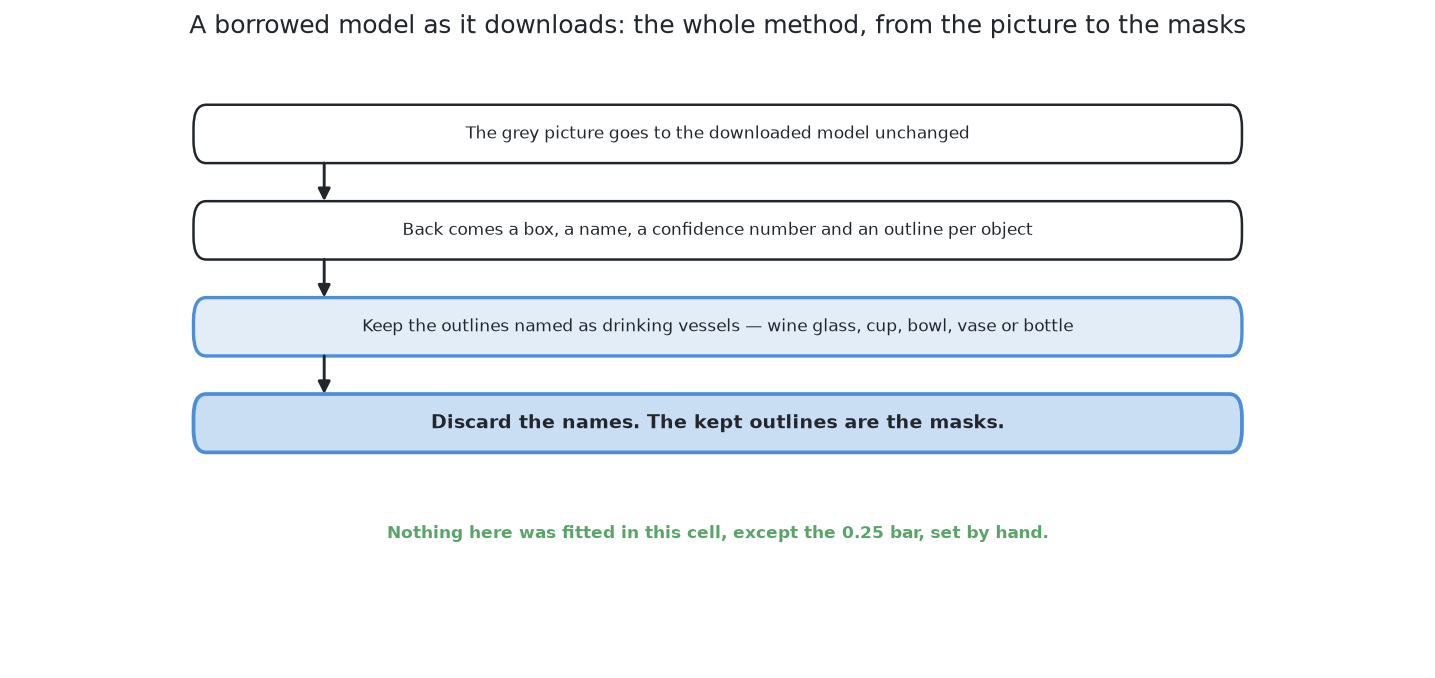
The method has only three steps, and this section lists them.
- The grey picture goes into the model unchanged.
- The model returns a list of objects, each with a name and an outline.
- The solution keeps the outlines named as a drinking vessel, such as "cup" or "wine glass". It drops the rest, and then it throws the names away.
The kept outlines are the masks. The examiner turns each mask into a place and a width, as it does for all six solutions. The next section shows how little this needs.
3. What it needs#
This solution needs very little, and that is its main point. It needs the Ultralytics package, which downloads the weights by itself. It needs no labels, no training run and no graphics card of its own.
Its one real cost is the licence. The model is under the AGPL-3.0 (GNU Affero General Public License, version 3). This licence also covers software that only serves answers over a network. The licence section explains this in full. The next section shows what the model found.
4. What it scored#
Every solution is run on two sets of arrangements. The spawned set uses the cell's own spacing. The crowded set puts the glasses closer than that. Each row below gives the count per 100 glasses, with the lowest and highest block in brackets.
| found per 100 | missed | merged | place | mask covered | mask not the glass | |
|---|---|---|---|---|---|---|
| spawned | 6.4 (2.0–11.9) | 93.6 | 0.0 | 23.7 mm | 95.2% | 3.3% |
| crowded | 2.1 (0.0–4.2) | 97.9 | 0.0 | 39.1 mm | 96.0% | 4.9% |
It finds about six glasses in a hundred. This is the worst score in the book. The reason is the domain gap. This means the pictures here are very different from the photographs the model learned from. Why it failed explains it in full. The results compare all six. The next section says what this result teaches.
5. Where it is strong and where it breaks#
This section lists what the method does well and badly, given the score above. It is strong because nothing is fitted. It can be tried in an afternoon. It gives one outline per object, so two touching glasses are not joined into one shape.
It breaks because of the domain gap. Its masks also mark only the part of a glass the camera saw. So a glass partly behind another one looks smaller and in the wrong place. A glass hidden completely is not in the picture at all, so no model can find it. The next section says when these points make it worth using.
6. When to choose it#
This section turns the strengths and weaknesses above into advice. Run this first, because it is the cheapest test of whether you need a trained model at all. On pictures like ordinary photographs, it may be good enough on its own.
Do not keep it when the pictures are unlike photographs, as here. Then use the same model, fine-tuned or a foundation model with a keeper. Its real value is the comparison with solution 4, not its own score.
The code is in
src/08_seeing-the-glasses/03-yolo-zero-shot/.
It writes its own results.json beside itself. The full treatment starts at
what it is.
← A network trained from scratch · The same model, fine-tuned →