This page is a short summary of the second of the six solutions. It trains a small network on this cell's own pictures and borrows nothing. The page covers what the network predicts, what it needs, its score, and where it breaks. The chapter on this solution explains it in full.
Contents#
- What it is
- How it works
- What it needs
- What it scored
- Where it is strong and where it breaks
- When to choose it
1. What it is#
A neural network is a large set of numbers, called weights. A picture goes in and an answer comes out. Training changes the weights step by step until the answers match known examples. Training from scratch means the weights start as random numbers, not as weights someone else fitted.
This solution trains one small network from scratch on this cell's pictures. Nothing is downloaded. So it has no domain gap, which is the difference between the pictures a model learned from and the pictures it is shown. That makes it the control for the four borrowed models. What it is explains this role.
The next section says what the network is asked to predict.
2. How it works#
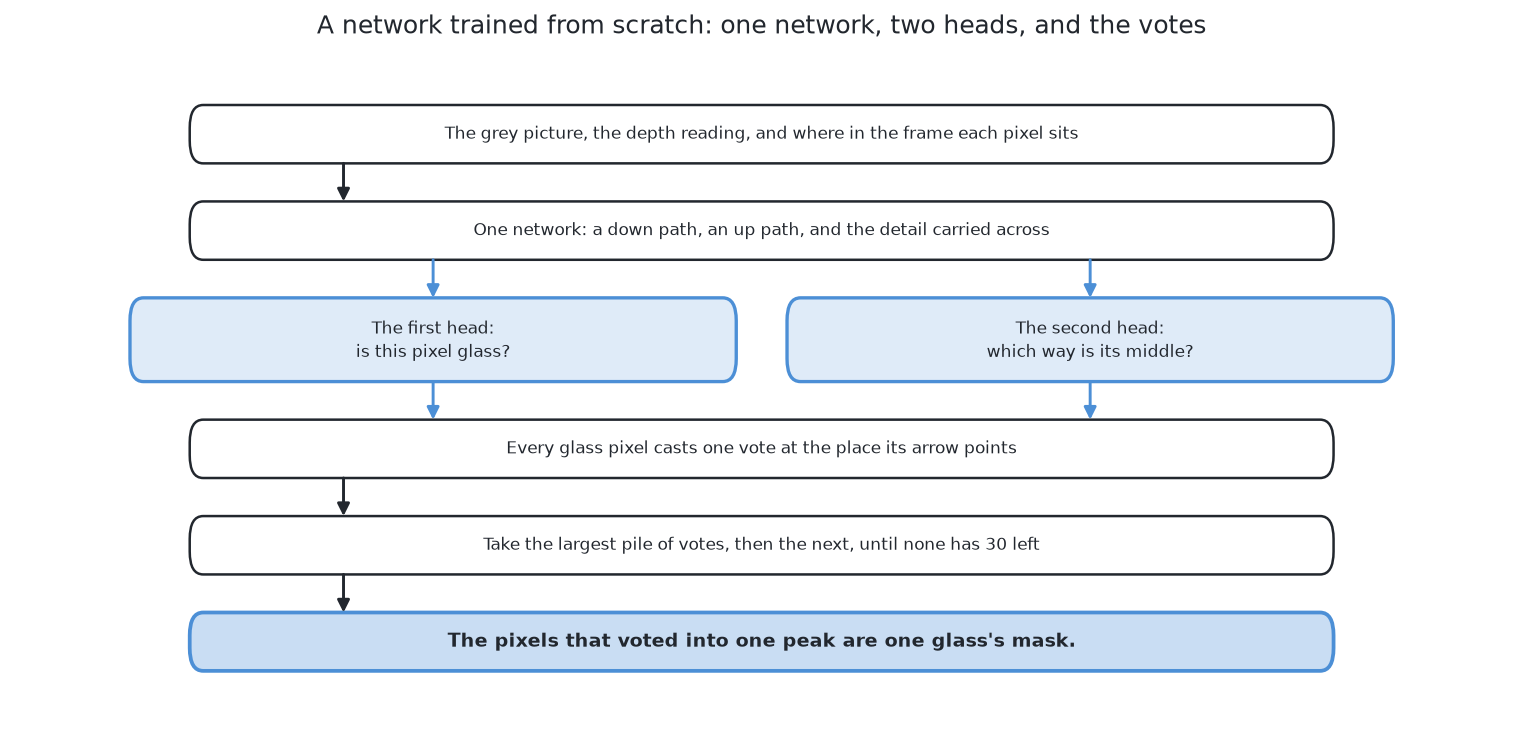
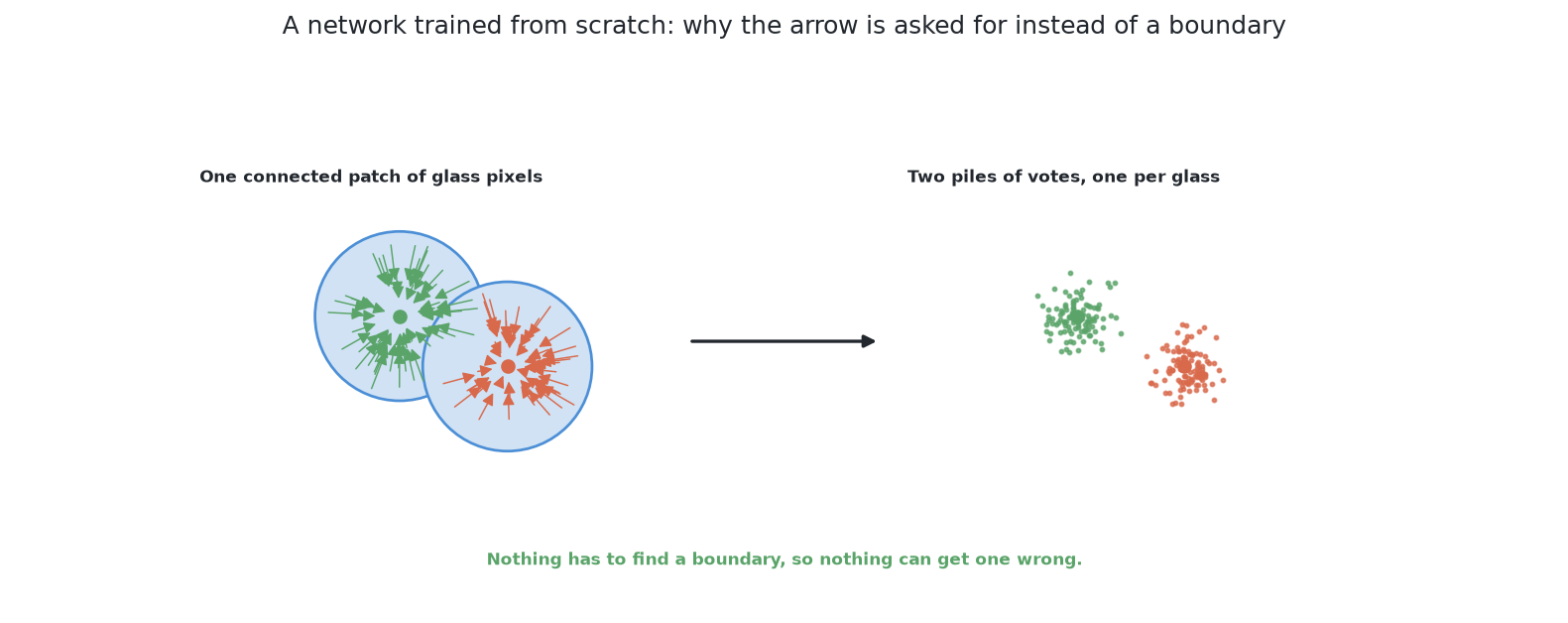
The key choice is what the network predicts. A label "glass or not" at each pixel is not enough. Two glasses whose outlines touch give one joined region, and the label cannot say where to cut it.
So the network has two outputs, called heads. The first says whether each pixel is glass. The second gives each glass pixel an arrow towards the middle of its own glass. Each glass pixel then votes for the place its arrow points to. One glass makes one pile of votes. Two glasses make two piles, even when their pixels touch.
The network is a U-Net, a standard small design that labels every pixel of a picture. The training labels come from the examiner's answer key, which says which glass owns each pixel. A second way, using the arm's own movement, is described but is not the source of the numbers below. How it works explains the votes and both ways of making labels. The next section lists what this design needs.
3. What it needs#
Training a network has costs that the written rule does not have. It needs PyTorch, a training set and a training run before it can answer anything. It runs on this Mac's built-in graphics, and it has no licence condition. Its weights file must be kept in step with the cell. What it needs gives the full list. The next section shows how well it did.
4. What it scored#
This section gives the solution's score on the shared examiner. The table has one row for the spawned run and one for the crowded run. Each column is an average over five blocks, with the lowest and highest block in brackets for "found".
| found per 100 | missed | merged | place | mask covered | mask not the glass | |
|---|---|---|---|---|---|---|
| spawned | 64.1 (62.4–66.7) | 35.9 | 0.0 | 0.6 mm | 98.3% | 1.6% |
| crowded | 74.6 (71.3–79.8) | 25.4 | 0.6 | 0.9 mm | 97.1% | 1.4% |
When it reports a glass, the report is very good. Its places are within about one millimetre, and it merges almost nothing. But it misses many glasses. It also does better on the crowded run than on the spawned run. The cause is the voting. A glass whose middle falls outside the picture casts votes that are dropped. How it compares gives the counts. The results compares it with the other five. The next section says what these numbers mean.
5. Where it is strong and where it breaks#
The score shows a method that is precise but misses glasses. This section lists its other strengths and limits.
Its strengths are these. It has no domain gap. It splits touching glasses without looking for a boundary. A partly hidden glass still votes for the right middle. The size of a pile of votes tells you how sure it is.
Its limits are these. It cannot see a glass that is fully hidden, because no pixels means no votes. Looking again at what was hidden deals with that case. It must be trained before it can answer. It cannot explain a wrong answer. Its weights must be kept in step with the cell. The next section turns these into advice.
6. When to choose it#
These strengths and limits tell you when to use it. Choose it when labels are free and the pictures look nothing like photographs. Both are true in this cell. In most real work labels are costly, so fine-tuning a larger model is usually the better choice.
Its main use here is as a measuring line. If a borrowed model does no better than this small network, its size and its licence gave nothing in this cell.
The code is in
src/08_seeing-the-glasses/02-train-from-scratch/.
It writes its own results.json. The full treatment starts at what it
is.