This page is a short summary of the fourth of the six solutions. It uses the same model and the same downloaded weights as a borrowed model, as it downloads. The one change is that the model is trained further on this cell's own pictures. The page says what that means, what it needs, what it scored and when to choose it. The full story is in the chapter on this solution.
Contents#
- What it is
- How it works
- What it needs
- What it scored
- Where it is strong and where it breaks
- When to choose it
1. What it is#
Fine-tuning means taking a model that is already trained and training it a little more on your own pictures. The model keeps what it learned in general. It learns the look of your pictures on top.
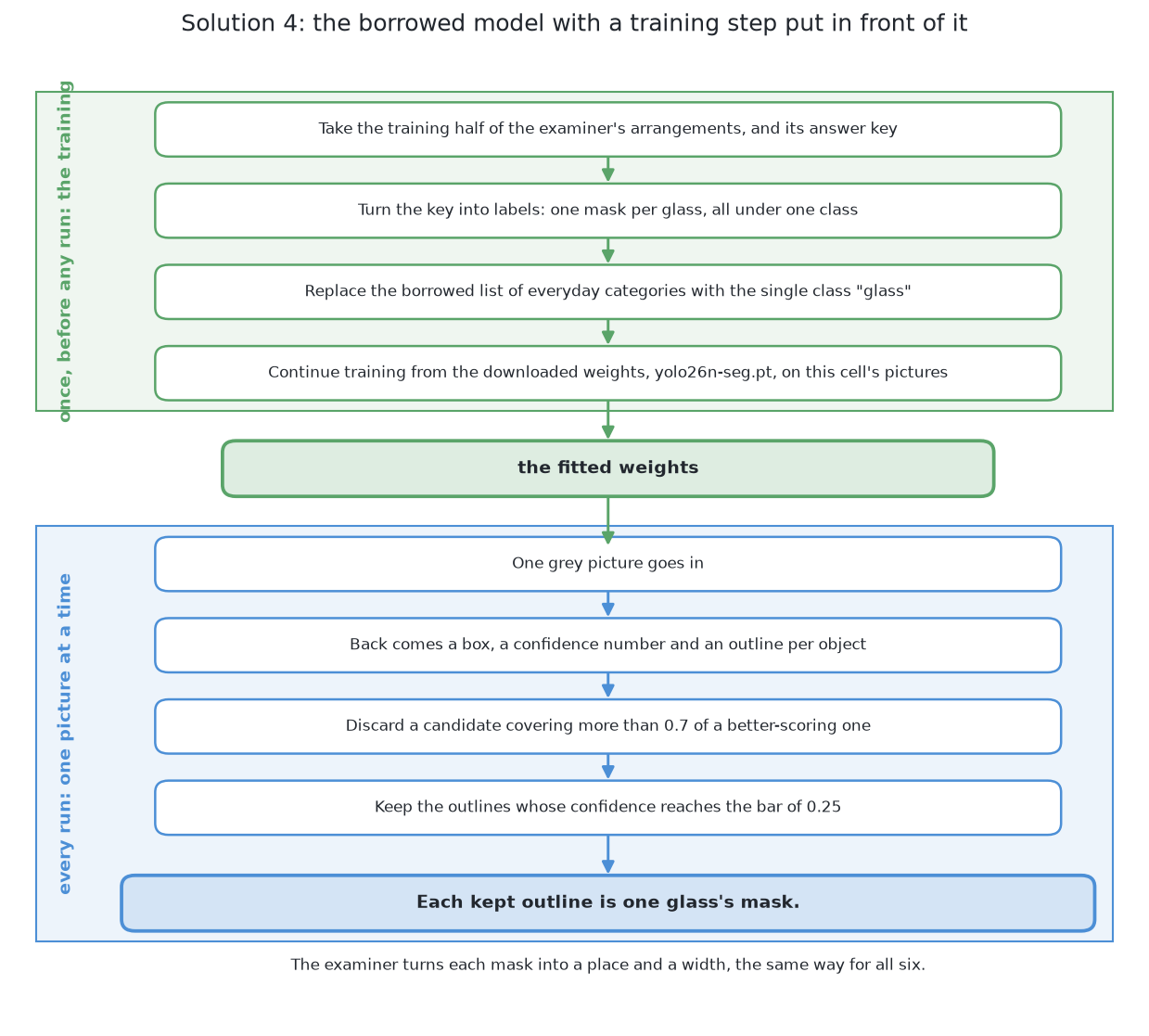
Solutions 3 and 4 are a matched pair. Only the training differs between them. So the difference in their scores shows what training is worth. The next section shows the training step that this solution adds.
2. How it works#
This solution is solution 3 with a training step in front. The training labels are free, because the examiner knows which glass owns each pixel. The list of names is cut to one class, "glass". After training, the run is the same as solution 3. The examiner turns each mask into a place and a width.
Training cannot change the shape of the output. The mask still marks only what the camera saw. How the model is trained explains this in full. The next section lists what this training costs.
3. What it needs#
This section lists what the training step above needs. It needs the Ultralytics package, PyTorch and the downloaded weights. It trains on this laptop's built-in graphics. It needs a training set, which the examiner labels for free, and time on the machine for the training run. After training, the weights file must be kept in step with the cell.
The licence is the expensive part. The AGPL-3.0 covers the library, and it also covers the new weights file that training makes. The licence section explains the AGPL in full. The next section shows what the training bought.
4. What it scored#
Every solution is run on a spawned set at the cell's own spacing and a crowded set that is closer. Each row gives the count per 100 glasses, with the lowest and highest block in brackets.
| found per 100 | missed | merged | place | mask covered | mask not the glass | |
|---|---|---|---|---|---|---|
| spawned | 99.4 (99.0–100.0) | 0.6 | 0.0 | 6.6 mm | 99.7% | 4.6% |
| crowded | 72.0 (70.8–72.9) | 28.0 | 0.8 | 0.6 mm | 99.2% | 3.7% |
Solution 3 found 6.4 glasses per 100 on the spawned set. This solution finds 99.4. Only the training changed, so training bought that difference. Its masks cover more of each glass than any other solution's. They also reach a little past the glass. The results compare all six. The next section sums up what this means.
5. Where it is strong and where it breaks#
This section turns the scores above into strengths and weaknesses. It is strong because it is trained on the pictures it will see. Its labels cost nothing. It has only two settings, a confidence bar and an overlap limit.
It has three weaknesses. First, its masks mark only what the camera saw, so a partly hidden glass looks smaller. Second, its weights are good for this cell and worse elsewhere. Third, the AGPL licence covers its weights too. The next section says when to choose it anyway.
6. When to choose it#
This section turns the points above into advice. Choose it when a borrowed model nearly works and labels are cheap. This is true for most factory vision work.
Do not choose it if the licence matters. Then a transformer segmenter, fine-tuned does the same job under Apache 2.0. If labels must be drawn by hand, a foundation model with a keeper needs far fewer of them.
The code is in
src/08_seeing-the-glasses/04-yolo-fine-tuned/.
It writes its own results.json beside itself. The full treatment starts at
what it is.
← A borrowed model, as it downloads · A foundation model with a keeper →