This page is a short summary of the fifth of the six solutions. This solution splits the job in two. A large borrowed model draws outlines but does not name them. A small model trained here decides which outlines are glasses. The page says what it is, what it needs, what it scored and when to choose it. The full story is in the chapter on this solution.
Contents#
- What it is
- How it works
- What it needs
- What it scored
- Where it is strong and where it breaks
- When to choose it
1. What it is#
A foundation model is a large model trained once on very broad data and then used for many jobs. The one here is SAM 2 (Segment Anything Model 2). It outlines whatever is at a point in a picture. It does not say what the thing is.
Finding shapes works on new kinds of pictures. Naming them does not, as solution 3 showed with 6.4 glasses per 100. So this solution borrows the finding and replaces the naming. A small model trained here does the naming. This book calls it the keeper, because it decides which outlines to keep. The next section shows the steps of a run.
2. How it works#
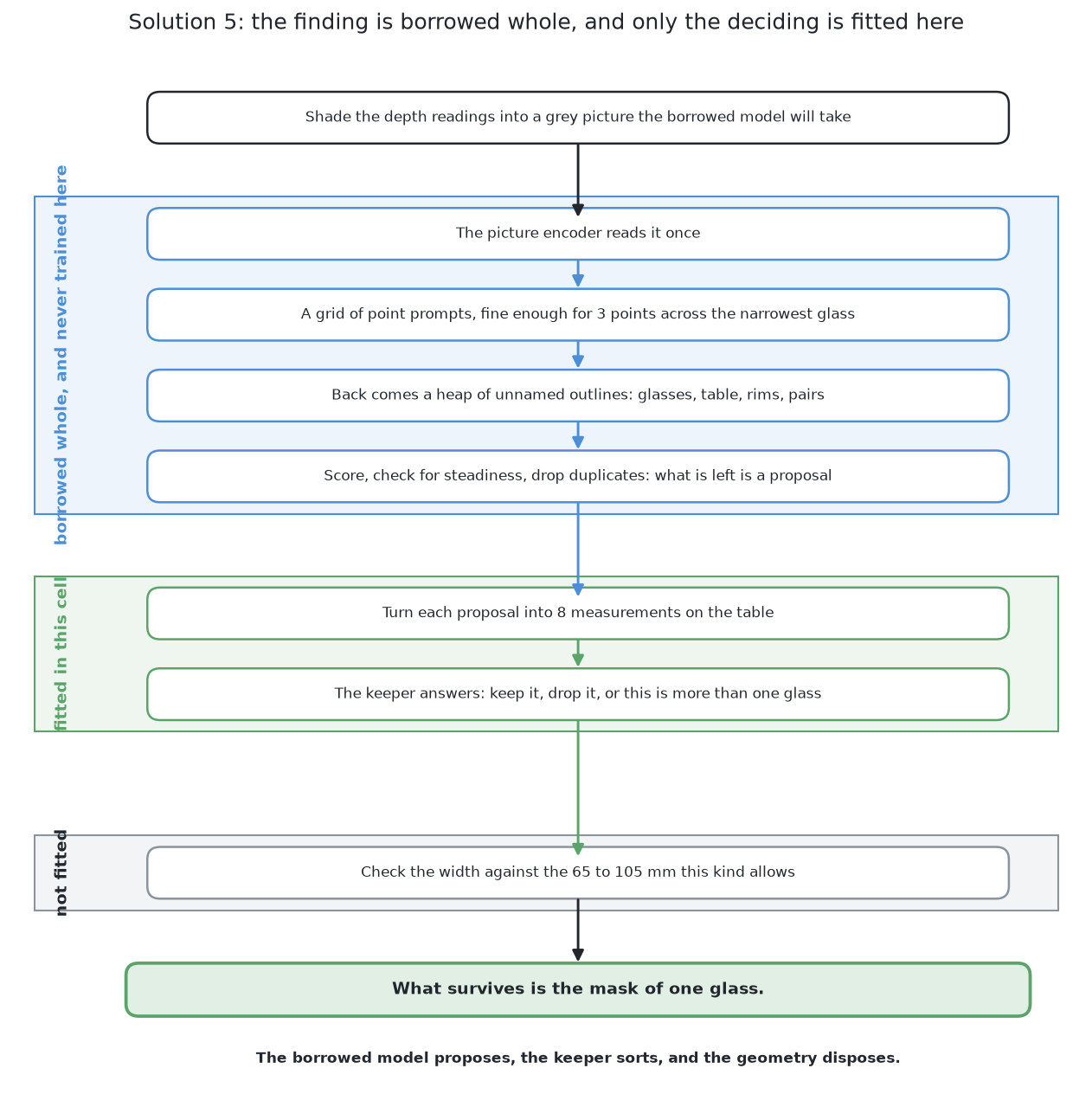
A run has four steps.
- SAM 2 is pointed at a grid of points across the grey picture. It outlines everything it finds.
- Duplicates and weak outlines are removed. Each one left is a proposal.
- The keeper reads a few measurements of each proposal, such as its width and height. It answers keep, drop, or more than one glass.
- A kept proposal must still pass a width check for the known kind of glass.
SAM 2 is never trained here. How it works explains the keeper in full. The next section lists what these steps need.
3. What it needs#
This section lists what the steps above need. It needs a deep learning framework and a SAM 2 weights file that this project cannot make. It needs a set of labelled proposals for the keeper. The examiner makes these labels for free. It needs far fewer of them than a network trained from scratch. Fitting the keeper takes seconds. Running SAM 2 over the pictures takes most of the time.
Its licence is permissive, unlike the two solutions built on YOLO. What it needs gives the details. The next section shows what it scored.
4. What it scored#
Every solution is run on a spawned set at the cell's own spacing and a crowded set that is closer. Each row gives the count per 100 glasses, with the lowest and highest block in brackets.
| found per 100 | missed | merged | place | mask covered | mask not the glass | |
|---|---|---|---|---|---|---|
| spawned | 83.0 (78.0–86.1) | 17.0 | 0.0 | 5.6 mm | 97.2% | 0.0% |
| crowded | 73.6 (71.9–76.6) | 26.4 | 0.0 | 0.8 mm | 98.3% | 0.0% |
The last column is the result to notice. None of its masks spread onto a neighbour or the table, and it merged no glasses. The keeper and the width check drop a doubtful proposal instead of making a wrong report. The cost is in the first column. About one glass in six is missed on the spawned set. The results compare all six. The next section sums up what this means.
5. Where it is strong and where it breaks#
This section turns the scores above into strengths and weaknesses. It is strong because almost nothing is trained here. The keeper is small, fast and easy to check. It needs the least data of the solutions that train anything. It also sees objects that are not glasses, such as a spoon, and says "not a glass".
It has four weaknesses. First, the domain gap cannot be closed, because SAM 2 is never trained here. Second, it cannot be taught this cell's hard cases, such as glasses that touch. Third, it needs depth twice, for the picture and for the keeper's measurements. Real clear glass gives no depth, so it would have no input. Fourth, a glass hidden completely is not in the picture, as looking again at what was hidden explains. The next section says when to choose it anyway.
6. When to choose it#
This section turns the points above into advice. Choose it when labelled examples are scarce. Choose it also when a wrong answer costs more than a missing one.
Do not choose it when accuracy matters more than setup cost. Then use the same model, fine-tuned or a transformer segmenter, fine-tuned. Do not choose it when the sensor gives no depth.
The code is in
src/08_seeing-the-glasses/05-sam2-with-a-keeper/.
It writes its own results.json beside itself. The full treatment starts at
what it is.
← The same model, fine-tuned · A transformer segmenter, fine-tuned →