This page is a short summary of the sixth of the six solutions. This solution uses a modern transformer model, trained further on this cell's own pictures. Its licence is permissive. The page says what it is, how it differs, what it needs, what it scored and when to choose it. The full story is in the chapter on this solution.
Contents#
- What it is
- How it works
- What it needs
- What it scored
- Where it is strong and where it breaks
- When to choose it
1. What it is#
The model is RF-DETR-Seg, under the Apache 2.0 licence. It comes already trained on ordinary photographs. Here it is trained further with one class, "glass", exactly as the same model, fine-tuned is.
So solutions 4 and 6 are trained the same way on the same pictures. Only the design of the model differs. The next section shows what that design changes.
2. How it works#
This section shows the two ways this design differs from YOLO.
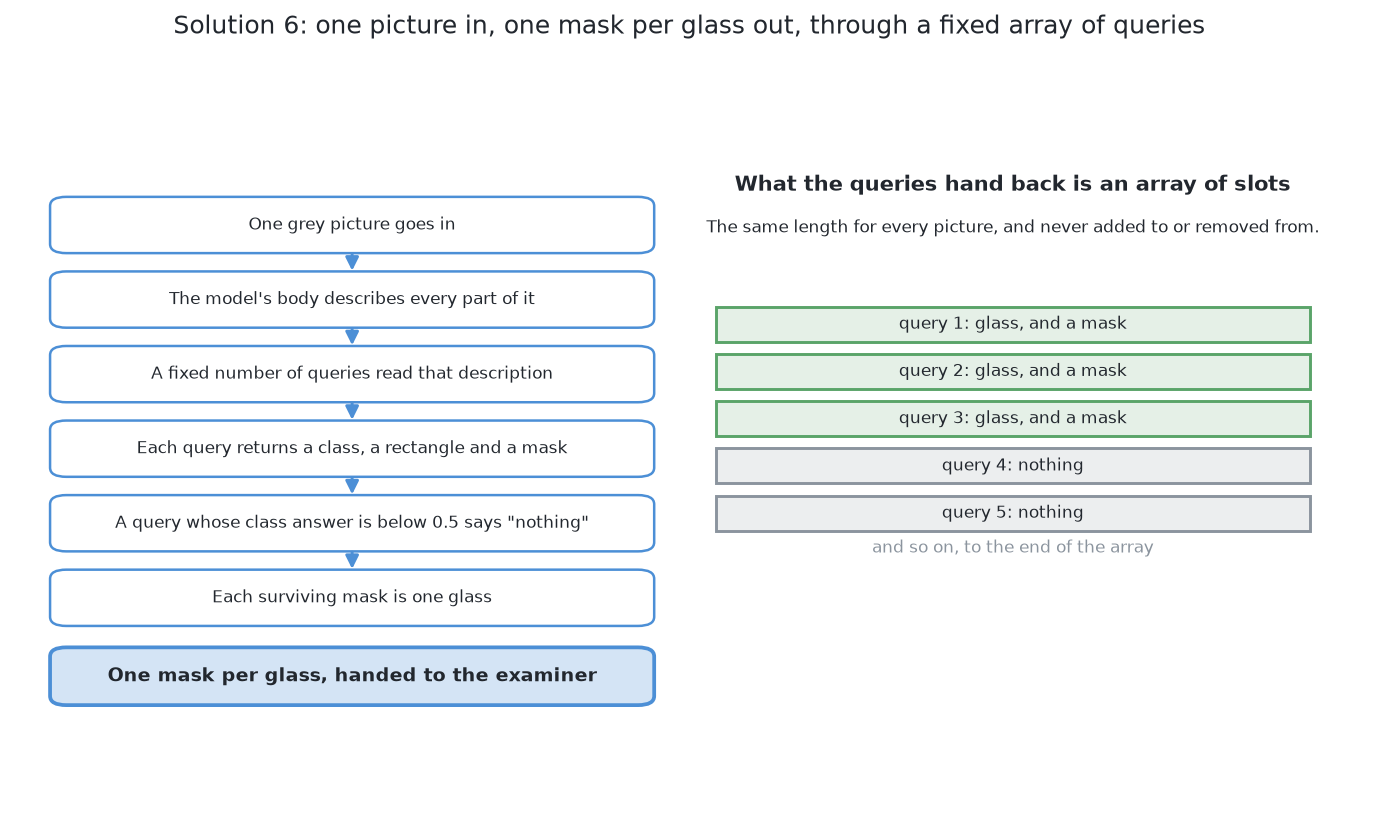
First, the model has a fixed number of slots, called queries. Each slot reports one glass or nothing. In training, slots are matched to glasses one to one. This is called set prediction. So two touching glasses fill two slots, and nothing has to be cut apart. There is also no overlap limit to choose.
Second, the mask is drawn over the whole picture, not inside a box. So it is the only one of the six that could be trained to mark the hidden part of a glass. That second way was not trained to the end, so it has no score here. How it works explains both in full. The examiner turns each mask into a place and a width, as for all six. The next section lists what this needs.
3. What it needs#
This section lists what the model above needs. It needs a deep learning framework and a large downloaded weights file. It needs a training set, which the examiner labels for free. It needs time on the machine for training, which is its largest cost. It trains on this laptop's built-in graphics. Its weights must be kept in step with the cell.
Its Apache 2.0 licence puts no duty on the code around it. What it needs gives the details. The next section shows what it scored.
4. What it scored#
Every solution is run on a spawned set at the cell's own spacing and a crowded set that is closer. Each row gives the count per 100 glasses, with the lowest and highest block in brackets.
| found per 100 | missed | merged | place | mask covered | mask not the glass | |
|---|---|---|---|---|---|---|
| spawned | 96.4 (94.9–98.0) | 3.6 | 0.0 | 6.0 mm | 96.6% | 0.0% |
| crowded | 81.9 (77.2–86.5) | 18.1 | 1.4 | 0.5 mm | 97.2% | 0.0% |
It finds more crowded glasses than any other solution. It is the only one clear of the group on crowded tables. Exact masks would find 86.4, because some glasses are hidden completely. None of its masks spread onto a neighbour or the table.
It is not best everywhere. The fine-tuned YOLO found more glasses on the spawned set, 99.4 against 96.4. It also merged fewer crowded glasses, 0.8 per 100 against 1.4. The results compare all six. The next section sums up what this means.
5. Where it is strong and where it breaks#
This section turns the scores above into strengths and weaknesses. It is strong because it gives one mask per glass and never has to cut touching glasses apart. It has one less setting to choose than YOLO. It is the only one that could be asked for the hidden part of a glass. Its licence is permissive.
It has four weaknesses. Training needs patience, because the slots take time to settle. The hidden-part way is easy to get wrong without any warning. A glass hidden completely fills no slot. Its answers cannot explain themselves. How it compares explains these in full. The next section says when to choose it.
6. When to choose it#
This section turns the points above into advice. Choose it when the work must ship with a clean licence. On ability alone it and the fine-tuned YOLO are close, so the licence decides. Choose it also when the hidden part of an object matters.
Do not choose it when setup cost is the problem. Then a foundation model with a keeper needs almost no training data. It also needs depth, just as rules on the table does.
The code is in
src/08_seeing-the-glasses/06-rf-detr-fine-tuned/.
It writes its own results.json beside itself. The full treatment starts at
what it is.
← A foundation model with a keeper · Rules on the table — what it is →