This page answers one question: how can one model take a camera picture and a sentence, and move a robot arm to do what the sentence says?
This is a page for a reader who has read the two pages before it, language models as planners and vision-language models. So you should already know what a token is, and how a picture is cut into patches. It also helps to have read the movement models overview, which explains the words policy, observation and action, because this page uses those words in the same way.
This page explains how these models work, but it does not try to list the newest ones. For that, read foundation models and generalist policies, which records what each laboratory has released or shown, as of September 2026.
Contents#
- What it is
- What goes in and what comes out
- How it works inside
- How it is trained
- Well-known models of this kind · 5.1 SmolVLA, the one to start with · 5.2 The pi models from Physical Intelligence · 5.3 GR00T N1.7 from NVIDIA · 5.4 MolmoAct2 from the Allen Institute for AI · 5.5 X-VLA · 5.6 OpenVLA · 5.7 The ones you will read about but cannot have · 5.8 How to choose
- Where this is going
- Where to read next
1. What it is#
Here is the idea in one sentence. A vision-language-action model, or VLA, is a vision-language model that has been taught to output arm movements as well as words.
Think of asking a person to "put the mug in the bowl". They do not write a plan first, and they do not say where the mug is, because they look, understand and move all at once. So a VLA tries to do the same in one model.
The two pages before this one split the job into parts. A planner chose the steps, a vision-language model found the mug and checked the result, and other models and ordinary code did the moving. A VLA replaces all of those parts with one network. So it is a policy, in the sense of the movement models chapter, because it turns an observation into an action, many times a second. What makes it different from the other policies in that chapter is where it starts, since it starts from a vision-language model that already knows what mugs and bowls are, and what the words mean.
2. What goes in and what comes out#
Three things go in, each time the model runs:
- one or more camera pictures, often one from above the table and one from a small camera on the wrist
- the instruction, in words, such as "put the mug in the bowl"
- the arm's current joint angles, read from the sensors in the joints
One thing comes out, which is the next movements of the arm. Depending on the model, a movement is given as target joint angles, or as how far to move and turn the gripper, and it also says whether the gripper should open or close. Most VLAs output a short sequence of movements each time they run, not just one.
The instruction stays the same for the whole task, while the pictures and the joint angles change every time the model runs. So the model sees the result of its last movement before it chooses the next one.
3. How it works inside#
The starting point: a vision-language model#
Every VLA starts from a vision-language model, as described on the previous page. The picture is cut into patches, the patches and the words become one row of tokens, and a transformer reads the row. That model already knows a great deal about everyday objects, but what it cannot do is say "move 3 mm to the left". So there are two main ways to teach it that.
Way 1: write the movement as tokens#
The first way was shown by Google's RT-2 in 2023, and it writes each movement as text. The model then outputs a movement in exactly the same way that it outputs a word. RT-2 was never released, so it appears here only because it is the clearest example of the method, and the models you can actually use are in section 5.
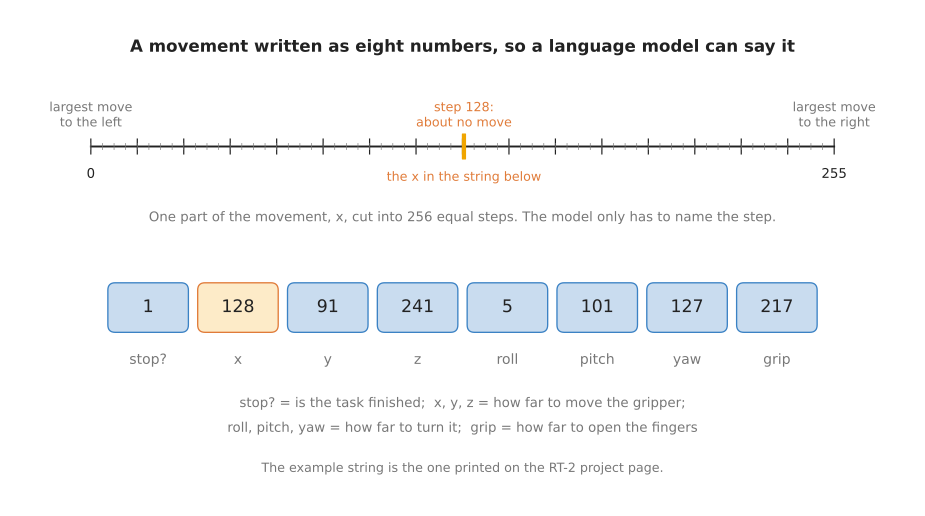
The picture shows how this works. A movement of the gripper has several parts, because
it moves along three directions, called x, y and z, and it turns about three
directions, called roll, pitch and yaw. It also opens or closes, and RT-2 adds one
more part that says whether the task is finished. Each part has a smallest and a
largest allowed value, and that range is cut into 256 equal steps, numbered 0 to 255.
So the model does not need to write an exact distance, and it only needs to name the
step, such as step 128, which is near the middle and means "almost no movement". A
whole movement therefore becomes eight numbers, such as 1 128 91 241 5 101 127 217.
It is worth being exact about what that last step means, because it is the whole method. A token is one entry in the model's fixed list of tokens, and the chapter overview describes that list: tens of thousands of entries, each with its own list of numbers learned during training. So to write step 128, the model needs an entry that means step 128. The method therefore adds 256 new entries to a list that was built for words, and the layer at the end of the model, which gives a score to every entry in the list, now scores joint angles alongside words. Turning a joint angle into a token means those two things at once: the angle is rounded to one of 256 steps, and that step is given a place in the vocabulary beside "the" and "mug".
What makes this clever is that nothing else in the model has to change. The model already writes numbers as tokens, so the training simply adds examples in which the right answer to a picture and an instruction is a string of eight numbers, and the output layer, the training method and the whole machinery of writing text are reused untouched. OpenVLA, the first open VLA, uses the same idea, and section 5.6 is about it, including the awkward question of where its 256 new entries came from. Of the models in section 5, only OpenVLA and π0-FAST write movements this way.
What makes it clumsy is that 256 steps is coarse, and that the model writes the numbers one token at a time. Writing one token takes about as long as writing one word in a chat window. So a model that writes eight tokens for every movement is slow. A written movement also means nothing on its own, because the same step number stands for a different distance as soon as the range it was cut from changes.
Way 2: add a small action expert#
The second way keeps the vision-language model for the understanding, and adds a second, smaller network that only produces movements. This smaller network is called the action expert, and most of the models in section 5 work this way: SmolVLA from Hugging Face, π0 and π0.5 from Physical Intelligence, GR00T N1.7 from NVIDIA, MolmoAct2 from the Allen Institute for AI, and X-VLA from an academic group.
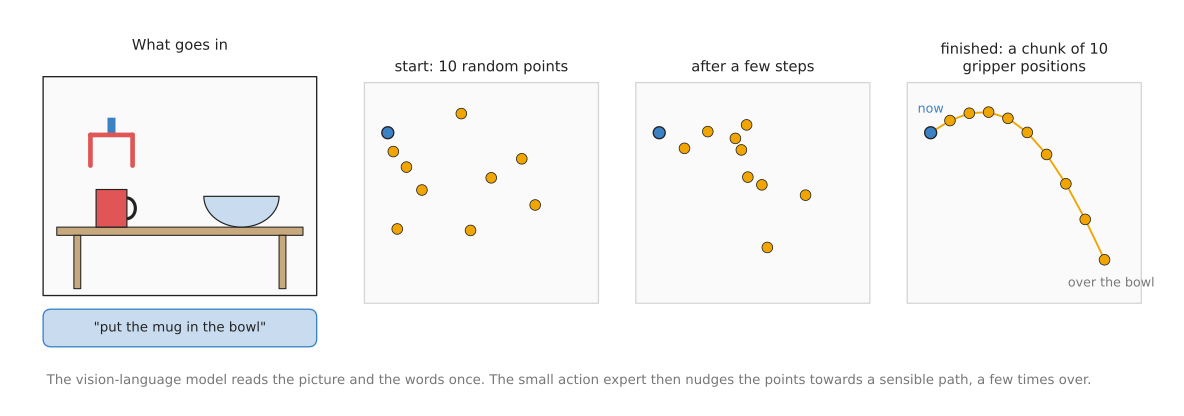
The picture below shows what happens, in four steps.
- The vision-language model reads the pictures and the instruction once, and then passes its internal numbers to the action expert.
- The action expert starts from random numbers, which in the picture are ten random points, and each point is one future position of the gripper.
- The action expert moves every point a little towards where it should be, and it does this a few times, for example ten times. At each step it uses the numbers from the vision-language model, so it "knows" where the mug and the bowl are.
- After the last step, the points form a smooth path from where the gripper is now to where it should go next.
This method of starting from random numbers and moving them step by step is called flow matching, and every model named just above produces its movements this way, which is why those two words come up again in section 5. The page on diffusion and flow policies explains it in more detail, and why it copes well when a task can be done in more than one way.
The benefit is that the output is smooth, exact numbers rather than 256 coarse steps. The action expert is also small, so it is quick to run.
Why it outputs a chunk of actions#
Both ways are slow compared with an arm, because an arm's controller wants a new target many times a second, while a large model may take a noticeable part of a second to run once.
So the fix is to output a short sequence of movements each time, instead of one. This sequence is called a chunk, and the arm works through the chunk while the model is already working out the next one.
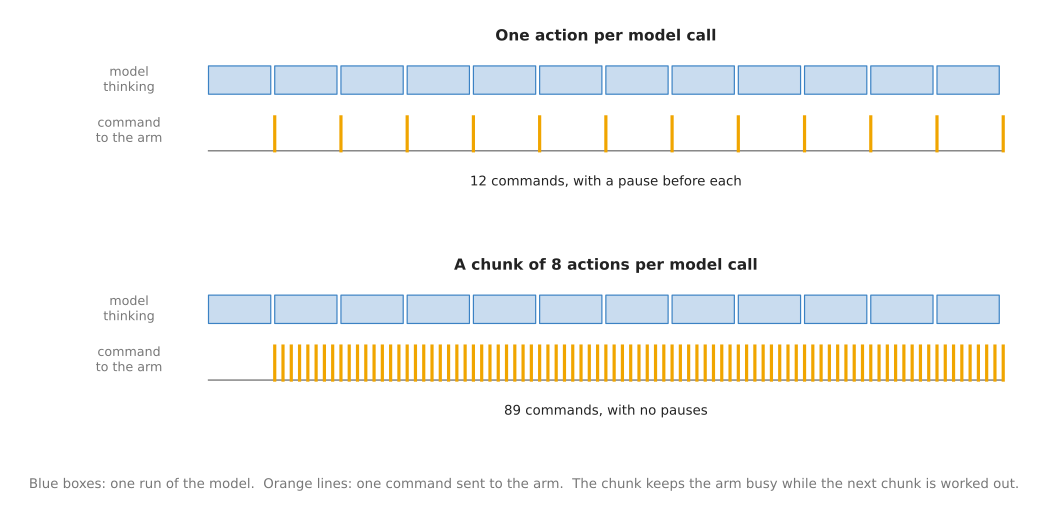
The picture compares the two. In the top row, the model sends one command each time it finishes, and the arm waits in between. In the bottom row, each run of the model gives eight commands, spread over the time of the next run, so the arm gets a steady flow of commands. The movement is also smoother, because the commands in one chunk come from one decision. The page on action chunking transformers explains chunks in detail.
4. How it is trained#
A VLA is trained in three stages, one after another. The first stage is the vision-language model's own training, from the previous page, while the next two stages use robot data.
A demonstration is one recording of the task being done well. A person usually drives the robot through the task, and the robot records the camera pictures and joint angles many times a second. Each recording also has a sentence that says what the task was. The page on where the data comes from describes how demonstrations are recorded.
- Train on many robots. The model is trained on a large pool of demonstrations, from many laboratories and many kinds of robot arm, and the training teaches it to output the recorded movement for each recorded picture and sentence. For example, OpenVLA was trained on 970,000 demonstrations from a shared pool called Open X-Embodiment, while the π0 models were trained on 10,000 hours or more of robot data. Some laboratories also mix in the internet pictures and questions from the vision-language model's own training, because this keeps the model from forgetting what it knew about objects and words.
- Fine-tune on your robot and your task. The model from stage 1 is then trained a little more, on demonstrations of your task on your robot. This extra training is called fine-tuning, and it usually needs far fewer demonstrations than stage 1, often tens to hundreds.
Robot demonstrations are slow and expensive to record, because each one needs a robot and a person, and this is the main limit on the whole field. So in 2026 several laboratories started to replace part of the robot data with video of people doing everyday tasks with their own hands. NVIDIA's GR00T N1.7, for example, was trained on 20,000 hours of such video alongside robot demonstrations. The data and demonstration document covers this in depth.
5. Well-known models of this kind#
This section names the models you will actually meet, says what each one is for, and ends with one recommendation you can follow. Each sub-section opens with one short line giving the model's size, the machine it needs and its licence, in the bands that section 7 of the chapter overview defines. So read that line for the band and the table below for the exact figure.
The table has two columns, so read a row from left to right as one sentence about one model. The left column names the model and says how current it is. The right column holds everything else: the size, the licence on the code and the licence on the trained numbers, what the model is best at, and the case for choosing it. A model has two licences because the programs and the trained numbers are published separately and often on different terms, so each row names the code licence first and the weights second. Every licence here was read from the project's own files in September 2026 by the frontier document, which is the page to check when you want to know what is current.
| Model | What decides it |
|---|---|
| SmolVLA, most used in 2026 | It has 450 million parameters, and both its code and its weights are Apache-2.0. It is the one model here that runs on hardware you already own. Pick it when you are learning, with a small arm and one computer. |
| π0, π0-FAST and π0.5, most used in 2026 | Their size is not stated, their code is Apache-2.0, and their weights are served from the project's own storage with no licence of their own. They are the best models here at smooth two-armed tasks such as folding cloth. Pick them when you have an NVIDIA card and a robot like ALOHA or DROID. |
| GR00T N1.7, most used in 2026 | It has 3 billion parameters, its code is Apache-2.0, and its weights are under the NVIDIA Open Model License. It is the best model here at working on a robot it was not trained on. Pick it when you want the most capable open model and you have NVIDIA hardware. |
| MolmoAct2, worth betting on | It has 5 billion parameters, its code is Apache-2.0, and its model card declares no licence for the weights. It publishes more evidence about itself than anything else here. Pick it when you have to justify the choice with numbers, or when you own an SO-100. |
| X-VLA, worth betting on | It has 0.9 billion parameters, its code licence has not been checked, and its weights are Apache-2.0. It is built to be adapted to an unusual robot. Pick it when the licence on the weights themselves has to be permissive. |
| OpenVLA, historical | It has 7 billion parameters, and its code and its weights are both MIT. It is the number everyone compares against. Pick it when you want that baseline, or one whole model you can read. |
5.1 SmolVLA, the one to start with#
SmolVLA is most used in 2026 by people learning on a small arm, because it is the only model in the table that runs without an NVIDIA graphics card.
Size m, a laptop to run it and a big card to train it, Apache-2.0 for the code and the weights.
Hugging Face released it on 3 June 2025. It pairs a SmolVLM2 vision-language backbone with a flow-matching action expert, the arrangement of way 2. Its authors trained it on about 10 million frames from 487 public datasets and report about 78 per cent success on real tasks with an SO-100 arm.
The one idea it is built on is that a working vision-language model can be cut down rather than replaced. The cuts are what make this the only model in the section that runs on a laptop, and there are three of them.
The first cut is in the backbone. The action expert does not read the backbone's final answer, because SmolVLA stops the backbone at half its layers and reads the numbers from there. The second cut is in the picture. Each camera frame reaches the language model as only sixty-four tokens, because the grid of patches the vision encoder produces is folded, so that every small square of neighbouring patches becomes one longer list of numbers; the trick is called pixel shuffle, and a frame that would arrive as about a thousand tokens arrives as sixty-four. The third cut is in the expert itself, whose layers alternate between looking at the backbone's numbers and looking at each other, instead of doing both in every layer. A fourth change is a rearrangement rather than a cut: the program that runs the model is split in two, so one half works out the next chunk while the other half is still feeding the current chunk to the arm, and the arm never waits for a decision.
π0.5, in the next sub-section, does none of this. It runs its whole backbone and lets the action tokens attend to all of it, which is much of why it understands more and why it needs the card. SmolVLA's first cut is where its loss of understanding comes from, because the upper layers of a language model are where the subtlest reading of a sentence is assembled, and SmolVLA never runs them. The squeezed picture costs the same way: sixty-four lists of numbers cannot hold what a thousand hold, so a small difference between two objects can be gone before the language model sees anything at all.
On an arm, that difference shows up twice and in opposite directions. It shows up in your favour the moment you have no NVIDIA card, because then SmolVLA is the only one of the two that runs. It shows up against you when the task turns on a fine detail, such as picking the one cube with a mark on it out of four identical cubes, which is exactly what sixty-four tokens throws away.
The obvious alternative is π0.5, which is the stronger model. You pick SmolVLA anyway when you lack the hardware for π0.5, and that is most people: the π0 repository asks for an NVIDIA card with more than 8 GB of video memory, while SmolVLA's announcement says the model runs on a central processing unit and on a MacBook.
It costs you accuracy, because it is the smallest model here and the weakest on a task far from its training data, and it must be fine-tuned on your own recordings first. LeRobot's guide recommends about 50 recorded episodes and puts 20,000 training steps at roughly four hours on one A100 graphics card, while its hardware guide puts that training on a big card, so a Mac is slow rather than useless. The usual mistake is too few recordings of each variation: the authors found 25 episodes of their task not enough and 50 enough.
The library is LeRobot, and SmolVLA is driven from the command line rather than from Python. Two commands do the whole job.
pip install -e ".[smolvla]"   # the SmolVLA extras, inside a LeRobot checkout

# Fine-tune the public base model on your own recordings.
lerobot-train \
  --policy.path=lerobot/smolvla_base \
  --dataset.repo_id=${HF_USER}/mydataset \
  --batch_size=64 \
  --steps=20000 \
  --output_dir=outputs/train/my_smolvla \
  --policy.device=cuda

# Run the fine-tuned model on the real arm.
lerobot-rollout \
  --policy.path=${HF_USER}/my_smolvla \
  --robot.type=so101_follower \
  --robot.port=/dev/ttyACM0 \
  --robot.cameras="{ front: {type: opencv, index_or_path: 8, width: 640, height: 480, fps: 30}}" \
  --task="Grasp a lego block and put it in the bin."
LeRobot gives you the training loop, the dataset format, the cameras and the arm driver.
You supply the dataset, recorded as section 4 describes, and
your own serial port and camera index. The sentence after --task must be the sentence
you recorded with, because the model learned to connect those words to that movement.
5.2 The pi models from Physical Intelligence#
These are most used in 2026 by people who have an NVIDIA graphics card, because they are the only weights from a frontier laboratory that anyone can download.
Size not stated, a big card, Apache-2.0 for the code and no licence at all on the weights.
Physical Intelligence announced π0 on 31 October 2024 and published it on 4 February 2025, then announced π0.5 on 22 April 2025. The openpi repository puts their training data at 10,000 hours or more.
The one idea π0 is built on is that the understanding and the moving should live in the same transformer without sharing the same weights. Its base is PaliGemma, the vision-language model in section 5.5 of the previous page. The pictures and the instruction pass through PaliGemma's own weights, exactly as they always did, while the two inputs PaliGemma never saw in its own training, which are the arm's joint readings and the half-finished movement the expert is refining, pass through a second and smaller set of weights. The paper calls the arrangement analogous to a mixture of experts, meaning one network that holds several sets of weights and sends each kind of input to the set that suits it. The two sets meet in one place only: in the layers where every token may look at every other token, so the action tokens can see the picture and the words.
SmolVLA, above, has the same two parts, and the difference is how much of the backbone the expert is allowed to see. SmolVLA reads the backbone halfway up and squeezes the picture first, whereas π0 runs PaliGemma whole.
π0.5 adds a second idea, and it is the most interesting thing on this page, because it uses both of section 3's ways at the same time. The problem it solves is that an action expert starts out as random numbers, and training a random part that is attached to a trained part damages the trained part, because the corrections that teach the expert are passed back into the language model as well. Physical Intelligence calls the fix knowledge insulation. The corrections are cut at the join, so nothing the expert learns flows back into the language model. The language model is then given a job of its own on the same recordings, which is to write the movement as discrete tokens in the manner of way 1. So it still learns what a movement has to do with a picture and a sentence, from a signal that does not depend on the untrained expert, while the expert learns the smooth numbers separately. π0-FAST is the model that keeps way 1 and nothing else, and it compresses a whole chunk of movement in frequency space before writing it as tokens, rather than writing every number of every step on its own, which is how it gets round the coarseness that section 3 describes.
On an arm, the difference shows up on long tasks that need both hands, such as folding a piece of cloth. A model whose language understanding survived its robot training can be told "fold the towel in half, then in half again" and still have the second half of that sentence mean something, and the smooth output of a flow-matching expert is what lets two grippers move together without steps in the path.
The obvious alternative is GR00T N1.7, which is also open and also uses an action expert. You pick a pi model when your robot resembles ALOHA or DROID, because fine-tuned checkpoints exist for those two platforms, and when you read research, because π0.5 is what most 2026 papers measure themselves against.
It costs you an NVIDIA card and one particular Linux machine, because the repository
says only Ubuntu 22.04 has been tested. Fine-tuning needs far more memory than running:
part of the model wants a workstation and all of it wants the largest single card you
can get. The weights also arrive from the project's own storage with no licence of their
own, so settle that before you ship. The first failure is usually a licence prompt
rather than a crash: the π0.5 recipe in LeRobot uses Google's gated
google/paligemma-3b-pt-224 tokenizer, which you must accept on the Hugging Face
website first.
The library is openpi, written in JAX, and the same models are in LeRobot for people who prefer PyTorch. This is openpi's own example, with a checkpoint fine-tuned on the DROID robot.
from openpi.training import config as _config
from openpi.policies import policy_config
from openpi.shared import download

config = _config.get_config("pi05_droid")
checkpoint_dir = download.maybe_download("gs://openpi-assets/checkpoints/pi05_droid")

policy = policy_config.create_trained_policy(config, checkpoint_dir)

example = {
    "observation/exterior_image_1_left": ...,   # the camera looking at the table
    "observation/wrist_image_left": ...,        # the camera on the wrist
    "prompt": "pick up the fork",
}
action_chunk = policy.infer(example)["actions"]
The library downloads the checkpoint, runs both networks, and hands back a chunk of
movements. You supply the contents of example: real pictures, the arm's joint angles,
and the key names this checkpoint expects, which is why they say exterior and left.
You also write the loop that reads the cameras and sends the chunk to the arm.
5.3 GR00T N1.7 from NVIDIA#
GR00T N1.7 is most used in 2026 where capability matters more than the price of the graphics card, and it is the most capable open model on the shelf.
Size l, a big card to run it and a workstation to fine-tune it, Apache-2.0 for the code and the NVIDIA Open Model License for the weights.
NVIDIA tagged it on 18 April 2026 as a general-availability release, which for NVIDIA means a supported product rather than an experiment. It has a Cosmos-Reason2-2B backbone built on the Qwen3-VL architecture and a flow-matching action head, and it was pretrained on 20,000 hours of human video alongside robot demonstrations.
The one idea it is built on is that a movement should be described in a way that means the same thing on every body. The models before it mostly learn where to put the gripper, as a target in the robot's own coordinates, and that is what NVIDIA says it changed: GR00T's movements are distances from where the gripper is now. Three centimetres to the left is three centimetres to the left on an SO-100, on a Franka and on a human hand holding a sponge, while the coordinates of a point on a table mean nothing to a robot standing somewhere else. NVIDIA names that one choice as the key factor in its cross-robot performance.
That choice then decides the rest of the model. It is what lets human video be training data at all, because a video of a hand has no joint readings and no robot coordinates, but it does show the hand moving a certain distance. It also forces the model to carry every body at once instead of one, so the slot where the state and the movement go is wide enough for many robots' joints, and an embodiment tag tells the model which part of that wide slot this robot is using. That tag is why the server command below has one. The change of backbone fits the same purpose: Cosmos-Reason2-2B takes a picture at its own shape rather than padding it into a square, so a wide view of a long table is not squashed before the model reads it.
What the idea costs is accumulated error and a setting you can get wrong. A relative movement has to be added to where the arm actually is, so the model's answer is only as good as the arm's own reading of its current pose, and an error in that reading goes into the next command instead of being corrected by it. A model that names a destination does not have that problem, because each command says where to end up rather than how far to go. The embodiment tag is the second cost, because it is a label you choose rather than something the model works out, and the wrong tag has the model reading the numbers in the wrong slots, which looks like a badly trained model rather than a configuration mistake.
On an arm, the difference from π0.5 is simply whether you own the robot the model was trained on. If your arm is an ALOHA or a DROID, π0.5 has a fine-tuned checkpoint for that exact platform and you should use it. If your arm is a cheap one you assembled yourself, no checkpoint on this page was recorded on it, and then the question is which model's way of describing a movement still carries over, which is the argument above.
The obvious alternative is π0.5, and you pick GR00T for the reason above when the robot you own is not the robot the model was trained on. The second reason is support: NVIDIA ships this as a product with a version number, while the openpi repository's own update log has recorded no new model since September 2025.
It costs you NVIDIA hardware, with no way round it, and not just any NVIDIA hardware: the supported platforms are a desktop card on CUDA 12.8, a Jetson Thor or Orin, or a DGX Spark. The NVIDIA Open Model License on the weights allows commercial use, but it adds conditions Apache-2.0 does not, such as attribution when you redistribute and the loss of the licence if you switch off a safety check without putting a similar one in its place. The repository's own sentence about being "fully commercially licensable under Apache 2.0" describes the code only. The first run usually fails for a smaller reason: the backbone is a gated download, so without Hugging Face access the model refuses to load.
The library is the Isaac-GR00T repository, and the model is also in LeRobot. NVIDIA runs the model as a server and the robot as a client, so the graphics card does not have to sit on the robot.
# On the machine with the graphics card.
uv run python gr00t/eval/run_gr00t_server.py \
    --model-path nvidia/GR00T-N1.7-3B \
    --embodiment-tag OXE_DROID_RELATIVE_EEF_RELATIVE_JOINT \
    --device cuda:0
from gr00t.policy.server_client import PolicyClient

policy = PolicyClient(host="localhost", port=5555)

obs, info = env.reset()                  # your robot, or your simulator
action, info = policy.get_action(obs)    # one chunk of movements
obs, reward, done, truncated, info = env.step(action)
The server loads the model and does the thinking. You supply env, your own code around
the real arm or the simulator, which must produce the picture and joint-angle names
GR00T expects and accept the movements it returns. You also choose the embodiment tag,
which tells the model which robot it is driving and so decides how its numbers are read.
5.4 MolmoAct2 from the Allen Institute for AI#
MolmoAct2 is worth betting on, because no other open model publishes as much evidence about itself, and because the field is moving towards models that reason about the scene before they move.
Size l, a big card at reduced precision, Apache-2.0 for the code and no licence declared for the weights.
The Allen Institute for AI published it on 4 May 2026, with a paper at arXiv 2605.02881. It attaches a flow-matching action expert to a vision-language model that writes words, so one model both reasons and moves. It ships with its training data, including 720 hours of two-armed teleoperation, and with fine-tuned versions for the DROID Franka arm, a two-armed YAM robot, and the SO-100 and SO-101 learning arms.
The one idea it is built on is that the action expert should not be handed a conclusion. In GR00T and in π0, the vision-language model reads the pictures and the instruction and produces one set of numbers, and the expert works from that set alone. MolmoAct2 joins the two layer by layer instead. Each layer of the action expert looks at the matching layer of the vision-language model and reads the numbers that layer produced, rather than the numbers the whole backbone finished with. Its authors call this per-layer key-value conditioning, where the keys and the values are the two sets of numbers that each layer of a transformer offers up for other tokens to look at.
What that changes is which part of the backbone's reading reaches the movement. The early layers of a vision-language model hold plain things, such as where an edge or a surface is, and the late layers hold conclusions, such as what the object is called. A model that reads only the last layer has the conclusion and has lost the edge. Reading every layer gives the expert both, which is the same argument that DeepStack makes about pictures on the previous page, applied to movement instead.
A second thing follows from the arrangement, which is that the backbone goes on writing words while it drives the arm. So the model can be asked what it thinks it is doing, and the project ships a variant called MolmoThink that can be told to reason for longer or for less time, depending on how much delay you can accept. What the arrangement costs is time. Reading every layer is more work than reading the last one, and reasoning before moving adds a pause you can see.
On an arm, the difference shows up when a grasp has to be exact on an object the model knows by name. "Pick up the red mug by its handle" needs the conclusion that this mug is the red one and the edge detail of where the handle's rim is, and the layer-by-layer join is the arrangement that keeps hold of both. It shows up again when you have to explain a failure to somebody, because words are an output you can read and a chunk of joint targets is not.
The obvious alternative is again π0.5. You pick MolmoAct2 when you have to defend the choice to somebody, because its authors claim the widest evaluation of any open vision-language-action model, across seven simulated and real benchmarks, and publish the datasets with it. They report beating π0.5, and report that the vision-language model underneath beats GPT-5 and Gemini Robotics ER 1.5 across 13 tests of reasoning about the physical world. The second reason is narrower: it has a ready checkpoint for the SO-100 and SO-101, the arms a beginner is likely to own, and neither π0.5 nor GR00T has one.
It costs you legal certainty above all. The code's licence file says Apache-2.0 and the repository's README says Apache 2.0, while the model card on Hugging Face declares no licence at all in its metadata, so ask the authors before building a product on the weights. The project also warns that it has been checked only on the SO-100 and the Franka DROID setup, and only for simple tasks of the kind it was trained on.
The library is LeRobot, which carries MolmoAct2 as a policy, and the original training code is in allenai/molmoact2. This is LeRobot's own command for the SO-100 checkpoint.
lerobot-rollout \
  --policy.path=lerobot/MolmoAct2-SO100_101-LeRobot \
  --rename_map='{"observation.images.top": "observation.images.cam0", "observation.images.side": "observation.images.cam1"}' \
  --robot.type=so100_follower \
  --robot.port=/dev/ttyACM0 \
  --robot.cameras='{
      top: {type: opencv, index_or_path: 0, width: 640, height: 480, fps: 30},
      side: {type: opencv, index_or_path: 2, width: 640, height: 480, fps: 30}
  }' \
  --task="pick up the red cube" --duration=30
LeRobot supplies the model, the cameras and the arm driver. You supply two cameras in
the positions the checkpoint expects, a primary view and a second view, and the
--rename_map that says which of yours is which. People leave that mapping out, and the
model then reads the side view as if it were the view from above.
5.5 X-VLA#
X-VLA is worth betting on, because it attacks the problem that matters most in practice, which is a model that works on its builders' robot and not on yours.
Size m, a workstation to train it, Apache-2.0 for the weights and no licence checked on the code.
An academic group published it in November 2025, with a paper at arXiv 2510.10274. The released base model was trained on 290,000 recorded episodes from seven robot platforms.
The one idea it is built on is that the robot's body should be an input to the model rather than a change to the model. Each robot and each dataset it was trained on is described by a small set of learned numbers, called a soft prompt, and that set goes into the model alongside the picture tokens and the word tokens. So the model is told which body it is driving in the same way it is told what to pick up.
Compare that with GR00T, two sub-sections above, which has the same problem to solve. GR00T widens the model: the slot for the state and the movement is wide enough for many robots' joints, and a tag selects the part of the slot in use. X-VLA leaves the network alone and puts the difference in the input. Its authors describe the result as plain transformer encoders with soft prompts, and the plainness is the point, because there is no per-robot head, no per-robot output layer and nothing to write when a new robot arrives except a new prompt. Its movements still come out by flow matching, as GR00T's and π0's do.
What that buys is a small training job where the others have a large one. Adapting to a robot that resembles nothing in the training data means learning one new soft prompt, which is a small fraction of the model's numbers. What it costs is that a prompt can only pick among the ways of moving the model already has. A soft prompt tells the model which of the bodies it has seen this one is like; it cannot teach it a gripper that works in a way no training robot's gripper did.
On an arm, the difference shows up on a robot nobody sells. If you built the arm, with five joints and a gripper of your own design, SmolVLA's answer is to fine-tune the whole model on your recordings, and GR00T's is to find an embodiment tag that is close enough. X-VLA's answer is to train a short new prompt and leave the rest alone, which is the cheapest of the three to try and the one most likely to stall if your arm is genuinely unlike everything it has seen.
The obvious alternative at this size is SmolVLA. You pick X-VLA when the licence matters, because Apache-2.0 covers the weights themselves, and when your robot differs from everything in the training data, because its authors report nearly reaching π0's scores on two benchmarks while adjusting 1 per cent of the model, or 9 million numbers. Treat that as the best case, not the recipe: LeRobot's own guidance for a new robot is to train the vision and language parts as well.
It costs you a graphics card for training, so it is not a Mac model despite its size, and the frontier document records its code licence as not checked, which is worth checking yourself. Its checkpoints are uneven too: the simulation one reports 93 per cent on the LIBERO benchmark, while each real-robot one is tied to one platform, so you will probably fine-tune.
The library is LeRobot, which carries X-VLA as a policy type.
pip install -e .[xvla]

lerobot-train \
  --dataset.repo_id=YOUR_DATASET \
  --policy.path=lerobot/xvla-base \
  --policy.repo_id=HF_USER/xvla-your-robot \
  --policy.dtype=bfloat16 \
  --policy.action_mode=auto \
  --steps=20000 \
  --policy.device=cuda \
  --policy.train_soft_prompts=true
LeRobot holds the pretrained model and the training loop. You supply the dataset, recorded on your own robot, and the decision about what to train: the last flag trains the soft prompt, and the guidance is to let the vision and language parts train too.
5.6 OpenVLA#
OpenVLA is historical, and it is here because it explains how the others work and because every paper you read compares against it.
Size l, a big card, MIT for the code and the weights.
A group from Stanford, UC Berkeley, Google DeepMind and the Toyota Research Institute published it in June 2024, with a paper at arXiv 2406.09246. It was trained on 970,000 real robot demonstrations from the pooled Open X-Embodiment dataset, and it writes movements as tokens exactly as way 1 describes. That method came from Google's RT-2 in 2023, which was never released, so OpenVLA was the first such model anybody could download, and in September 2026 it was still the most downloaded robotics model on Hugging Face.
The one idea it is built on is that a movement is text, so no part of the model needs to be added. Every model above it has two pieces that were trained in different ways. OpenVLA has one piece. Its vision side joins the output of two encoders, DINOv2 and SigLIP, so that one of them supplies where things are and the other supplies what they are, and that output goes into a Llama 2 language model which writes tokens. The tokens it writes for a movement come out of the same layer, are scored in the same way and are trained by the same method as the tokens it writes for a word.
Making that work needs one trick, and the trick is the clearest answer to the question of what turning a joint angle into a token actually involves. Each number in a movement is cut into 256 steps, and the edges of those steps are spread evenly between the 1st and the 99th percentile of the training recordings, so that one unusually large movement in the data does not stretch every step. Then those 256 steps need 256 entries in the model's list of tokens, and Llama 2 had no room for them, because its tokenizer keeps only a hundred spare entries for this kind of use. So OpenVLA wrote its action tokens over the 256 least used tokens in Llama's vocabulary. Those entries used to be the rarest fragments of text the model knew, and in OpenVLA they mean step 0 to step 255 of a joint movement. Overwriting them is safe only because they were the rarest things the tokenizer had.
That is clever, because it costs nothing to build. There is no action expert, no second
training recipe and no new output layer, and the model that writes "the red mug is on
the left" is the model that writes 1 128 91 241 5 101 127 217, which is why this is
the one to read if you want to read a whole model. It is also clumsy in two ways that
every model above it was built to avoid. The numbers mean nothing on their own, because
the step edges came from the percentiles of one recorded dataset, so you have to tell
the library which dataset's ranges to undo them with; that is the unnorm_key in the
code below, and getting it wrong gives movements of the right shape and the wrong size.
And the model spells the movement out one token at a time, so one movement costs as many
passes through the whole network as it has numbers in it.
On an arm, that second point is the whole difference. With an action expert the arm gets a chunk of movements from one pass and keeps moving while the next chunk is worked out. With OpenVLA the arm waits while the model writes the movement out one number at a time, and the gap is long enough to see. Its own successor recipe, OpenVLA-OFT, exists to remove exactly that gap.
You would not pick it to drive a robot today, because SmolVLA and π0.5 are maintained while the OpenVLA repository has had no commit since March 2025. You would pick it for two other reasons. It is the baseline that published results are measured against, so you may have to run it to compare. And its code and its weights are both MIT, the most permissive pair in the table, so you can read, change and publish it without asking anybody.
It costs you speed above all, for the reason just given and in the way the chunking section explains. It also needs an NVIDIA graphics card, so it does not run on a Mac.
The library is transformers from Hugging Face, because OpenVLA is published as an
ordinary Hugging Face model. This is the example from its own model
card, with the instruction changed.
import torch
from PIL import Image
from transformers import AutoModelForVision2Seq, AutoProcessor

processor = AutoProcessor.from_pretrained("openvla/openvla-7b", trust_remote_code=True)
vla = AutoModelForVision2Seq.from_pretrained(
    "openvla/openvla-7b",
    torch_dtype=torch.bfloat16,
    low_cpu_mem_usage=True,
    trust_remote_code=True,
).to("cuda:0")

image = Image.open("table.jpg")
# The wording is fixed: OpenVLA was trained with "In:" before the instruction
# and "Out:" at the end, and other wordings give worse movements.
prompt = "In: What action should the robot take to put the mug in the bowl?\nOut:"

inputs = processor(prompt, image).to("cuda:0", dtype=torch.bfloat16)
# unnorm_key names the recorded dataset whose ranges turn the model's
# 0-to-255 steps back into real distances.
action = vla.predict_action(**inputs, unnorm_key="bridge_orig", do_sample=False)
The library gives you the seeing, the reading of the instruction and the choice of
movement in one call, and predict_action turns the tokens back into numbers. You
supply everything that touches the robot. The numbers say how far to move and turn the
gripper and whether to open or close it, so your program turns them into joint commands,
and you write the loop and the success check, because the model never stops by itself.
5.7 The ones you will read about but cannot have#
The strongest models of 2026 are not downloadable, and knowing their names matters anyway, because every claim you read about what robots can now do comes from one of them. π0.7 from Physical Intelligence, Gemini Robotics 2 from Google DeepMind, Helix 2.5 from Figure and Dyna-2 from Dyna Robotics were all demonstrated rather than released.
One of them is different in kind rather than in strength, and it is the reason this book has a page on the idea. Skild S1, announced in August 2026, is not told what to do in words at all. It is shown one video of the task and then does the task, with no fine-tuning. Everything else on this page learns a task by having that task trained into its weights, so a model that takes the task as an input instead is a different arrangement rather than a better model of the same arrangement. Prompting with a demonstration explains how that works and what it costs, and it is honest about how thin the published evidence still is.
5.8 How to choose#
Start with SmolVLA. On a small arm, with one computer and no NVIDIA graphics card, it is the only model here you can actually run, and the loop of recording demonstrations, fine-tuning and watching the arm fail teaches you more than the choice of model does.
Four things change that answer.
- You have an NVIDIA graphics card with 16 GB or more. Then use π0.5 if your robot resembles ALOHA or DROID, and GR00T N1.7 if it does not, because GR00T's relative movements transfer between robot bodies better.
- You own an SO-100 or SO-101 and SmolVLA is not accurate enough. Then try the MolmoAct2 checkpoint for those arms, which is the only frontier-style open model with a checkpoint for that hardware.
- Somebody has to approve the licence. Then choose from the models that are permissive on the weights themselves, which here are X-VLA and OpenVLA, or GigaBrain-0.7, a 3.5-billion-parameter model from August 2026 that is Apache-2.0 on both and sits on the frontier document's shelf.
- You need a number to compare against. Then run OpenVLA, because that is the comparison everybody else publishes.
Do not choose on success rates reported by different laboratories. Each number was measured by the group that benefits from it, on a robot you do not have. The honest way to choose between two models is to fine-tune both on your own recordings and count the successes on your own arm.
6. Where this is going#
Forward-looking writing about robots is where invented facts collect, so every statement below says what kind of claim it rests on. A demonstration is a recording of something working once under conditions the publisher chose. A product announcement says something can be bought or downloaded today, which you can check, so it is worth the most. A research result is a measured number on a stated task. A projection is a statement about a date that has not arrived, and it is worth the least. The frontier chapter's section on the four kinds of claim explains why the difference decides everything. Where a judgement is mine rather than an organisation's published statement, the sentence says so.
The change so far is one movement rather than a list of papers. The first VLAs were one laboratory's trick: take a model that already answered questions about pictures, and teach its output head to emit movements instead of words. That trick became the default way to build a general policy, and then it became infrastructure, with one library, one dataset format and a shelf of downloadable checkpoints. The frontier chapter counted the attention behind it from arXiv's own interface: abstracts in the robotics category containing "vision-language-action" went from 0.52 per cent in 2024 to 10.78 per cent in the first nine months of 2026. The hard problem moved too, from the architecture, which is now shared and boring, to the data and the measurement.
Industry use starts with an honest summary, because it is not what the videos suggest. No company has published a fleet size, an uptime figure, or a count of how often a person had to intervene, for a VLA doing production work, and those are the three numbers an ordinary automation vendor publishes without being asked. What you can buy today is the hardware and the toolchain rather than the frontier model. Universal Robots sells an AI Accelerator, which bundles an embedded NVIDIA Jetson Orin AGX 64 GB computer with an Orbbec Gemini 335Lg depth camera on its own PolyScope X software, with support for the Robot Operating System version 2, and its page says it is available for order. That is a product announcement, and the interesting part is not the specification: an industrial arm vendor now treats the computer a learned policy needs as a catalogue item. The same company's news centre records a launch with Scale AI, on 16 March 2026, of an imitation learning system called the UR AI Trainer. NVIDIA's GR00T N1.7 is the model side of the same pattern: a vendor gives weights away because it sells the computers they run on.
The deployments with a named customer are small, and each was published by the company doing the deploying. Figure wrote on 30 June 2026 that a Figure 03 robot is at BMW doing part sequencing, which means selecting and sorting parts for an assembly line, and the post describes one robot. Dyna Robotics reports a restaurant customer, Din Tai Fung, expanding from pilot sites to all of its locations, and the model behind that service has no released weights. Skild AI says S1 is in commercial use and reachable only through partners and an early-access form, and its earlier partnership post names ABB Robotics, Universal Robots, Mobile Industrial Robots and NVIDIA, with the first two planning to integrate the model into their robot ranges. That post gives no date, which makes it a projection. NVIDIA's post about Skild relays more than 60 deployment partnerships and a 100 million US dollar annual revenue run rate, which are Skild's own figures repeated by a partner rather than audited numbers.
The first thing being worked on right now is force. Every model on this page outputs positions, joint angles or end-effector poses, and the cost shows up in the publishers' own numbers: Google DeepMind reports Gemini Robotics 2 succeeding 92 per cent of the time at unscrewing a light bulb and 36 per cent at screwing one in. Taking apart needs position control and putting together needs force control, so that pair of numbers is the clearest published measure of what is missing. Two September 2026 papers attack it. CompVLA has the policy predict a stiffness matrix alongside the motion, so the model deciding where to go also decides how hard to push. ForceRFT refines a trained VLA's actions using force-guided reinforcement learning. Both are research results rather than products.
The second is size, and a dated product announcement is driving it. GR00T N1.7 wants 16 GB or more of video memory to run and 40 GB or more to fine-tune. NVIDIA announced three Jetson Thor computers on 15 July 2026 with physical hardware stated for the first quarter of 2027, and the entry-level part has 16 gigabytes of memory, which current VLAs do not comfortably fit into. So the work is to make them fit. FoldQuantVLA reports four-bit weights and four-bit activations with speedups of 1.20 to 1.33 times. Quantisation means storing each number with fewer bits, which costs some accuracy.
The third is where training data comes from, and it is the distinguishing work of 2026. GR00T N1.7 was pretrained on 20,000 hours of human video from a corpus NVIDIA calls EgoScale, which only works because its actions are relative to the gripper's current pose: three centimetres to the left means the same thing for a hand and for a gripper, while a target coordinate does not. Dyna Robotics reports pretraining on more than one million hours of first-person human video, and Index is Figure's phone application for collecting such video, with 44,000 weekly active users across 108 countries and more than 16 million videos reported in August 2026. The open counterpart you can download is OpenWAM-α, Apache-2.0 and pretrained on 518.5 million frames. A second strand adds practice instead of recordings: Physical Intelligence's π*0.6 has a teleoperator take over when the robot starts to go wrong and then lets it practise alone, and Skild's physical self-play improves a policy by playing football against copies of itself. Neither released weights.
The fourth is measurement, and it is the front a developer benefits from soonest.
Benchmarks appeared in 20.04 per cent of robotics abstracts on arXiv in 2026 against
15.27 per cent in 2025, so the field is building measuring instruments faster than
methods. LIBERO-VPro tested six foundation models
across twelve categories of visual disturbance and found something you can act on: they
tolerate whole objects being hidden, break when the small cues at the point of contact
are disturbed, and are badly hurt by stale or missing camera frames.
IndustrialVLA-Bench proposes a shared reporting
format so two laboratories' numbers can be compared, and a survey of the embodiment
gap argues that a success rate never reveals how much
work it took to get a model onto one robot. LeRobot 0.6.0 shipped
lerobot-eval, one command that runs six simulated benchmarks through a single
harness, and Robometer, which scores
progress from a video and an instruction so a machine can grade the attempts.
What is unsolved begins with force, which is why that is a front and a failure at once. Impedance control, the settled mathematics for deciding how stiffly a joint resists being pushed, has existed for decades, and no released VLA exposes it. The share of robotics abstracts containing "dexterous" moved only from 3.64 to 4.16 per cent between 2025 and 2026, which is not the pattern that precedes a sudden improvement. Part of the reason is dull: the cheap teleoperation rigs most data comes from give the operator no sense of touch, so they record where the arm went and not how hard it pushed. Assembly is most of the paid work in manipulation and it is what these models are worst at.
The second unsolved problem is that none of them can refuse. A policy always emits an action, and no model here can say that it does not recognise this scene and will leave the object alone. Where doing nothing is cheaper than being wrong, you build that check yourself, and uncertainty and confidence is the page about it.
The third is the distance between a research result and an industrial requirement. The strongest published numbers of 2026 are 56 per cent for Figure's Helix 2.5 across 30 unseen homes, 53 per cent mean normalised score for Dyna-2 across 14 tasks, 66 per cent for Skild's S1 on unseen long tasks, and 45.7 per cent for Gemini Robotics 2 picking an object off the floor. A cell that runs unwatched needs a failure rate roughly a hundred times lower, and nothing published shows a mechanism that closes a gap that size. The one method that has moved a number that far, π*0.6's practice loop, adds task-specific practice, which is the opposite of generality.
Five things follow for the next two to three years, in the order I would bet on them. Each is my expectation rather than anybody's announcement unless the sentence says otherwise, and the reason is the content.
The dataset format will keep deciding what gets adopted, more than the model will. This is the safest of the five because it is already mostly true. The frontier chapter counted 77,598 datasets on the Hugging Face Hub carrying the LeRobot tag in September 2026, and LeRobot implements about ten policies behind one dataset layout and one training script. A method that cannot read that format has an adoption problem unrelated to whether it works, so I expect the next VLA most people use to be the one that lands in that library first rather than the one with the best number.
Quantised models running on the robot's own computer will become the normal way to deploy one. The dated part is a product announcement rather than my opinion: NVIDIA has stated Jetson Thor hardware for the first quarter of 2027, and its record of shipping what it announces is checkable, because GR00T N1.7, its LeRobot integration and Isaac ROS 5.0 all arrived. The rest is my inference from two facts that point at each other: the entry-level board has a fixed 16 gigabyte budget, and the work that makes a VLA fit it already exists. That matters to you and not only to a company, because a model that fits a 16 gigabyte board also fits a desktop graphics card you can afford.
Force or stiffness will become an ordinary policy output, the way the action chunk became ordinary. The reason is the gap between 92 and 36 per cent in Google's own numbers, which points at exactly one missing output. Action chunking made the same journey, from one paper to a field every policy has, because it fixed a visible failure anybody could reproduce. I am less confident of the pace than of the direction, for the two reasons above: dexterity research is barely growing, and force data is harder to collect than position data.
The open shelf will stay roughly a year and a half behind the frontier, and the vendors who sell hardware will keep it stocked. The evidence for the lag is a release record rather than a forecast. Physical Intelligence published π0 and π0.5 and released their weights three to five months later, then published π*0.6 and π0.7 and released nothing, and openpi still carries checkpoints for only the first two. Figure has released neither Helix nor Index, Skild no weights for S1, and two of Google DeepMind's three robotics models reach early-access partners only. Against that, GR00T N1.7 is downloadable and GigaBrain-0.7 is Apache-2.0 on code and weights. My expectation, for a commercial reason rather than a technical one, is that an organisation selling computers or arms keeps giving models away while one selling a robot service stops. For somebody learning, that is better news than it sounds, because the open second tier runs on hardware you can buy.
Published evaluation will become a condition of being taken seriously, and regulation is the reason rather than good manners. You cannot certify a policy you cannot measure. The European Union's machinery rules, Regulation (EU) 2023/1230, apply on a mandatory basis from 20 January 2027 and cover machinery with safety functions that use artificial intelligence, while the rules for artificial intelligence embedded in regulated products under the AI Act now have a transition until 2 August 2028. Both dates come from published legal texts, which makes them the most reliable here, and the second has already been moved once by a year.
One expectation runs against all of that. I do not expect a general VLA to reach industrial reliability inside this window, for the reason in the third unsolved problem: the gap is about two orders of magnitude and no published mechanism closes it. That is my judgement rather than a reported claim, and the way to check it is to watch for the three numbers an automation vendor publishes without being asked, which are how many robots, how many hours, and how many human interventions.
7. Where to read next#
- Foundation models and generalist policies is the record of the current state of the art, and it covers every important VLA as of September 2026, with what it can do, what it cannot, and whether you can download it.
- Action chunking transformers and diffusion and flow policies explain the two ideas that VLAs borrowed from the movement models chapter.
- World models is the next chapter, because some of the newest robot models predict the next camera picture as well as the next movement.
- Learned methods in the frameworks book compares VLAs with the other ways of training one arm.